
Join Our JEE Preparation Group
Prep with like-minded aspirants; Get access to free daily tests and study material.
Sign in
Please select an account to continue using cracku.in
↓ →
Join Our JEE Preparation Group
Prep with like-minded aspirants; Get access to free daily tests and study material.
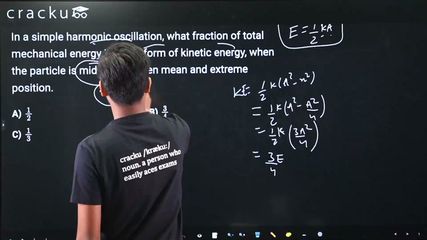
In a simple harmonic oscillation, what fraction of total mechanical energy is in the form of kinetic energy, when the particle is midway between mean and extreme position.
For any particle executing simple harmonic motion (SHM) we first recall the basic energy relations. The total mechanical energy $$E$$ of the oscillator is always constant and is given by the familiar result
$$E = \frac12 k A^{2}$$
where $$k$$ denotes the force constant (or the effective spring constant) and $$A$$ is the amplitude of the oscillation. This total energy is the sum of kinetic energy $$K$$ and potential energy $$U$$ at every instant, so we may write
$$E = K + U.$$
Next, for a displacement $$x$$ measured from the mean (equilibrium) position, the potential energy of the oscillator is known to be
$$U = \frac12 k x^{2}.$$
This comes straight from the spring-potential formula $$U = \tfrac12 k x^{2}$$ for a Hookean system. Correspondingly, because the total $$E$$ is fixed, the kinetic energy at that same instant must satisfy
$$K \;=\; E - U.$$
Substituting the explicit expressions for $$E$$ and $$U$$ we obtain
$$K \;=\; \frac12 k A^{2} \;-\; \frac12 k x^{2}.$$
Now the problem statement tells us that the particle is midway between the mean position and an extreme position. The extreme positions are at $$x = +A$$ and $$x = -A$$, while the mean position is at $$x = 0$$. Exactly half-way between $$0$$ and $$A$$ therefore corresponds to
$$x = \frac{A}{2}.$$
We substitute this value into the kinetic-energy expression derived above:
$$\begin{aligned} K &= \frac12 k \left(A^{2} - x^{2}\right) \\ &= \frac12 k \left(A^{2} - \left(\frac{A}{2}\right)^{2}\right) \\ &= \frac12 k \left(A^{2} - \frac{A^{2}}{4}\right) \\ &= \frac12 k \left(\frac{3A^{2}}{4}\right) \\ &= \frac{3}{8}\,k A^{2}. \end{aligned}$$
Let us now form the required fraction of kinetic energy to total energy. The total energy, already written above, is $$E = \tfrac12 k A^{2}$$, so
$$\begin{aligned} \text{Fraction of }E\text{ present as }K &= \frac{K}{E} \\ &= \frac{\dfrac{3}{8} k A^{2}}{\dfrac12 k A^{2}} \\ &= \frac{3}{8} \times \frac{2}{1} \\ &= \frac{3}{4}. \end{aligned}$$
Thus, when the particle is situated halfway between the mean position and an extreme position, three quarters of its total mechanical energy is in the form of kinetic energy.
Hence, the correct answer is Option B.
Was this solution helpful?
Click on the Email ☝️ to Watch the Video Solution
Create a FREE account and get:
_1.webp)

Educational materials for JEE preparation

Ask our AI anything

AI can make mistakes. Please verify important information.
AI can make mistakes. Please verify important information.
