
Join Our JEE Preparation Group
Prep with like-minded aspirants; Get access to free daily tests and study material.
Sign in
Please select an account to continue using cracku.in
↓ →
Join Our JEE Preparation Group
Prep with like-minded aspirants; Get access to free daily tests and study material.
An ideal gas is enclosed in a cylinder at pressure of 2 atm and temperature, 300 K. The mean time between two successive collisions is $$6 \times 10^{-8}$$ s. If the pressure is doubled and temperature is increased to 500 K, the mean time between two successive collisions will be close to:
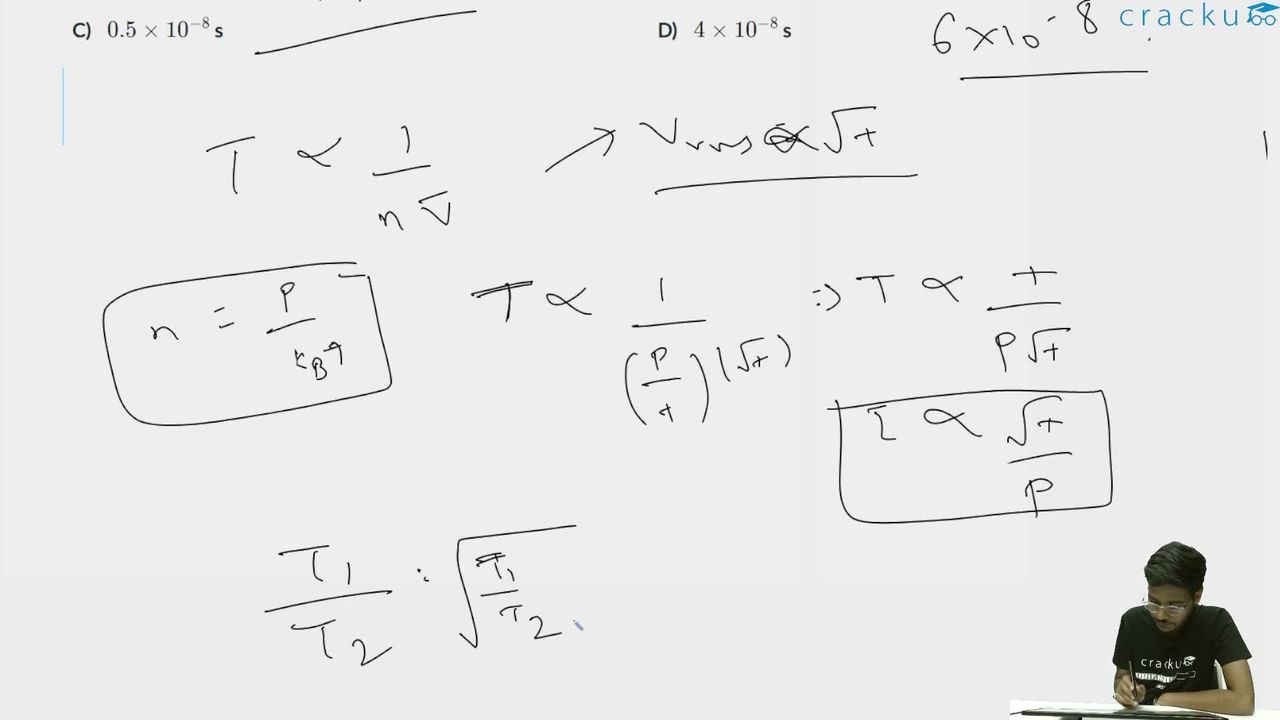
For an ideal gas, the mean time between two successive intermolecular collisions (often written as $$\tau$$) is inversely proportional to the collision frequency. The collision frequency, in turn, is proportional to the number density of molecules and to their average speed.
Mathematically, we write the proportionality as
$$\tau \propto \dfrac{1}{n \, \bar v}$$
Here, $$n$$ is the number of molecules per unit volume and $$\bar v$$ is the average (root-mean-square) molecular speed.
For an ideal gas we have two important relations:
1. The ideal-gas equation gives the number density
$$n = \dfrac{P}{k_{\text B}T} \; ,$$
where $$P$$ is pressure, $$T$$ is absolute temperature and $$k_{\text B}$$ is Boltzmann’s constant.
2. The root-mean-square speed varies with temperature as
$$\bar v \propto \sqrt{T}\; .$$
Putting these together in the proportionality for $$\tau$$ we get
$$\tau \propto \dfrac{1}{\left(\dfrac{P}{T}\right)\sqrt{T}} = \dfrac{T}{P\sqrt{T}} = \dfrac{\sqrt{T}}{P}\; .$$
So, the mean collision time is directly proportional to $$\sqrt{T}$$ and inversely proportional to the pressure $$P$$. We can therefore write the ratio of the mean times in two different states as
$$\dfrac{\tau_2}{\tau_1} = \dfrac{\sqrt{T_2}/P_2}{\sqrt{T_1}/P_1} = \dfrac{\sqrt{T_2}\,P_1}{\sqrt{T_1}\,P_2}\; .$$
Now we substitute the numerical data. The initial state has
$$P_1 = 2 \text{ atm}, \qquad T_1 = 300 \text{ K}, \qquad \tau_1 = 6 \times 10^{-8} \text{ s}.$$
The final state has
$$P_2 = 2P_1 = 4 \text{ atm}, \qquad T_2 = 500 \text{ K}.$$
First we compute the square roots of the temperatures:
$$\sqrt{T_1} = \sqrt{300}\; \text{K}^{1/2} \approx 17.3205\; ,$$
$$\sqrt{T_2} = \sqrt{500}\; \text{K}^{1/2} \approx 22.3607\; .$$
Next we form the ratio:
$$\dfrac{\tau_2}{\tau_1} = \dfrac{22.3607 \times 2}{17.3205 \times 4} = \dfrac{44.7214}{69.2820} \approx 0.645\; .$$
Multiplying this ratio by the initial mean time gives the new mean time:
$$\tau_2 = 0.645 \times \left(6 \times 10^{-8}\right)\, \text{s} = 3.87 \times 10^{-8}\, \text{s} \approx 4 \times 10^{-8}\, \text{s}.$$
Hence, the correct answer is Option D.
Was this solution helpful?
Click on the Email ☝️ to Watch the Video Solution
Create a FREE account and get:
_1.webp)

Educational materials for JEE preparation

Ask our AI anything

AI can make mistakes. Please verify important information.
AI can make mistakes. Please verify important information.


