
Join Our JEE Preparation Group
Prep with like-minded aspirants; Get access to free daily tests and study material.
Sign in
Please select an account to continue using cracku.in
↓ →
Join Our JEE Preparation Group
Prep with like-minded aspirants; Get access to free daily tests and study material.
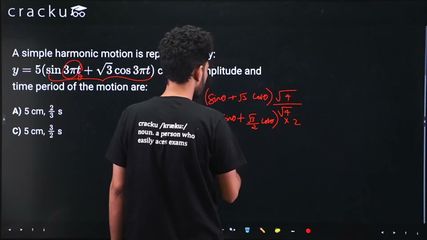
A simple harmonic motion is represented by: $$y = 5(\sin 3\pi t + \sqrt{3} \cos 3\pi t)$$ cm. The amplitude and time period of the motion are:
We are given the displacement of a particle executing simple harmonic motion as
$$y \;=\; 5\bigl(\sin 3\pi t \;+\; \sqrt{3}\,\cos 3\pi t\bigr)\ \text{cm}.$$
To identify the amplitude and the time period, we rewrite the expression in the standard SHM form
$$y \;=\; A\sin(\omega t + \phi),$$
where $$A$$ is the amplitude and $$\omega$$ is the angular frequency. We note that the given expression is a linear combination of $$\sin 3\pi t$$ and $$\cos 3\pi t$$ with the same angular frequency $$3\pi\ \text{rad s}^{-1}$$. A standard trigonometric result states that for
$$y \;=\; a\sin\theta \;+\; b\cos\theta,$$
the equivalent single-sine form is
$$y \;=\; \sqrt{a^{2}+b^{2}}\;\sin\!\bigl(\theta+\phi\bigr),$$
where $$\sqrt{a^{2}+b^{2}}$$ equals the amplitude. Here
$$a \;=\; 5,\qquad b \;=\; 5\sqrt{3}.$$
Therefore, the amplitude $$A$$ is
$$A \;=\; \sqrt{a^{2}+b^{2}} \;=\; \sqrt{5^{2} + (5\sqrt{3})^{2}} \;=\; \sqrt{25 + 75} \;=\; \sqrt{100} \;=\; 10\ \text{cm}.$$
Next we determine the time period. The angular frequency present in both sine and cosine terms is
$$\omega \;=\; 3\pi\ \text{rad s}^{-1}.$$
For simple harmonic motion, the relation between the angular frequency $$\omega$$ and the time period $$T$$ is
$$\omega \;=\; \frac{2\pi}{T}.$$
Solving for $$T$$, we obtain
$$T \;=\; \frac{2\pi}{\omega} \;=\; \frac{2\pi}{3\pi} \;=\; \frac{2}{3}\ \text{s}.$$
So the motion has an amplitude of $$10\ \text{cm}$$ and a time period of $$\dfrac{2}{3}\ \text{s}$$.
Hence, the correct answer is Option B.
Was this solution helpful?
Click on the Email ☝️ to Watch the Video Solution
Create a FREE account and get:
_1.webp)

Educational materials for JEE preparation

Ask our AI anything

AI can make mistakes. Please verify important information.
AI can make mistakes. Please verify important information.


