
Join Our JEE Preparation Group
Prep with like-minded aspirants; Get access to free daily tests and study material.
Sign in
Please select an account to continue using cracku.in
↓ →
Join Our JEE Preparation Group
Prep with like-minded aspirants; Get access to free daily tests and study material.
The given series up to 40 terms is:
$$1 + 3 + 5^2 + 7 + 9^2 + 11 + 13^2 + \dots$$
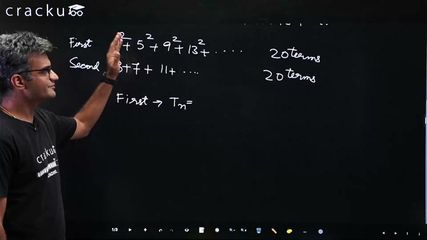
We can split this series into two separate progressions consisting of 20 terms each based on the odd and even positions.
The terms at even positions (2nd, 4th, 6th, ..., 40th terms) form an Arithmetic Progression:
$$S_{\text{even}} = 3 + 7 + 11 + \dots \text{ up to 20 terms}$$
The general term for this AP is $$T_{2k} = 4k - 1$$.
The sum is given by:
$$S_{\text{even}} = \sum_{k=1}^{20} (4k - 1) = 4\left(\frac{20 \times 21}{2}\right) - 20 = 840 - 20 = 820$$
---
The terms at odd positions (1st, 3rd, 5th, ..., 39th terms) form a sequence of squared odd numbers (where $$1 = 1^2$$):
$$S_{\text{odd}} = 1^2 + 5^2 + 9^2 + 13^2 + \dots \text{ up to 20 terms}$$
The general term for this sequence is $$T_{2k-1} = (4k - 3)^2 = 16k^2 - 24k + 9$$.
The sum is given by:
$$S_{\text{odd}} = \sum_{k=1}^{20} (16k^2 - 24k + 9) = 16\sum_{k=1}^{20} k^2 - 24\sum_{k=1}^{20} k + \sum_{k=1}^{20} 9$$
Using the standard summation formulas:
$$\sum_{k=1}^{20} k^2 = \frac{20 \times 21 \times 41}{6} = 2870$$
$$\sum_{k=1}^{20} k = \frac{20 \times 21}{2} = 210$$
Substituting these values into the expression for $$S_{\text{odd}}$$:
$$S_{\text{odd}} = 16(2870) - 24(210) + 9(20) = 45920 - 5040 + 180 = 41060$$
---
Combining both sums to find the total value of the series:
$$\text{Total Sum} = S_{\text{even}} + S_{\text{odd}} = 820 + 41060 = 41880$$
Therefore, the final sum is equal to 41880.
Was this solution helpful?
Click on the Email ☝️ to Watch the Video Solution
Create a FREE account and get:
_1.webp)

Educational materials for JEE preparation

Ask our AI anything

AI can make mistakes. Please verify important information.
AI can make mistakes. Please verify important information.
