
Join Our JEE Preparation Group
Prep with like-minded aspirants; Get access to free daily tests and study material.
Sign in
Please select an account to continue using cracku.in
↓ →
Join Our JEE Preparation Group
Prep with like-minded aspirants; Get access to free daily tests and study material.
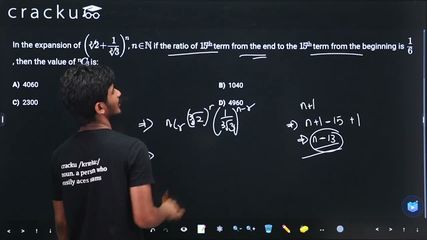
In the expansion of $$\left(\sqrt[3]{2} + \dfrac{1}{\sqrt[3]{3}}\right)^n$$, $$n \in \mathbb{N}$$, if the ratio of $$15^{\text{th}}$$ term from the end to the $$15^{\text{th}}$$ term from the beginning is $$\dfrac{1}{6}$$, then the value of $${}^nC_3$$ is:
Rewrite the binomial in the order that will make the calculation convenient (addition is commutative):
$$\left(\sqrt[3]{2}+\dfrac{1}{\sqrt[3]{3}}\right)^n
=\left(\dfrac{1}{\sqrt[3]{3}}+\sqrt[3]{2}\right)^n.$$
Let
$$a=\dfrac{1}{\sqrt[3]{3}}=3^{-1/3},\qquad
b=\sqrt[3]{2}=2^{1/3}.$$
The general term in the expansion of $$(a+b)^n$$ is
$$T_{r+1} = {}^nC_r\,a^{\,n-r}\,b^{\,r},\qquad r=0,1,2,\ldots ,n.$$
15th term from the beginning
Here, $$r=14$$ (because the first term corresponds to $$r=0$$).
$$T_{15} = {}^nC_{14}\,a^{\,n-14}\,b^{\,14}.$$
15th term from the end
The $$k^{\text{th}}$$ term from the end is obtained by putting $$r = n-k+1.$$
For $$k=15$$ we get $$r = n-14.$$
$$T_{\text{end}} = {}^nC_{\,n-14}\,a^{\,14}\,b^{\,n-14}.$$
Because $$\binom{n}{n-14} = \binom{n}{14},$$ the binomial coefficients of the two terms are equal.
Given ratio
$$\dfrac{\text{15th term from end}}{\text{15th term from beginning}} = \dfrac{1}{6}.$$
Substituting the two terms (the coefficients cancel):
$$\dfrac{a^{14}\,b^{\,n-14}}{a^{\,n-14}\,b^{14}}
= \dfrac{1}{6}.$$
Simplify the left-hand side:
$$a^{\,14-(n-14)}\,b^{\,(n-14)-14}
= a^{\,28-n}\,b^{\,n-28}.$$
Insert $$a=3^{-1/3}$$ and $$b=2^{1/3}:$$
$$\bigl(3^{-1/3}\bigr)^{28-n}\,
\bigl(2^{1/3}\bigr)^{n-28}
= 3^{\,(28-n)(-1/3)}\,
2^{\,(n-28)/3}
= 3^{\,(n-28)/3}\,2^{\,(n-28)/3}
= 6^{\,(n-28)/3}.$$
Hence
$$6^{\,(n-28)/3} = \dfrac{1}{6} = 6^{-1}.$$
Equate the exponents (bases are equal and positive):
$$\dfrac{n-28}{3} = -1
\;\;\Longrightarrow\;\;
n-28 = -3
\;\;\Longrightarrow\;\;
n = 25.$$
Finally, compute $${}^nC_3$$:
$${}^{25}C_3
= \dfrac{25\times 24\times 23}{3\times 2\times 1}
= 2300.$$
Therefore, $${}^nC_3 = 2300,$$ which is Option C.
Was this solution helpful?
Click on the Email ☝️ to Watch the Video Solution
Create a FREE account and get:
_1.webp)

Educational materials for JEE preparation

Ask our AI anything

AI can make mistakes. Please verify important information.
AI can make mistakes. Please verify important information.
