
Join Our JEE Preparation Group
Prep with like-minded aspirants; Get access to free daily tests and study material.
Sign in
Please select an account to continue using cracku.in
↓ →
Join Our JEE Preparation Group
Prep with like-minded aspirants; Get access to free daily tests and study material.
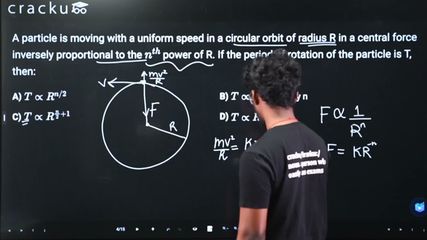
A particle is moving with a uniform speed in a circular orbit of radius R in a central force inversely proportional to the $$n^{th}$$ power of R. If the period of rotation of the particle is T, then:
We begin by recalling the condition for uniform circular motion. In a circle of radius $$R$$, the required centripetal force is given by the well-known formula
$$F_{\text{centripetal}}=\frac{m v^{2}}{R},$$
where $$m$$ is the mass of the particle and $$v$$ is its constant linear speed along the orbit.
According to the statement of the problem, the only force acting is a central force that varies inversely as the $$n^{\text{th}}$$ power of the distance $$R$$. Hence we can write this central force as
$$F_{\text{central}}=\frac{k}{R^{\,n}},$$
where $$k$$ is a positive proportionality constant (its exact value is immaterial for the proportionality we seek).
For the particle to remain in uniform circular motion, the central force must supply exactly the needed centripetal force. Therefore we equate the two expressions:
$$\frac{m v^{2}}{R}=\frac{k}{R^{\,n}}.$$
Now we isolate $$v^{2}$$ by multiplying both sides by $$R$$:
$$m v^{2}=k\,R^{\,1-n}.$$
Next we divide by $$m$$ to solve for $$v^{2}$$:
$$v^{2}=\frac{k}{m}\,R^{\,1-n}.$$
Taking the square root of both sides gives the speed $$v$$ explicitly:
$$v=\sqrt{\frac{k}{m}}\;R^{\,\frac{1-n}{2}}.$$
The time period $$T$$ of one complete revolution is the circumference $$2\pi R$$ divided by the speed $$v$$. Stating this definition, we have
$$T=\frac{2\pi R}{v}.$$
Substituting the expression we have just obtained for $$v$$, we write
$$T=\frac{2\pi R}{\sqrt{\frac{k}{m}}\;R^{\,\frac{1-n}{2}}}.$$
To simplify, notice that dividing by a power of $$R$$ subtracts the exponents. First, let us handle the constant factors:
$$\frac{2\pi R}{\sqrt{\frac{k}{m}}}=2\pi\sqrt{\frac{m}{k}}\;R,$$
because $$\displaystyle\frac{1}{\sqrt{k/m}}=\sqrt{\frac{m}{k}}.$$
Now place the remaining power of $$R$$ in the denominator:
$$T = 2\pi\sqrt{\frac{m}{k}}\;R \;R^{-\frac{1-n}{2}}.$$
Using the law of indices $$R^{a}R^{b}=R^{\,a+b}$$, we combine the exponents of $$R$$:
$$T = 2\pi\sqrt{\frac{m}{k}}\;R^{\,1-\frac{1-n}{2}}.$$
Next we simplify the exponent. The exponent is
$$1-\frac{1-n}{2}=\frac{2}{2}-\frac{1-n}{2}=\frac{2-(1-n)}{2}.$$
Expanding the parentheses in the numerator gives
$$2-(1-n)=2-1+n=1+n.$$
Hence the exponent becomes $$\dfrac{1+n}{2}$$, and we obtain
$$T = 2\pi\sqrt{\frac{m}{k}}\;R^{\frac{\,1+n}{2}}.$$
The factor $$2\pi\sqrt{m/k}$$ is a constant for a given system, so the proportionality we seek is
$$T\;\propto\;R^{\frac{n+1}{2}}.$$
This matches Option D exactly. All other options give different powers of $$R$$, so they are incorrect.
Hence, the correct answer is Option 4.
Was this solution helpful?
Click on the Email ☝️ to Watch the Video Solution
Create a FREE account and get:
_1.webp)

Educational materials for JEE preparation

Ask our AI anything

AI can make mistakes. Please verify important information.
AI can make mistakes. Please verify important information.
