Match List I with List II
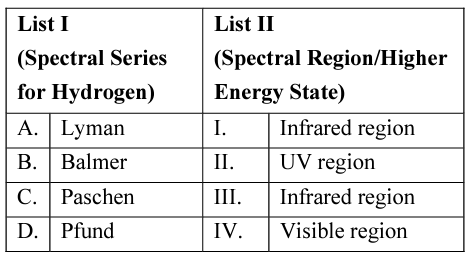
Choose the correct answer from the options given below:
Sign in
Please select an account to continue using cracku.in
↓ →

Join Our JEE Preparation Group
Prep with like-minded aspirants; Get access to free daily tests and study material.
Match List I with List II
Choose the correct answer from the options given below:
Login to view the detailed solution.
The element having the highest first ionization enthalpy is
Login to view the detailed solution.
Given below are two statements:
Statement I: Fluorine has most negative electron gain enthalpy in its group.
Statement II: Oxygen has least negative electron gain enthalpy in its group.
In the light of the above statements, choose the most appropriate from the options given below.
Login to view the detailed solution.
.webp)
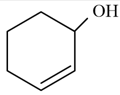
According to IUPAC system, the compound is named as:
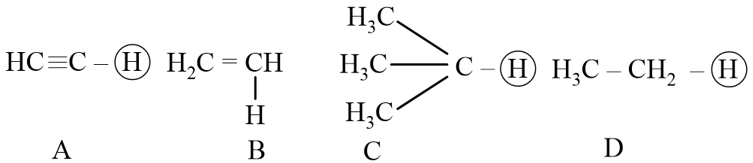
The ascending acidity order of the following H atoms is
Match List I with List II
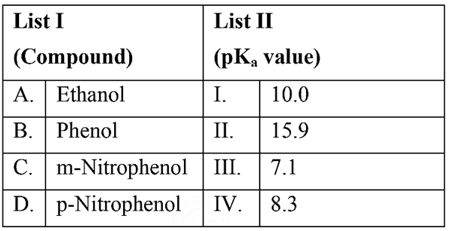
Choose the correct answer from the options given below:
Login to view the detailed solution.
.webp)
Which one of the following will show geometrical isomerism?
Login to view the detailed solution.
Chromatographic technique/s based on the principle of differential adsorption is/are
A. Column chromatography B. Thin layer chromatography C. Paper chromatography
Choose the most appropriate answer from the options given below:
Login to view the detailed solution.
Anomalous behaviour of oxygen is due to its
Login to view the detailed solution.
.webp)
Which of the following acts as a strong reducing agent? (Atomic number: Ce = 58, Eu = 63, Gd = 64, Lu = 71)
Login to view the detailed solution.
Which of the following statements are correct about Zn, Cd and Hg?
A. They exhibit high enthalpy of atomization as the d-subshell is full.
B. Zn and Cd do not show variable oxidation state while Hg shows +I and +II.
C. Compounds of Zn, Cd and Hg are paramagnetic in nature.
D. Zn, Cd and Hg are called soft metals.
Choose the most appropriate from the options given below:
Login to view the detailed solution.
The correct IUPAC name of $$K_2MnO_4$$ is:
Login to view the detailed solution.
.webp)
Alkyl halide is converted into alkyl isocyanide by reaction with
Login to view the detailed solution.
Phenol treated with chloroform in presence of sodium hydroxide, which further hydrolysed in presence of an acid results
Login to view the detailed solution.
Identify the reagents used for the following conversion
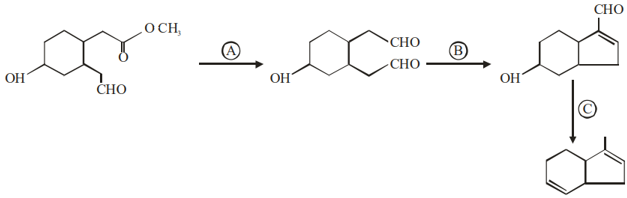
Login to view the detailed solution.

Which of the following reaction is correct?
Login to view the detailed solution.
The product A formed in the following reaction is:
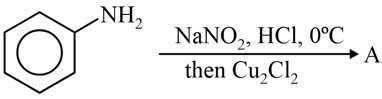
On passing a gas, '$$X$$', through Nessler's reagent, a brown precipitate is obtained. The gas '$$X$$' is
Login to view the detailed solution.
_1.webp)
A reagent which gives brilliant red precipitate with Nickel ions in basic medium is
Login to view the detailed solution.
Match List I with List II
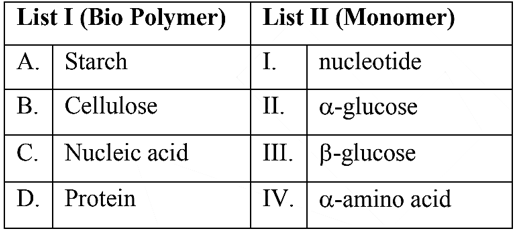
Choose the correct answer from the options given below:
Login to view the detailed solution.
The total number of molecules with zero dipole moment among $$CH_4, BF_3, H_2O, HF, NH_3, CO_2$$ and $$SO_2$$ is ______.
Login to view the detailed solution.
The total number of 'Sigma' and Pi bonds in 2-formylhex-4-enoic acid is ______.
Login to view the detailed solution.
The total number of anti bonding molecular orbitals, formed from $$2s$$ and $$2p$$ atomic orbitals in a diatomic molecule is ______.
Login to view the detailed solution.
Standard enthalpy of vapourisation for $$CCl_4$$ is $$30.5$$ kJ mol$$^{-1}$$. Heat required for vapourisation of $$284$$ g of $$CCl_4$$ at constant temperature is ______ kJ. (Given molar mass in g mol$$^{-1}$$; C = 12, Cl = 35.5)
Login to view the detailed solution.
The following concentrations were observed at $$500$$ K for the formation of $$NH_3$$ from $$N_2$$ and $$H_2$$. At equilibrium: $$[N_2] = 2 \times 10^{-2}$$ M, $$[H_2] = 3 \times 10^{-2}$$ M and $$[NH_3] = 1.5 \times 10^{-2}$$ M. Equilibrium constant for the reaction is ______.
Login to view the detailed solution.
If $$50$$ mL of $$0.5$$ M oxalic acid is required to neutralise $$25$$ mL of NaOH solution, the amount of NaOH in $$50$$ mL of given NaOH solution is ______ g.
Login to view the detailed solution.
Molality of $$0.8$$ M $$H_2SO_4$$ solution (density $$1.06$$ g cm$$^{-3}$$) is ______ $$\times 10^{-3}$$ m.
Login to view the detailed solution.
A constant current was passed through a solution of $$AuCl_4^-$$ ion between gold electrodes. After a period of $$10.0$$ minutes, the increase in mass of cathode was $$1.314$$ g. The total charge passed through the solution is ______ $$\times 10^{-2}$$ F. (Given atomic mass of Au = 197)
Login to view the detailed solution.
The half-life of radioisotopic bromine-82 is $$36$$ hours. The fraction which remains after one day is ______ $$\times 10^{-2}$$.
(Given antilog $$0.2006 = 1.587$$)
Login to view the detailed solution.
Oxidation state of Fe (Iron) in complex formed in Brown ring test.
Login to view the detailed solution.
Educational materials for JEE preparation
 Share
Share