
Join Our JEE Preparation Group
Prep with like-minded aspirants; Get access to free daily tests and study material.
Sign in
Please select an account to continue using cracku.in
↓ →
Join Our JEE Preparation Group
Prep with like-minded aspirants; Get access to free daily tests and study material.
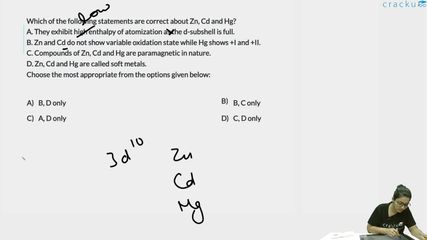
Which of the following statements are correct about Zn, Cd and Hg?
A. They exhibit high enthalpy of atomization as the d-subshell is full.
B. Zn and Cd do not show variable oxidation state while Hg shows +I and +II.
C. Compounds of Zn, Cd and Hg are paramagnetic in nature.
D. Zn, Cd and Hg are called soft metals.
Choose the most appropriate from the options given below:
We need to evaluate each statement about Zn, Cd, and Hg (Group 12 elements with completely filled d-orbitals).
Statement A: They exhibit high enthalpy of atomization as the d-subshell is full.
This is incorrect. Zn, Cd, and Hg have low enthalpies of atomization. In these elements, the d-subshell is completely filled ($$d^{10}$$), so the d-electrons do not participate in metallic bonding. The metallic bonding is weaker, resulting in low atomization enthalpies.
Statement B: Zn and Cd do not show variable oxidation state while Hg shows +I and +II.
This is correct. Zn and Cd predominantly show only the +2 oxidation state. Mercury, however, shows both +1 (as $$Hg_2^{2+}$$) and +2 oxidation states.
Statement C: Compounds of Zn, Cd and Hg are paramagnetic in nature.
This is incorrect. Zn$$^{2+}$$, Cd$$^{2+}$$, and Hg$$^{2+}$$ all have $$d^{10}$$ configuration with no unpaired electrons. Their compounds are diamagnetic, not paramagnetic.
Statement D: Zn, Cd and Hg are called soft metals.
This is correct. Due to weak metallic bonding (d-electrons do not participate in bonding), these metals are soft with low melting and boiling points.
The correct statements are B and D.
The correct answer is Option 1: B, D only.
Was this solution helpful?
Click on the Email ☝️ to Watch the Video Solution
Create a FREE account and get:
_1.webp)

Educational materials for JEE preparation

Ask our AI anything

AI can make mistakes. Please verify important information.
AI can make mistakes. Please verify important information.
