
Join Our JEE Preparation Group
Prep with like-minded aspirants; Get access to free daily tests and study material.
Sign in
Please select an account to continue using cracku.in
↓ →
Join Our JEE Preparation Group
Prep with like-minded aspirants; Get access to free daily tests and study material.
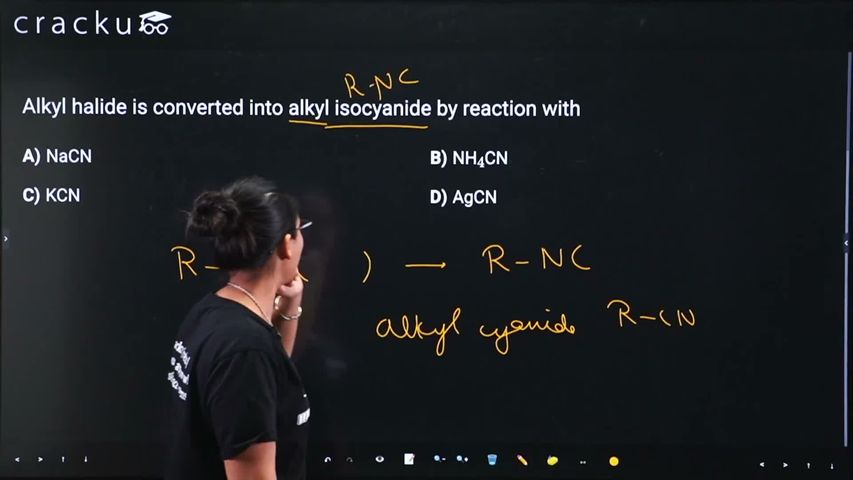
Alkyl halide is converted into alkyl isocyanide by reaction with
We need to identify which reagent converts an alkyl halide into an alkyl isocyanide. The key distinction lies in the ambident nature of the cyanide ion ($$CN^-$$), which can bond through either the carbon atom or the nitrogen atom. Bonding through carbon ($$C$$) gives an alkyl cyanide (nitrile) $$R-CN$$, while bonding through nitrogen ($$N$$) yields an alkyl isocyanide $$R-NC$$.
According to the HSAB (Hard-Soft Acid-Base) principle, $$NaCN$$ and $$KCN$$ are ionic cyanides that provide free $$CN^-$$ ions in solution; these ions attack preferentially through the carbon end, forming alkyl cyanides (nitriles). By contrast, $$AgCN$$ is a covalent cyanide in which silver is bonded to the carbon end of $$CN$$, leaving the nitrogen end free to attack the alkyl halide and form an alkyl isocyanide.
The reaction with $$AgCN$$ is:
$$R-X + AgCN \rightarrow R-NC + AgX$$
This pathway produces an alkyl isocyanide because the nitrogen atom of $$CN$$ attacks the carbon of the alkyl halide. Therefore, the correct answer is Option 4: AgCN.
Was this solution helpful?
Click on the Email ☝️ to Watch the Video Solution
Create a FREE account and get:
_1.webp)

Educational materials for JEE preparation

Ask our AI anything

AI can make mistakes. Please verify important information.
AI can make mistakes. Please verify important information.
