For the following questions answer them individually
For the four sets of three measured physical quantities as given below. Which of the following options is correct?
$$(i)$$ $$A_1 = 24.36, B_1 = 0.0724, C_1 = 256.2$$
$$(ii)$$ $$A_2 = 24.44, B_2 = 16.082, C_2 = 240.2$$
$$(iii)$$ $$A_3 = 25.2, B_3 = 19.2812, C_3 = 236.183$$
$$(iv)$$ $$A_4 = 25, B_4 = 236.191, C_4 = 19.5$$
A spring mass system (mass $$m$$, spring constant $$k$$ and natural length $$l$$) rests in equilibrium on a horizontal disc. The free end of the spring is fixed at the centre of the disc. If the disc together with spring mass system rotates about it's axis with an angular velocity $$\omega$$, $$(k >> m\omega^2)$$ the relative change in the length of the spring is best given by the option:
A particle starts from the origin at $$t = 0$$ with an initial velocity of $$3.0\hat{i}$$ m/s and moves in the $$x - y$$ plane with a constant acceleration $$(6.0\hat{i} + 4.0\hat{j})$$ m/s$$^2$$. The $$x-$$ coordinate of the particle at the instant when its $$y-$$ coordinate is $$32m$$ is $$D$$ meters. The value of $$D$$ is:
A rod of length $$l$$ has non-uniform linear mass density given by $$\rho(x) = a + b\left(\frac{x}{l}\right)^2$$, where $$a$$ and $$b$$ are constants and $$0 < x \le l$$. The value of $$x$$ for the centre of mass of the rod is at:
A particle of mass $$m$$ is projected with a speed $$u$$ from the ground at an angle $$\theta = \frac{\pi}{3}$$ w.r.t. horizontal (x-axis). When it has reached its maximum height, it collides completely inelastically with another particle of the same mass and velocity $$u\hat{i}$$. The horizontal distance covered by the combined mass before reaching the ground is:
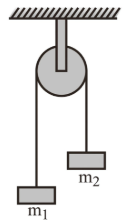
A uniformly thick wheel with moment of inertia $$I$$ and radius $$R$$ is free to rotate about its centre of mass (see fig). A massless string is wrapped over its rim and two blocks of masses $$m_1$$ and $$m_2$$ $$(m_1 > m_2)$$ are attached to the ends of the string. The system is released from rest. The angular speed of the wheel when $$m_1$$ descends by a distance $$h$$ is:
Planet $$A$$ has mass $$M$$ and radius $$R$$. Planet $$B$$ has half the mass and half the radius of Planet $$A$$. If the escape velocities from the Planets $$A$$ and $$B$$ are $$v_A$$ and $$v_B$$, respectively, then $$\frac{v_A}{v_B} = \frac{n}{4}$$. The value of $$n$$ is:
Two steel wires having same length are suspended from a ceiling under the same load. If the ratio of their energy stored per unit volume is 1 : 4, the ratio of their diameters is:
A small spherical droplet of density $$d$$ is floating exactly half immersed in a liquid of density $$\rho$$ and surface tension $$T$$. The radius of the droplet is (take note that the surface tension applies an upward force on the droplet):
Two gases - argon (atomic radius 0.07 nm, atomic weight 40) and xenon (atomic radius 0.1 nm, atomic weight 140) have the same number density and are at the same temperature. The ratio of their respective mean free times is closest to:
A wire of length $$L$$ and mass per unit length $$6.0 \times 10^{-3}$$ kg m$$^{-1}$$ is put under tension of 540 N. Two consecutive frequencies that it resonates at are: 420 Hz and 490 Hz. Then $$L$$ in meters is:
A small circular loop of conducting wire has radius $$a$$ and carries current $$I$$. It is placed in a uniform magnetic field $$B$$ perpendicular to its plane such that when rotated slightly about its diameter and released, it starts performing simple harmonic motion of time period $$T$$. The mass of the loop is $$m$$ then:
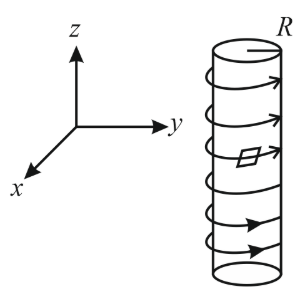
An electron gun is placed inside a long solenoid of radius $$R$$ on its axis. The solenoid has $$n$$ turns/length and carries a current $$I$$. The electron gun shoots an electron along the radius of the solenoid with speed $$v$$. If the electron does not hit the surface of the solenoid, maximum possible value of $$v$$ is (all symbols have their standard meaning):
In $$LC$$ circuit the inductance $$L = 40$$ mH and capacitance $$C = 100$$ $$\mu$$F. If a voltage $$V(t) = 10\sin(314t)$$ is applied to the circuit, the current in the circuit is given as:
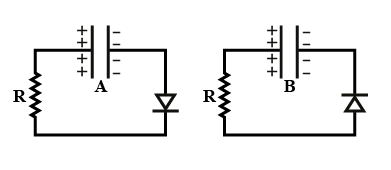
Two identical capacitors $$A$$ and $$B$$, charged to the same potential $$5V$$ are connected in two different circuits as shown below at time $$t = 0$$. If the charge on capacitors $$A$$ and $$B$$ at time $$t = CR$$ is $$Q_A$$ and $$Q_B$$ respectively, then (Here $$e$$ is the base of natural logarithm)
A plane electromagnetic wave is propagating along the direction $$\frac{\hat{i}+\hat{j}}{\sqrt{2}}$$, with its polarization along the direction $$\hat{k}$$. The correct form of the magnetic field of the wave would be (here $$B_0$$ is an appropriate constant):
There is a small source of light at some depth below the surface of water (refractive index $$= \frac{4}{3}$$) in a tank of large cross sectional surface area. Neglecting any reflection from the bottom and absorption by water, percentage of light that emerges out of surface is (nearly):
[Use the fact that surface area of a spherical cap of height $$h$$ and radius of curvature $$r$$ is $$2\pi rh$$]
An electron of mass $$m$$ and magnitude of charge $$e$$ at rest, gets accelerated by a constant electric field $$E$$. The rate of change of de-Broglie wavelength of this electron at time $$t$$ is (ignore relativistic effects):
The energy required to ionise a hydrogen like ion in its ground state is 9 Rydbergs. What is the wavelength of the radiation emitted when the electron in this ion jumps from the second excited state to the ground state?
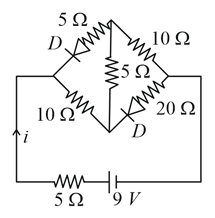
The current $$i$$ in the network is:
Starting at temperature $$300K$$, one mole of an ideal diatomic gas $$(\gamma = 1.4)$$ is first compressed adiabatically from volume $$V_1$$ to $$V_2 = \frac{V_1}{16}$$. It is then allowed to expand isobarically to volume $$2V_2$$. If all the processes are the quasi-static then the final temperature of the gas (in $$°K$$) is (to the nearest integer) ___________.
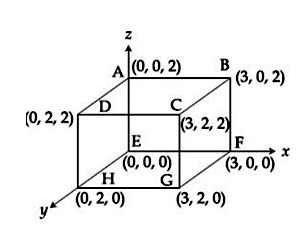
An electric field $$\vec{E} = 4x\hat{i} - (y^2 + 1)\hat{j}$$ N/C passes through the box shown in figure. The flux of the electric field through surfaces ABCD and BCGF are marked as $$\phi_I$$ and $$\phi_{II}$$ respectively. The difference between $$(\phi_I - \phi_{II})$$ is (in Nm$$^2$$/C) ___________.
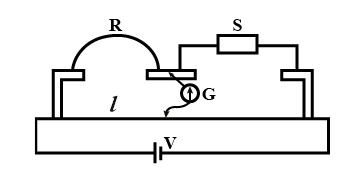
In a meter bridge experiment $$S$$ is a standard resistance. $$R$$ is a resistance wire. It is found that balancing length is $$l = 25$$ cm. If $$R$$ is replaced by a wire of half length and half diameter that of $$R$$ of same material, then the balancing distance $$l'$$ (in cm) will now be ___________.
In a Young's double slit experiment 15 fringes are observed on a small portion of the screen when light of wavelength 500 nm is used. Ten fringes are observed on the same section of the screen when another light source of wavelength $$\lambda$$ is used. Then the value of $$\lambda$$ is (in nm) ___________.
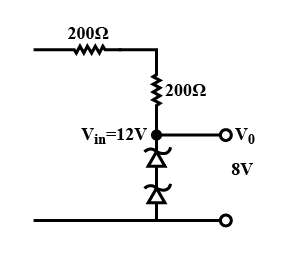
In the circuit shown below, is working as a 8 V dc regulated voltage source. When 12 V is used as an input, the power dissipated (in mW) in each diode is (Considering both zener diodes are identical) ___________.