
Join Our JEE Preparation Group
Prep with like-minded aspirants; Get access to free daily tests and study material.
Sign in
Please select an account to continue using cracku.in
↓ →
Join Our JEE Preparation Group
Prep with like-minded aspirants; Get access to free daily tests and study material.
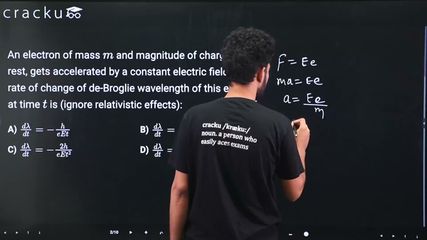
An electron of mass $$m$$ and magnitude of charge $$e$$ at rest, gets accelerated by a constant electric field $$E$$. The rate of change of de-Broglie wavelength of this electron at time $$t$$ is (ignore relativistic effects):
We begin with an electron that is initially at rest. Because it is placed in a constant, uniform electric field of magnitude $$E$$, it experiences a constant force. According to Newton’s second law,
$$F = m a.$$ But the electric force on a charge $$e$$ in an electric field $$E$$ is
$$F = eE.$$
Equating the two forces gives
$$m a = eE \quad\Longrightarrow\quad a = \frac{eE}{m}.$$
Since the acceleration $$a$$ is constant and the electron starts from rest, the kinematic relation for velocity after time $$t$$ is
$$v = a t.$$
Substituting the value of $$a$$ we just found, we have
$$v = \left(\frac{eE}{m}\right) t.$$
Linear momentum is defined as $$p = m v$$. Substituting for $$v$$, we obtain the momentum of the electron at time $$t$$:
$$p = m \left(\frac{eE}{m}\right) t = eE t.$$
The de-Broglie wavelength formula is stated as
$$\lambda = \frac{h}{p},$$
where $$h$$ is Planck’s constant. Inserting the expression for $$p$$ gives
$$\lambda = \frac{h}{eE t}.$$
We are asked for the rate of change of this wavelength with respect to time. Therefore, we differentiate $$\lambda$$ with respect to $$t$$. Writing $$\lambda(t) = \dfrac{h}{eE}\, t^{-1}$$, we differentiate using the power rule $$\dfrac{d}{dt}\bigl(t^{-1}\bigr) = -t^{-2}$$:
$$\frac{d\lambda}{dt} = \frac{h}{eE}\left(-t^{-2}\right) = -\frac{h}{eE t^{2}}.$$
The negative sign simply indicates that the wavelength decreases as the time increases, which is expected because the momentum is increasing. All algebraic steps are complete and no relativistic corrections were necessary (as instructed).
Hence, the correct answer is Option D.
Was this solution helpful?
Click on the Email ☝️ to Watch the Video Solution
Create a FREE account and get:
_1.webp)

Educational materials for JEE preparation

Ask our AI anything

AI can make mistakes. Please verify important information.
AI can make mistakes. Please verify important information.
