
Join Our JEE Preparation Group
Prep with like-minded aspirants; Get access to free daily tests and study material.
Sign in
Please select an account to continue using cracku.in
↓ →
Join Our JEE Preparation Group
Prep with like-minded aspirants; Get access to free daily tests and study material.
The energy required to ionise a hydrogen like ion in its ground state is 9 Rydbergs. What is the wavelength of the radiation emitted when the electron in this ion jumps from the second excited state to the ground state?
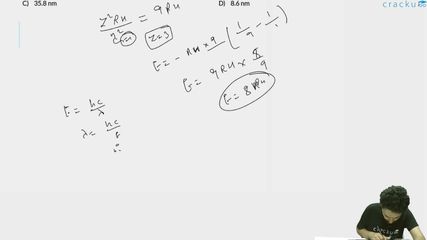
We have a hydrogen-like ion whose ionisation energy in the ground state is given as $$9$$ Rydbergs. For any hydrogen-like species the ionisation energy from the ground state is given by the formula
$$E_{\text{ion}} = Z^{2}R_{H},$$
where $$Z$$ is the atomic number (nuclear charge) and $$R_{H}$$ is the Rydberg constant expressed in energy units (1 Rydberg = 13.6 eV). Substituting the given value,
$$Z^{2}R_{H}=9\,R_{H}\;\;\Longrightarrow\;\;Z^{2}=9\;\;\Longrightarrow\;\;Z=3.$$
So the ion is $$\text{Li}^{2+}$$ (a 3-proton nucleus with one electron).
The energy of the $$n^{\text{th}}$$ Bohr orbit for any hydrogen-like ion is given by
$$E_{n}=-\dfrac{Z^{2}R_{H}}{n^{2}}.$$
The phrase “second excited state” means $$n=3$$ (ground state $$n=1$$, first excited $$n=2$$, second excited $$n=3$$). When the electron falls from this state to the ground state, the energy released is
$$\Delta E = E_{1}-E_{3}= \left(-\dfrac{Z^{2}R_{H}}{1^{2}}\right)-\left(-\dfrac{Z^{2}R_{H}}{3^{2}}\right)=Z^{2}R_{H}\left(1-\dfrac{1}{9}\right)=Z^{2}R_{H}\left(\dfrac{8}{9}\right).$$
With $$Z^{2}=9$$ we get
$$\Delta E = 9R_{H}\left(\dfrac{8}{9}\right)=8R_{H}.$$
Because $$1\,\text{Rydberg}=13.6\,\text{eV},$$ the photon energy in electron-volts is
$$\Delta E = 8 \times 13.6\,\text{eV}=108.8\,\text{eV}.$$
To convert this energy into wavelength we use the relation
$$E=\dfrac{hc}{\lambda}\quad\Longrightarrow\quad \lambda=\dfrac{hc}{E}.$$
In convenient units, $$hc=1240\,\text{eV nm}.$$ Substituting the numerical values,
$$\lambda=\dfrac{1240\,\text{eV nm}}{108.8\,\text{eV}}\approx11.4\,\text{nm}.$$
Hence, the correct answer is Option B.
Was this solution helpful?
Click on the Email ☝️ to Watch the Video Solution
Create a FREE account and get:
_1.webp)

Educational materials for JEE preparation

Ask our AI anything

AI can make mistakes. Please verify important information.
AI can make mistakes. Please verify important information.
