The 71$$^{st}$$ electron of an element X with an atomic number of 71 enters the orbital:

Join Our JEE Preparation Group
Prep with like-minded aspirants; Get access to free daily tests and study material.
Sign in
Please select an account to continue using cracku.in
↓ →
Join Our JEE Preparation Group
Prep with like-minded aspirants; Get access to free daily tests and study material.
The 71$$^{st}$$ electron of an element X with an atomic number of 71 enters the orbital:
Login to view the detailed solution.
The ground state energy of a hydrogen atom is $$-13.6$$ eV. The energy of second excited state of He$$^+$$ ion in eV is:
Login to view the detailed solution.
The process with negative entropy change is:
Login to view the detailed solution.
.webp)
An ideal gas undergoes isothermal compression from 5 m$$^3$$ to 1 m$$^3$$ against a constant external pressure of 4 N m$$^{-2}$$. The heat released in this process is 24 J mol$$^{-1}$$ K$$^{-1}$$ and is used to increase the pressure of 1 mole of Al. The temperature of Al increases by:
Login to view the detailed solution.
5.1 g $$NH_4SH$$ is introduced in 3.0 L evacuated flask at 327$$^{\circ}$$C. 30% of the solid $$NH_4SH$$ is decomposed to $$NH_3$$ and $$H_2S$$ as gases. The $$K_P$$ of the reaction at 327$$^{\circ}$$C is: ($$R = 0.082$$ L atm mol$$^{-1}$$ K$$^{-1}$$, Molar mass of S = 32 g mol$$^{-1}$$, Molar mass of N = 14 g mol$$^{-1}$$)
Login to view the detailed solution.
In the reaction of oxalate with permanganate in acidic medium, the number of electrons involved in producing one molecule of CO$$_2$$ is:
Login to view the detailed solution.
.webp)
The number of 2-centre-2-electron and 3-centre-2-electron bonds in $$B_2H_6$$, respectively, are:
Login to view the detailed solution.
What is the IUPAC name of the following compound?
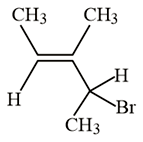
Login to view the detailed solution.
What will be the major product in the following mononitration reaction?
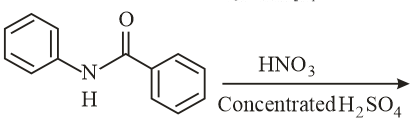
Login to view the detailed solution.
.webp)
The reaction that is not involved in the ozone layer depletion mechanism in the stratosphere is:
Login to view the detailed solution.
A compound of formula $$A_2B_3$$ has the HCP lattice. Which atom forms the HCP lattice and what fraction of the tetrahedral voids are occupied by the other atoms?
Login to view the detailed solution.
The amount of sugar ($$C_{12}H_{22}O_{11}$$) required to prepare 2L of its 0.1 M aqueous solution is:
Login to view the detailed solution.
.webp)
The elevation in boiling point for 1 molal solution of glucose is 2 K. The depression in freezing point for 2 molal solution of glucose in the same solvent is 2 K. The relation between $$K_b$$ and $$K_f$$ is:
Login to view the detailed solution.
In the cell, Pt(s)|H$$_2$$(g, 1 bar)|HCl(aq)|AgCl(s)|Ag(s)|Pt(s), the cell potential is 0.92 V when a $$10^{-6}$$ molar HCl solution is used. The standard electrode potential of Ag|AgCl|Cl$$^-$$ electrode is: (Given, $$\frac{2.303RT}{F} = 0.06$$ V at 298 K)
Login to view the detailed solution.
For an elementary chemical reaction, $$A_2 \underset{k_{-1}}{\overset{k_1}{\rightleftharpoons}} 2A$$, the expression for $$\frac{d[A]}{dt}$$ is:
Login to view the detailed solution.

The haemoglobin and the gold sol are examples of:
Login to view the detailed solution.
The electrolytes usually used in the electroplating of gold and silver, respectively, are:
Login to view the detailed solution.
Among the following reactions of hydrogen with halogens, the one that requires a catalyst is:
Login to view the detailed solution.
_1.webp)
The pair that contains two $$P - H$$ bonds in each of the oxoacids is:
Login to view the detailed solution.
Sodium metal on dissolution in liquid ammonia gives a deep blue solution due to the formation of:
Login to view the detailed solution.
A reaction of cobalt (III) chloride and ethylenediamine in a 1 : 2 mole ratio generates two isomeric products A (violet-coloured) and B (green-coloured). A can show optical activity, but, B is optically inactive. What type of isomers do A and B represent?
Login to view the detailed solution.
The difference in the number of unpaired electrons of a metal ion in its high-spin and low-spin octahedral complexes is two. The metal ion is:
Login to view the detailed solution.
The major product of the following reaction is:
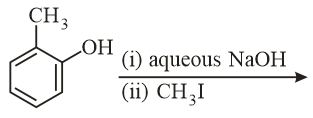
Login to view the detailed solution.
The major product obtained in the following reaction is:
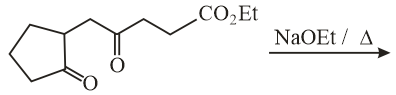
Login to view the detailed solution.
The major product of the following reaction is:

Which is the most suitable reagent for the following transformation?
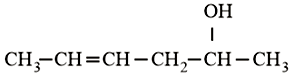

Login to view the detailed solution.
An aromatic compound 'A' having molecular formula $$C_7H_6O_2$$, on treating with aqueous ammonia and heating forms compound 'B'. The compound 'B' on reaction with molecular bromine and potassium hydroxide provides compound 'C' having molecular formula $$C_6H_7N$$. The structure of 'A' is:
Login to view the detailed solution.
The major product of the following reaction is:
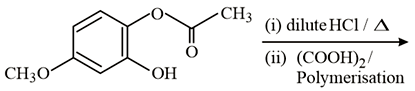
Login to view the detailed solution.
Which of the following tests cannot be used for identifying amino acids?
Login to view the detailed solution.
The correct match between item I and item II is:
Item I (Compound) Item II (Reagent)
a. Lysine p. 1-naphthol
b. Furfural q. Ninhydrin
c. Benzyl alcohol r. KMnO$$_4$$
d. Styrene s. Ceric ammonium nitrate
Login to view the detailed solution.
Educational materials for JEE preparation
 Share
Share