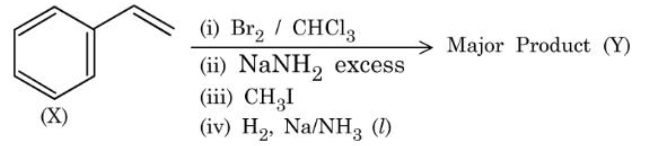
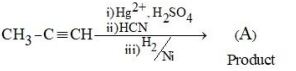
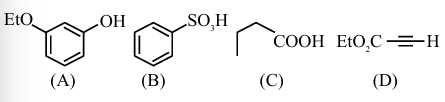
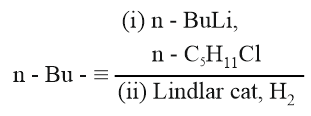
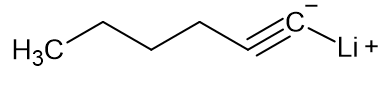
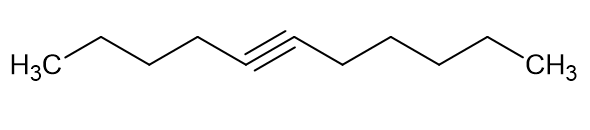
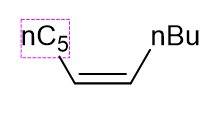
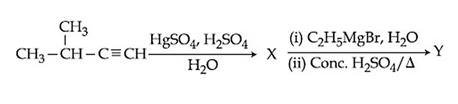
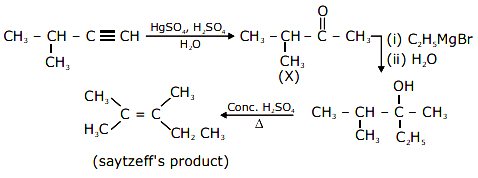
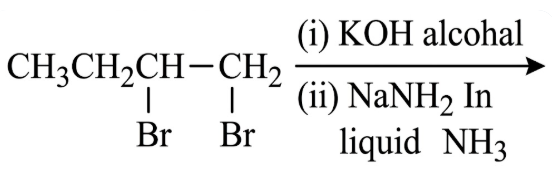
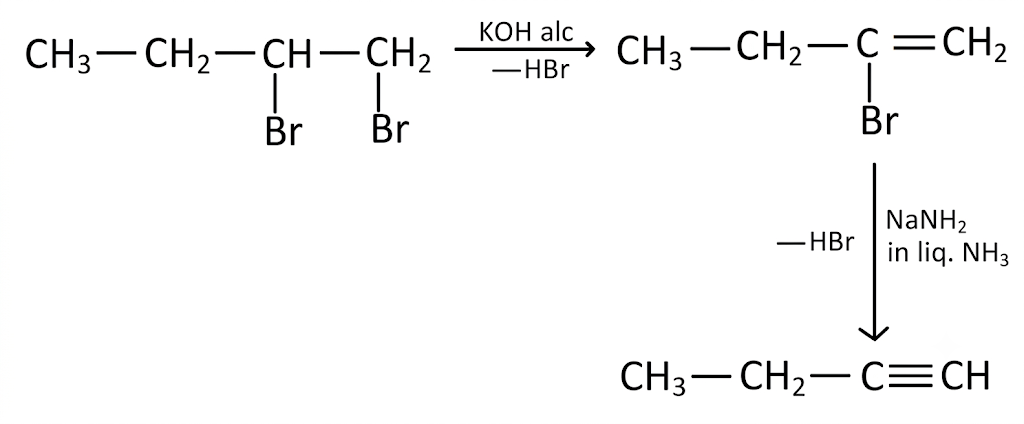
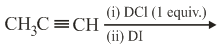
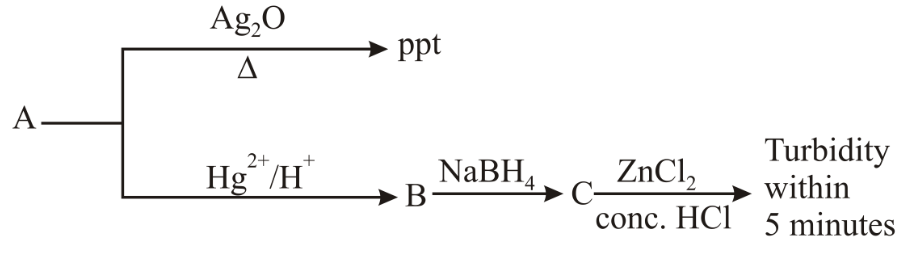
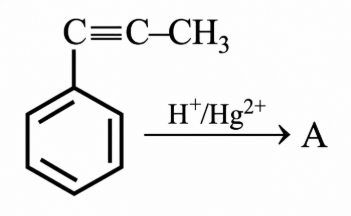
Compound (X) is subjected to the sequence of reactions as shown above:
Molar mass of the major product (Y) formed is ______ g mol$$^{-1}$$.
(Given molar mass in g mol$$^{-1}$$ C:12, H: 1, O: 16)
Sign in
Please select an account to continue using cracku.in
↓ →
Join Our JEE Preparation Group
Prep with like-minded aspirants; Get access to free daily tests and study material.

Compound (X) is subjected to the sequence of reactions as shown above:
Molar mass of the major product (Y) formed is ______ g mol$$^{-1}$$.
(Given molar mass in g mol$$^{-1}$$ C:12, H: 1, O: 16)
Step-1 Identification of the starting alkyne X
The product Y finally obtained after the dissolving-metal reduction (Na/NH3(l) + H2) must be a trans (E)-alkene because $$\text{Na}/\text{NH}_3(l)$$ converts an internal alkyne into a trans-alkene without disturbing an aromatic ring if present.
A molar mass of 118 g mol-1 corresponds to the molecular formula $$C_9H_{10}$$ ( $$9\times 12 + 10\times 1 = 118$$ ). Such a formula suggests the presence of a benzene ring ( $$C_6H_5$$ ) attached to a three-carbon side chain ( $$C_3H_5$$ ).
Therefore, compound Y is most plausibly trans-1-phenyl-1-propene (trans-β-methyl-styrene): $$\text{Ph-CH}=CH-CH_3$$.
Step-2 Retracing the sequence from Y to X
(i) The immediate precursor of this alkene in the given sequence must be the corresponding internal alkyne, $$\text{Ph-C}\equiv\text{C-CH}_3$$, because dissolving-metal reduction adds two hydrogens across a C≡C bond to give the trans-C=C product.
(ii) This alkyne is obtained by alkylating the sodium acetylide of a terminal alkyne with $$\text{CH}_3\text{I}$$. Hence the terminal alkyne just before step (iii) is phenylacetylene, $$\text{Ph-C}\equiv\text{C-H}$$, whose acidic proton has been removed by excess $$\text{NaNH}_2$$ to give $$\text{Ph-C}\equiv\text{C}^-\,\text{Na}^+$$.
(iii) That sodium acetylide itself is produced from the vic-dibromoalkene obtained in step (i) by double dehydro-bromination with excess $$\text{NaNH}_2$$.
(iv) Finally, the vic-dibromoalkene arises from the addition of one equivalent of $$\text{Br}_2$$ to the starting alkyne X.
Thus the only alkyne that fits all the steps is phenylacetylene, $$\text{Ph-C}\equiv\text{C-H}$$.
Step-3 Verification of the whole sequence
Case 1: $$\text{Ph-C}\equiv\text{C-H}\xrightarrow{\text{Br}_2/\text{CHCl}_3}$$ trans-1,2-dibromostyrene.
Case 2: trans-1,2-dibromostyrene $$\xrightarrow[\text{excess}]{\text{NaNH}_2}$$ phenylacetylene (regenerated) and then $$\text{Ph-C}\equiv\text{C}^-\,\text{Na}^+$$.
Case 3: $$\text{Ph-C}\equiv\text{C}^-\,\text{Na}^+\xrightarrow{\text{CH}_3\text{I}}$$ 1-phenyl-1-butyne, $$\text{Ph-C}\equiv\text{C-CH}_3$$.
Case 4: 1-phenyl-1-butyne $$\xrightarrow{\text{H}_2,\ \text{Na}/\text{NH}_3(l)}$$ trans-1-phenyl-1-propene (compound Y), $$\text{Ph-CH}=CH-CH_3$$.
Step-4 Molar-mass calculation of Y
Number of atoms in Y: 9 C and 10 H.
Molar mass $$M = 9\times 12\;(\text{C}) + 10\times 1\;(\text{H}) = 108 + 10 = 118\ \text{g mol}^{-1}$$.
Hence, the molar mass of compound Y is 118 g mol-1.
Option B which is: 118
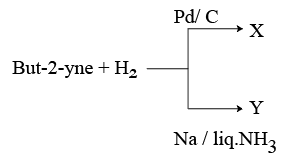
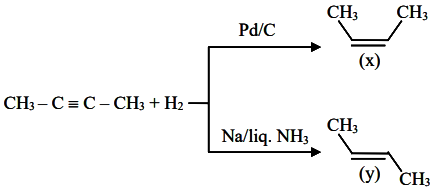
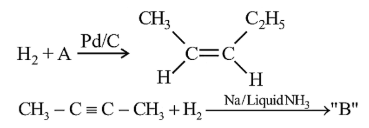
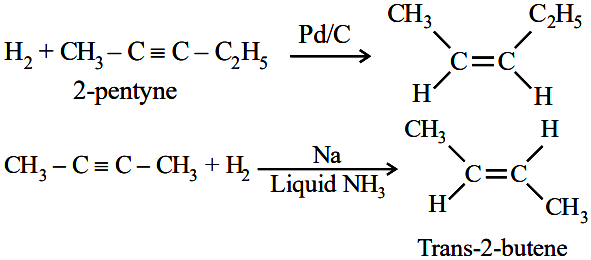
But-2-yne and hydrogen (one mole each) are separately treated with (i) Pd/C and (ii) Na/ liq. NH3 to give the products X and Y respectively.
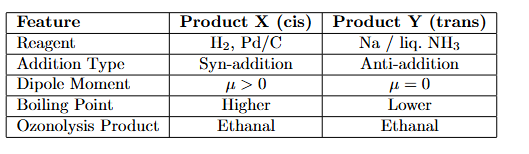
Identify the incorrect statements.
A. X and Y are stereoisomers.
B. Dipole moment of X is zero.
C. Boiling point of X is higher than Y.
D. X and Y react with $$O_{3}/Zn+H_{2}O$$ to give different products.
Choose the correct answer from the options given below :

CORRECT order of stability for the following is
$$CH_{2}=CH^{-},CH_{3}-CH_{2}^{-},CH\equiv C^{-}$$
We need to arrange three carbanions in decreasing order of stability.
Key Concept: Stability of carbanions depends on the hybridisation of the carbon bearing the negative charge. The greater the s-character of the orbital holding the lone pair, the closer the electrons are held to the nucleus, and the more stable the carbanion. The s-character of different hybridisations is:
- $$sp$$ hybrid: 50% s-character
- $$sp^2$$ hybrid: 33.3% s-character
- $$sp^3$$ hybrid: 25% s-character
The carbanion $$CH \equiv C^-$$ (acetylide ion) features an $$sp$$-hybridised carbon bearing the negative charge. With 50% s-character, its lone pair is held closest to the nucleus, making it the most stable of the three.
In the case of $$CH_2 = CH^-$$ (vinyl carbanion), the negatively charged carbon is $$sp^2$$ hybridised. With 33.3% s-character, this carbanion has intermediate stability.
The carbanion $$CH_3 - CH_2^-$$ (ethyl carbanion) is $$sp^3$$ hybridised, possessing only 25% s-character, so its lone pair is held furthest from the nucleus. Additionally, the methyl group exerts a +I (electron-donating inductive) effect that increases electron density on the negatively charged carbon, further destabilising it. This is the least stable carbanion.
Therefore, the decreasing order of stability is $$CH \equiv C^- > CH_2 = CH^- > CH_3 - CH_2^-$$.
The correct answer is Option 2: $$CH \equiv C^- > CH_2 = CH^- > CH_3 - CH_2^-$$.
Predict your JEE Main percentile, rank & performance in seconds
Educational materials for JEE preparation