Group
Group
 Group
Group
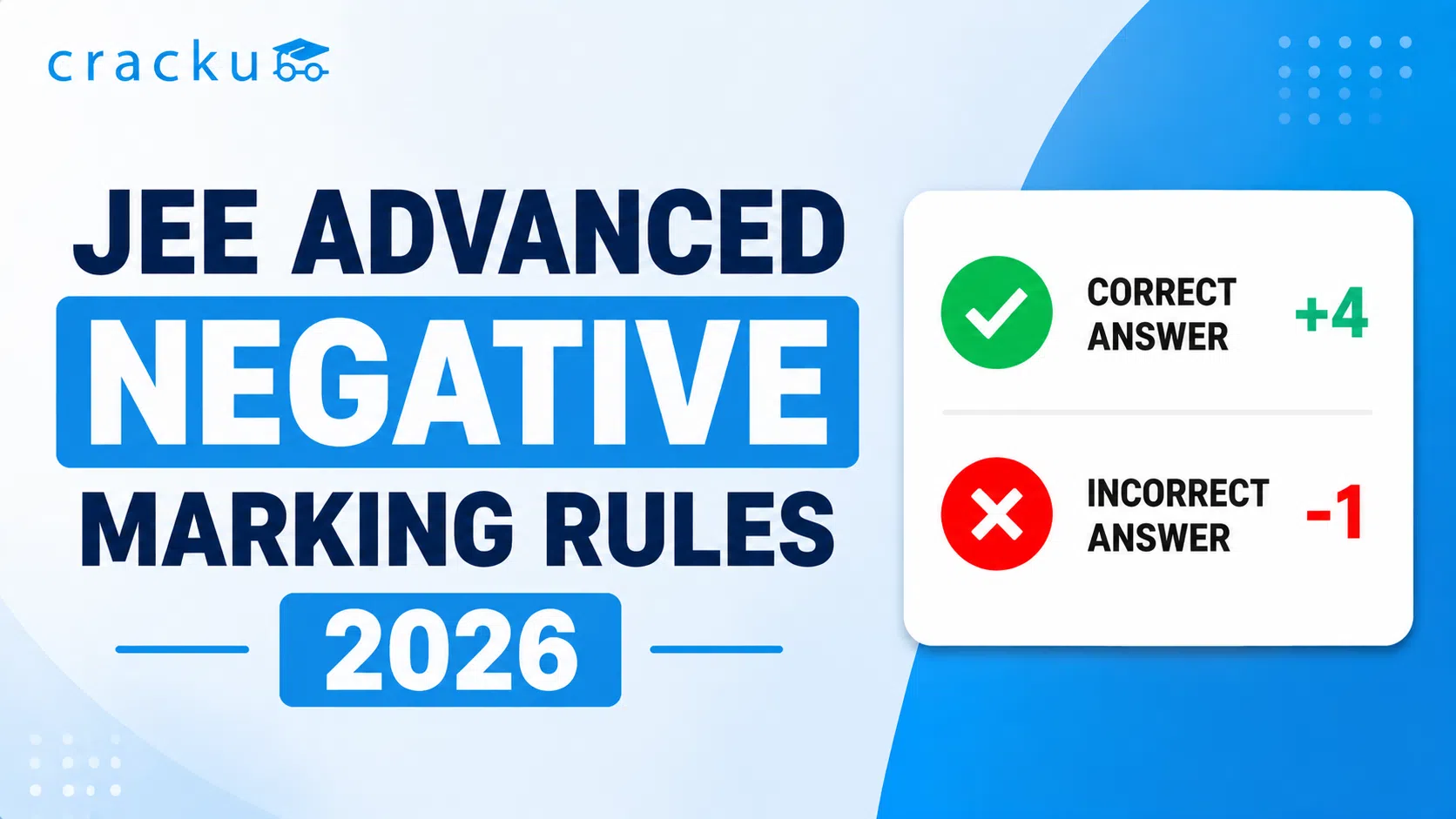
JEE Advanced Negative Marking Rules 2026
If you are preparing for JEE Advanced 2026, the exam is now over, but understanding the marking scheme is still just as crucial as solving questions correctly. Many students lost marks not because their answers were wrong, but because they did not fully grasp how negative marking and partial marks applied across different sections. This blog explains the JEE Advanced 2026 marking rules in a simple, step‑by‑step way so you can analyse your performance better and plan your preparation more effectively for future attempts or related exams.
Predict Your JEE Score Here: JEE Advanced Score Calculator
JEE Advanced Exam Pattern 2026
JEE Advanced 2026 is conducted in two papers: Paper 1 and Paper 2. Each paper tests three subjects: Mathematics, Physics, and Chemistry. Both papers are conducted on the same day in two separate sessions.
Based on the official 2026 question papers, each paper is divided into four sections:
Section 1: Single Correct Answer (4 questions)
Section 2: One or More Correct Answers (5 questions in Paper 2, 4 in Paper 1)
Section 3: Numerical Value-based questions (5 questions in Paper 2, 4 in Paper 1)
Section 4: Integer/Numerical Value questions based on a common question stem (2 questions per stem)
Each section follows a different marking scheme. So, a student who knows how each section is marked can approach the paper more wisely.
Also Read: JEE Advanced 2026 Exam Analysis, Paper 1 & 2 Difficulty Level
JEE Advanced 2026 Marks Distribution
Here is a subject-wise and section-wise marks breakdown based on the 2026 exam structure:
Paper / Subject | Section 1 | Section 2 | Section 3 | Section 4 | Total |
Paper 1 – Maths | 12 | 16 | 16 | 16 | 60 |
Paper 1 – Physics | 12 | 16 | 16 | 16 | 60 |
Paper 1 – Chemistry | 12 | 16 | 16 | 16 | 60 |
Paper 2 – Maths | 12 | 20 | 20 | 8 | 60 |
Paper 2 – Physics | 12 | 20 | 20 | 8 | 60 |
Paper 2 – Chemistry | 12 | 20 | 20 | 8 | 60 |
Note: The exact total marks per paper may vary slightly. Refer to the official JEE Advanced 2026 brochure for the final confirmed total.
JEE Advanced Negative Marking Rules
Not every section carries negative marking. The rules differ based on the question type. Here is a consolidated overview:
Section Type | Full Marks | Partial Marks | Zero Marks | Negative Marks |
Section 1 – Single Correct (4 Qs) | +3 | Not Applicable | 0 | -1 |
Section 2 – One or More Correct (5 Qs) | +4 | +1 to +3 | 0 | -1 |
Section 3 – Numerical Value (5 Qs) | +4 | Not Applicable | 0 | No Negative |
Section 4 – Numerical Value (2 Qs per stem) | +2 | Not Applicable | 0 | No Negative |
Key takeaway: Section 3 and Section 4 do not have negative marking. This means you can attempt these questions without the risk of losing marks, even if you are not fully sure of the answer.
Which Questions Have Negative Marking in JEE Advanced 2026?
Based on the 2026 marking scheme, negative marking applies to:
Section 1 (Single Correct): If you choose the wrong option, you lose 1 mark. There is no partial credit here.
Section 2 (One or More Correct): If even one incorrect option is chosen, you get -1. So guessing randomly here is risky.
No negative marking applies to:
Section 3 (Numerical Value): You get +4 for a correct answer and 0 for an incorrect or unanswered one.
Section 4 (Numerical, Paragraph-based): You get +2 for correct and 0 otherwise.
So if you are unsure about a single correct or one-or-more correct question, it is better to leave it blank rather than guess, unless you can eliminate at least two or three options confidently.
Also Read: JEE Advanced Answer Key 2026, Release Date & Download Link
JEE Advanced Partial Marking Rules
The partial marking system in JEE Advanced 2026 applies only to Section 2 (One or More Correct Answer type). This is designed to reward students who identify some of the correct options, even if they do not get all of them right.
Here is how partial marking works in detail:
Scenario (Section 2 – One or More Correct) | Marks Awarded |
All correct options chosen (e.g., A, B, D are correct, and you chose only A, B, D) | +4 |
All 4 options are correct, but only 3 are chosen | +3 |
3+ correct options exist, only 2 correct ones chosen | +2 |
2+ correct options exist, only 1 correct one chosen | +1 |
Any incorrect option chosen (regardless of correct ones) | -1 |
No option chosen (unanswered) | 0 |
This partial marking system makes Section 2 a unique challenge. You need to be accurate about which options are correct. Selecting an extra wrong option, even if all other selections are right, results in -1. So precision matters more than speed in this section.
Example from the 2026 Paper 2 Maths Section 2: In a question where (A), (B), and (D) are the only correct answers, choosing only (A) and (B) gives you +2. Choosing (A), (B), and (C) gives -1, even though two of your choices were right.
Also Read: JEE Advanced 2026 Question Paper 1 & 2, Download PDF
How to Avoid Negative Marking and Improve Your JEE Advanced Score
Here are some simple strategies based on the marking rules:
Attempt Section 3 and Section 4 first: Since there is no negative marking, you should solve all these questions. Even if you are not sure, a well-reasoned attempt can give you +4 or +2.
Be selective in Section 1: Only mark an answer if you are at least 70 to 80 percent confident. A wrong answer costs you 4 marks net (you lose 1 and miss out on +3).
Think carefully before choosing options in Section 2: This section rewards partial knowledge, but one wrong selection cancels it all. If you are confident about 2 options being correct, mark only those.
Manage your time by section type: Spend your extra time verifying Section 1 and Section 2 answers, since these are the ones that can cause mark deductions.
Practice with real JEE Advanced question papers: Understanding how questions are structured helps you gauge your confidence level before marking. You can use the
Practise with real JEE Advanced past papers: Understanding question structures helps you gauge confidence before marking. Use the Cracku JEE Question Bank to practise topic-wise questions with actual exam difficulty levels.
Simulate the exam daily: Daily practice under timed conditions helps you build the habit of skipping uncertain questions. Try the Cracku JEE Daily Target for structured daily preparation with curated questions.
Avoid random guessing in Section 1 and 2: The temptation to guess near the end of the exam can cost you significantly. Negative marks can pull your rank down more than an unanswered question.
Track your accuracy during mock tests: If you notice you are frequently wrong in any subject or section type, it is a signal to be more conservative during the actual exam.
Understanding the JEE Advanced 2026 negative marking rules is one of the most underrated parts of exam preparation. Many students focus entirely on solving more questions but overlook the impact of wrong answers on their final score. With the right strategy, you can protect your marks in Sections 1 and 2 while maximising your score in Sections 3 and 4 where there is no risk involved.
Also Read: JEE Advanced Response Sheet 2026, Release Date & Link
JEE Advanced Negative Marking Rules 2026: Conclusion
Understanding JEE Advanced 2026 negative marking rules is crucial for improving exam performance. Sections 1 and 2 penalise incorrect attempts, while partial marking rewards precise selection of correct options. Sections 3 and 4 have no negative marking, so attempting them strategically can maximise your score. Knowing the marking scheme allows students to plan which questions to attempt confidently and which to leave to avoid unnecessary deductions.
Practising with past papers and mock tests helps develop accuracy and decision-making skills for Sections 1 and 2. Daily simulation under timed conditions improves your ability to skip uncertain questions and focus on safer scoring areas. With a clear understanding of negative marking and partial credit, students can enhance their overall JEE Advanced performance and protect their rank effectively.
.webp)