91- 6303239042
 IPMAT WhatsApp Group



Many think that the IPM program is only for science students. The exam evaluates logic and reading skills as much as numerical ability. Most math topics come from Class 10. Students from Humanities and Commerce bring fresh perspectives to management discussions. They have an advantage in later rounds. Success in IPM depends on overall aptitude and preparation.
A seat in the Integrated Program in Management comes through steady practice. The test evaluates how you think under pressure. Commerce students already understand many business ideas. Arts students usually have strong reading skills. These are vital for the Verbal Ability section. Turn your academic background into a winning advantage by starting early. Consistency is what counts.
IPMAT Exam Pattern 2026
The IIM Indore aptitude test has 90 questions. The paper has three sections and lasts 120 minutes. You get 40 minutes for each section. These include Quantitative Ability (MCQ), Quantitative Ability (Short Answer), and Verbal Ability. You cannot jump between sections. The system locks you into one area until the timer ends. IIM Indore uses the Short Answer section for raw problem-solving. You type the number into a box. No options exist. This section has zero negative marks. It rewards precision.
The IIM Rohtak aptitude test has 120 questions. This is a speed-based exam that lasts exactly 120 minutes. It features three sections: Quantitative Ability, Logical Reasoning, and Verbal Ability. Each section contains 40 questions. Unlike Indore, all questions in the Rohtak paper are Multiple Choice Questions. The exam is a speed test. You must perform consistently in Math, Logic, and English to succeed.
The marking scheme involves penalties for wrong choices. A negative mark of 1 point is a penalty for incorrect guessing. It discourages random choices and rewards accuracy. IIM Rohtak gives weight to your past school performance as well. This is an advantage for students with high marks in school. The selection process is a mix of your test score and your profile.
IIM Indore Exam Pattern Details
Section Name | Question Type | Number of Questions | Marking Scheme |
Quantitative Ability (SA) | Short Answer | 15 | +4 for correct, 0 for wrong |
Quantitative Ability (MCQ) | Multiple Choice | 30 | +4 for correct, -1 for wrong |
Verbal Ability (MCQ) | Multiple Choice | 45 | +4 for correct, -1 for wrong |
Total | 90 | 360 Marks |
IIM Rohtak Exam Pattern Details
Section Name | Number of Questions | Sectional Time | Marking Scheme |
Quantitative Ability | 40 | No Sectional Time Limit | +4 for correct, -1 for wrong |
Logical Reasoning | 40 | +4 for correct, -1 for wrong | |
Verbal Ability | 40 | +4 for correct, -1 for wrong | |
Total | 120 | 120 Minutes | 480 Marks |
Read More: IPMAT Exam Pattern 2026, Marking Scheme, Negative Marking
IPMAT Section-Wise Preparation Strategy
Each section of the exam demands a unique mindset and specific practice drills. You must align your strategy with the skills tested in each individual section.
Quantitative Ability
You need to spend 2 hours daily. That is the minimum for non-science students. Start with NCERT textbooks from Class 8 to 10. Basics come first. Start with topics like Percentages, Ratios, and Profit and Loss etc. These show up in both simple questions and complex data sets. Logic matters. Move to Number Systems and basic Geometry next. Maintain a personal formula notebook for quick revision every week.
Practice 20 to 30 questions per topic. This volume builds understanding before you move on. Do not jump to advanced formulas immediately. Learn the traditional method first. Shortcuts fail when questions get twisted. Algebra questions show up in almost every Indore paper. Spend time on equations and inequalities. This builds the logic for Short Answer questions.
- Arithmetic topics: Percentages, Ratios, Averages, MIxtures & Solutions, Time Speed Distance and Work.
- Number Systems: Divisibility Rules, Factors, Remainders Theorem.
- Algebra basics: Linear & Quadratic Equations, Inequalities, Modulus, Logarithms.
- Geometry fundamentals: Lines, Angles, Triangles, Circles, Centers.
- Modern Math: Set Theory, Basic Probability, Permutation & Combination.
Verbal Ability
Daily spend 30 to 45 minutes on reading. This is the base for the Verbal section. Reading Comprehension is the most important area. Use high-quality sources like editorials from major newspapers. This habit improves your reading speed. It also helps you grasp the author's tone. Vocabulary should be learned through context rather than memorizing lists. Read the sentence. Find the difficult word. Use it in your own writing. This makes the meaning stick forever.
45 questions appear in the IIM Indore Verbal section. This is a high-scoring zone for Arts and Commerce students. Focus on Grammar basics first. Subject-Verb Agreement and Tenses are key. Sentence Correction and Para Jumbles require logic over memory. For Para Jumbles, look for connecting words and pronouns. These identify mandatory pairs. Practice 2 to 3 reading passages every day.
- RC Focus: Identifying the main idea and tone.
- Vocabulary: Context-based usage and root word analysis.
- Grammar: Tenses, Pronouns, Subject-Verb Agreement.
- Verbal Ability: Para Jumbles, Sentence Completion & Correction
- Analytical tools: Summarising long passages.
Logical Reasoning
There are 40 questions dedicated to Logical Reasoning in the IIM Rohtak exam. This section checks analytical thinking. Seating Arrangements and Puzzles are the heaviest topics here. Never solve these in your head. Draw a table or a diagram on paper. This prevents simple errors. Syllogisms and Coding-Decoding are other areas where you can score quickly. No shortcut exists.
Practice daily 30 to 40 minutes. Start with easy puzzles. Increase the difficulty slowly. Identify "trap" questions that take too much time. Skipping a hard puzzle can save your total score. Train your brain to spot patterns. Use Venn diagrams for Syllogisms. Accuracy is the priority. Can be hard but very scoring.
- Arrangements: Linear, Circular, and Matrix-based seating.
- Puzzles: Scheduling, Selection, and Grid puzzles.
- Deductions: Syllogisms and Statement-Assumption logic.
- Series: Number and Letter patterns.
- Relations: Family trees and Direction sense tests.
Read More: IPMAT Preparation Strategy 2026, Section-Wise Tips for Exam
Common Mistakes to Avoid for Commerce and Arts Students
Start preparing for the exam right now. Many students wait until the Class 12 boards finish. Big mistake. You cannot shift from school theory to aptitude in a short time. The delay creates massive pressure. It leads to burnout. Shifting your brain to handle logic takes time. Start early. Most students miss this.
15 well-analyzed mocks beat 30 unanalyzed ones. Students solve questions without checking errors. This habit stops progress. Analyzing mistakes is better than solving more questions. Find out why you missed an answer. Fix the gap early. The score does not improve when students skip analysis. Most students take the mock, check the score, and move on. Don’t make this mistake and do proper analysis after every mock.
- Math anxiety: Avoiding the Quant section until it is too late.
- Shortcuts only: Using tricks without learning the actual concepts.
- Ignoring English: Thinking school English is enough for competitive RCs.
- Resource overload: Buying too many books and finishing none.
- No notes: Not maintaining a personal book for formulas and errors.
Many candidates lose marks on questions they already know how to solve. This happens due to silly calculation slips. Students often rush through the easy questions and make sign errors. Maintain a calm execution. If you get stuck, move on. Return later if time permits. Every point counts.
Which topics matter most? Arithmetic and Algebra. Many students spend weeks on higher math topics like Modern maths. These have low weightage compared to basic Arithmetic. Focus on high-yield areas first. This ensures you clear the sectional cutoffs. Balance is the key. No section should be skipped.
Read More: IPMAT Important Topics 2026, Check Topic-wise Weightage
How Should Commerce and Arts Students Prepare for IPMAT 2026?
Daily spend 1.5 to 2 hours studying for Class 11 students. They have time to build deep roots. Class 12 students need 2.5 to 3 hours daily. Balance board exams with aptitude. A 70-30 split in time between boards and IPMAT keeps both on track. Consistent practice wins. Use the morning for math. Your mind is fresh then. Afternoon is better for English. Read editorials when energy is lower. Weekends are for full mocks. Spend more time on the review than the test.
Commerce and Arts students shine in interviews. Use your background as a strength. Interviewers ask why you want management. Arts students should discuss society. Commerce students should focus on business. The IPM course at Indore includes Sociology and Psychology. These fit your background perfectly.
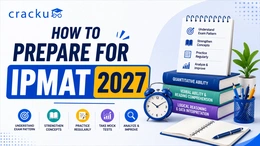
- Phase 1: Build a foundation using NCERT math.
- Phase 2: Practice topic-wise questions to build accuracy.
- Phase 3: Solve previous year papers to understand trends.
- Phase 4: Take full mocks and analyze the errors.
- Daily drill: 15 minutes of mental math for speed and also reading editorials or newspapers.
The PI round judges your confidence and general awareness. The institute checks documents only at the interview stage. Ensure your school marks meet the 60% minimum for General. Reserved categories need 55%. Academic diversity is valued. Show that you are more than just your test score.
Stay consistent with your routine. Learn to skip difficult questions without guilt. This saves you from penalty marks. Accuracy matters more than speed in the beginning. Once you get 80% accuracy, then work on speed. A disciplined plan puts you in the top 1%. Your background is a strength. Use it to win. All the best.
IPMAT Preparation Strategy For Commerce and Arts Students: Conclusion
Commerce and Arts students have a special advantage when it comes to the IPMAT exam. Arts students are good at the Verbal Ability section because of their strong background in subjects like Sociology and Psychology. Commerce students, on the other hand, already know key business ideas that will help them in the exam. By following a clear study plan, practicing regularly, and taking mock tests, students from both streams can do well in every section of the exam.
For the Quantitative Ability section, students should start by mastering basic topics like Arithmetic and Algebra, and then move on to Geometry and Number Systems. The Verbal Ability section requires daily reading and grammar practice. The Logical Reasoning section needs regular problem-solving practice. Staying consistent and disciplined in your study routine is the key to scoring well in the IPMAT. Also, remember that your background will help you in the interview round.