91- 6303239042
 IPMAT WhatsApp Group




 Preferred Source

 Google Discover
NPAT Syllabus 2027
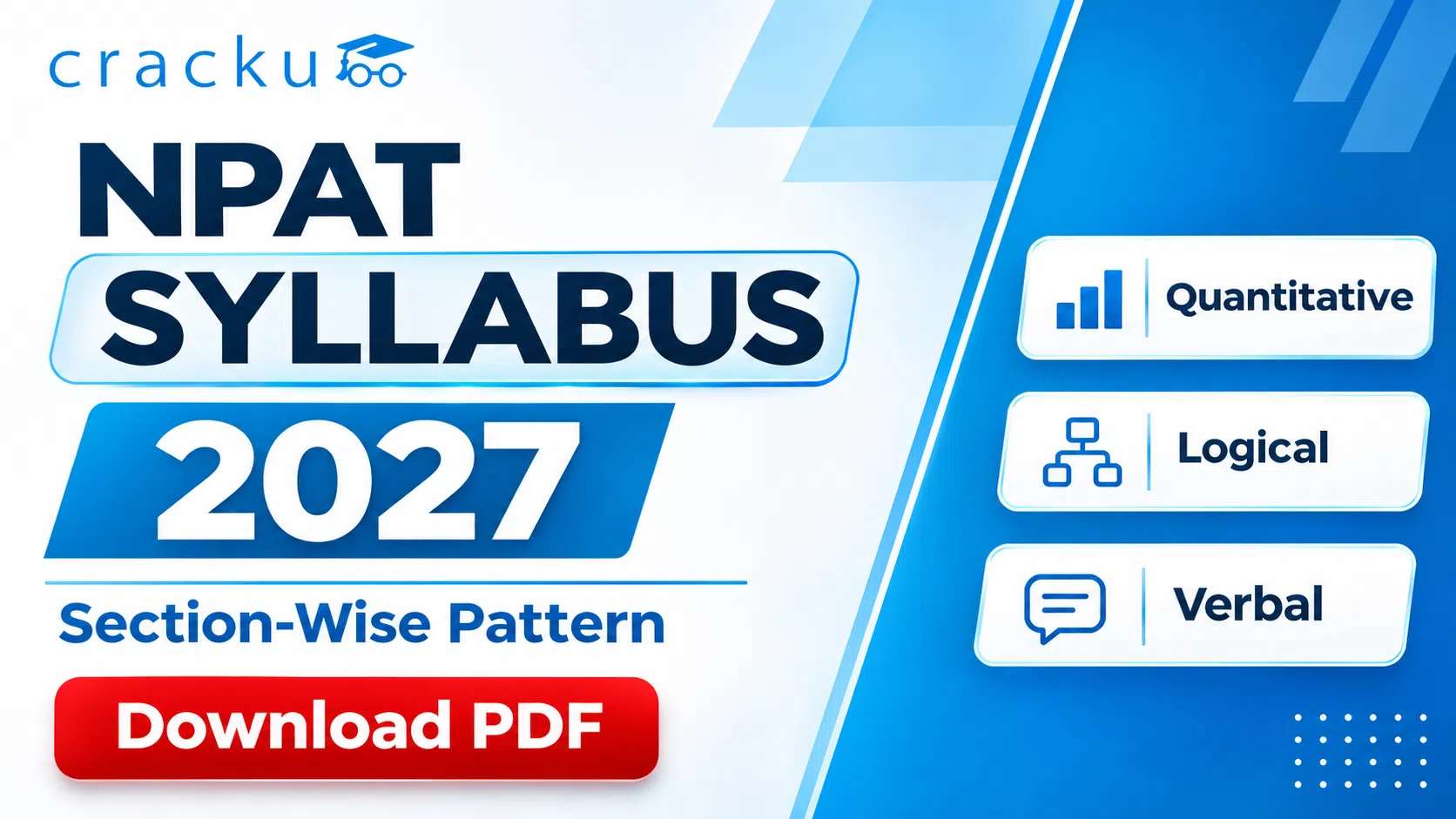
The National Test for Programs After Twelfth (NPAT) is conducted by SVKM's NMIMS for admission to its undergraduate programmes, and the NPAT Syllabus 2027 is divided into three sections, i.e., Quantitative Reasoning, Logical Reasoning, and Verbal Reasoning. As per the latest pattern notified by NMIMS, the test has 120 questions, 40 in each section, which are to be answered in 100 minutes in a computer-based online examination held at test centres, and the paper carries a total of 120 marks.
Download NPAT Syllabus 2026 PDF
What Is the NPAT Syllabus for UG Courses in 2027?
The NPAT syllabus for UG courses in 2027 consists of the same three sections for every programme, as NMIMS describes the NPAT as a standardised test that measures skills in quantitative reasoning, logical reasoning, and verbal reasoning. The NPAT Syllabus 2026 was the same for all the undergraduate programmes, as a result of which applicants to BBA, B.Com, and B.Sc. attempted the same question paper, and for the academic year 2026-27 NMIMS used the NPAT for admission to the following programmes.
- The Commerce programmes under the NPAT are the BBA, B.Com, B.Sc. Finance, and BBA (Fin Tech), along with the BBA MBA Integrated programme.
- The Economics, Branding and Advertising, and Liberal Arts programmes under the NPAT are the B.Sc. Economics, the BBA in Branding and Advertising, and the BA in Liberal Arts.
- The International Studies programme under the NPAT is the BBA (International Business), which is offered in collaboration with Kingston University as a dual degree programme in International Business.
- Admission to the Bachelor in Business Management and Marketing and to the BBA Finance is also made through the NPAT, on the basis of the same three-section syllabus of Quantitative Reasoning, Logical Reasoning and Verbal Reasoning.
NPAT Section-Wise Syllabus 2027
The NPAT section-wise syllabus 2027 is made up of six topic areas in each of the three sections, i.e., Quantitative Reasoning, Logical Reasoning and Verbal Reasoning, which together cover the mathematics, reasoning and English skills measured by the test, with each topic area divided into the sub-topics that it covers.
NPAT Quantitative Reasoning Syllabus 2027
Topic Area | Sub-Topics Covered |
Number System | Fractions, decimals, surds and number series |
Arithmetic | Percentages, profit and loss, discount, compound interest and annuities, ratio and proportion, time, work and distance, and 2D and 3D figures (areas and volumes) |
Algebra | Linear and quadratic equations, and AP and GP series |
Sets and Functions | Sets, Venn diagrams and mathematical functions |
Statistics and Probability | Measures of dispersion, mean, median and mode |
Trigonometry | Trigonometric ratios, identities, and heights and distances |
NPAT Logical Reasoning Syllabus 2027
Topic Area | Sub-Topics Covered |
Critical Thinking | Decisions based on specific rules or conditions |
Verbal-Logical Reasoning | Valid conclusions drawn from given statements |
Data Sufficiency | Whether the information given is enough to solve a problem |
Numerical Reasoning | Venn diagrams and mathematical relationships |
Data Interpretation | Data from bar graphs, pie charts and tables |
Spatial Reasoning | Patterns in figure series and figure analogies |
NPAT Verbal Reasoning Syllabus 2027
Topic Area | Sub-Topics Covered |
Error Recognition | Mistakes in grammar and sentence formation |
Applied Grammar | Correct use of tenses, prepositions and determiners |
Vocabulary | Meanings of words used in specific sentences |
Contextual Usage | The most appropriate words to fill in blanks |
Sequencing of Ideas | Rearranging jumbled sentences into a logical paragraph |
Reading Comprehension | Facts and moods in passages |
NPAT 2027 Important Topics and Topic-Wise Weightage
The NPAT 2027 important topics and topic-wise weightage are worked out section by section, as NMIMS gives each of the three sections the same number of questions and marks, while within each section a few topic areas carry more questions or need more focus than the others.
Section | Approx. Weightage |
Quantitative Reasoning | 33.3% (40 of 120 marks) |
Logical Reasoning | 33.3% (40 of 120 marks) |
Verbal Reasoning | 33.3% (40 of 120 marks) |
Total | 100% (120 marks) |
Under the NPAT Exam Pattern 2026, one mark was awarded for every correct answer in all three sections, which means that every question of the paper adds the same one mark to the score, whether it is drawn from Arithmetic, Data Interpretation, Reading Comprehension, or any other topic area. The important topic areas of each section are given below.
- In Quantitative Reasoning, Arithmetic is the most important topic area, as it carries the most questions, covering percentages, profit and loss, ratio, interest, and time, work and distance.
- In Logical Reasoning, Data Interpretation from charts and tables is a major part of the section, while series questions and Data Sufficiency also require focus.
- In Verbal Reasoning, the section centres on grammar, which is tested through Error Recognition and Applied Grammar, and on the Reading Comprehension of passages.
Read More: NPAT Previous Year Question Papers with Solutions PDF
NPAT Section-Wise Preparation Strategy 2027
Under the NPAT section-wise preparation strategy 2027, candidates are required to build speed along with accuracy in each of the three sections, since candidates answer all 120 questions of the paper within the same 100 minutes, which gives a candidate about 50 seconds for each question. The steps for each section, followed by the two rules that apply to the whole paper, are given below.
- Quantitative Reasoning: Candidates should begin Quantitative Reasoning with Arithmetic, its most important topic area, and then move on to Algebra, Statistics and Trigonometry, practising each topic at about 50 seconds per question.
- Logical Reasoning: Candidates should practise reading bar graphs, pie charts and tables for Data Interpretation without long calculations, given about 50 seconds per question, and should solve figure series and figure analogies for Spatial Reasoning.
- Verbal Reasoning: Candidates should revise tenses, prepositions and determiners for Error Recognition and Applied Grammar, and should practise passages for their facts and moods for Reading Comprehension.
- No negative marking: As NMIMS gives no negative marks for a wrong answer, candidates should mark an answer for every one of the 120 questions before the 100 minutes of the test end.
- Order of sections: Since the test has no sectional time limits, candidates may fix the order in which the three sections are attempted in their full-length mock tests and keep the same order in the test.
Read More: NPAT Exam Pattern 2026, Marking Scheme, Total Questions
How to Complete the NPAT 2027 Syllabus Effectively?
Candidates planning how to complete the NPAT 2027 syllabus effectively may begin with the school concepts behind each topic area, since most NPAT topics are taken from the Class 10 and Class 12 curriculum, and may revise Algebra, Statistics and Trigonometry from the school textbooks before starting timed practice.
- After the school concepts, candidates may take timed sectional tests of 40 questions each, which is the size of every NPAT section, so that candidates practise the topic areas of one section at a time.
- Candidates may then take full-length mock tests of 120 questions in 100 minutes, as practising mock tests and analysing the section-wise performance after each one may help candidates in completing the syllabus at the speed the test requires.
- NMIMS has published an official sample paper with 20 questions in each section (60 in all), which candidates should solve in one sitting of 50 minutes, i.e., at the rate of about 50 seconds per question allowed in the test.
Read More: NPAT Cut Off 2026, Colleges Category & Sectional Cutoffs
NPAT Syllabus 2027: Conclusion
Understanding the NPAT Syllabus 2027 is important for candidates preparing for admission to NMIMS undergraduate programmes. The syllabus covers three sections: Quantitative Reasoning, Logical Reasoning, and Verbal Reasoning. Each section carries equal weightage, so students should focus on all three sections and practise important topics regularly to improve their overall performance.
To prepare effectively for NPAT 2027, candidates should follow a structured study plan, revise important concepts, and attempt regular NPAT mock tests. Practising questions under timed conditions will help improve speed, accuracy, and time management. Candidates should also analyse their mock test performance to identify weak areas and strengthen their preparation before the examination.