91- 6303239042
 IPMAT WhatsApp Group




 Preferred Source

 Google Discover
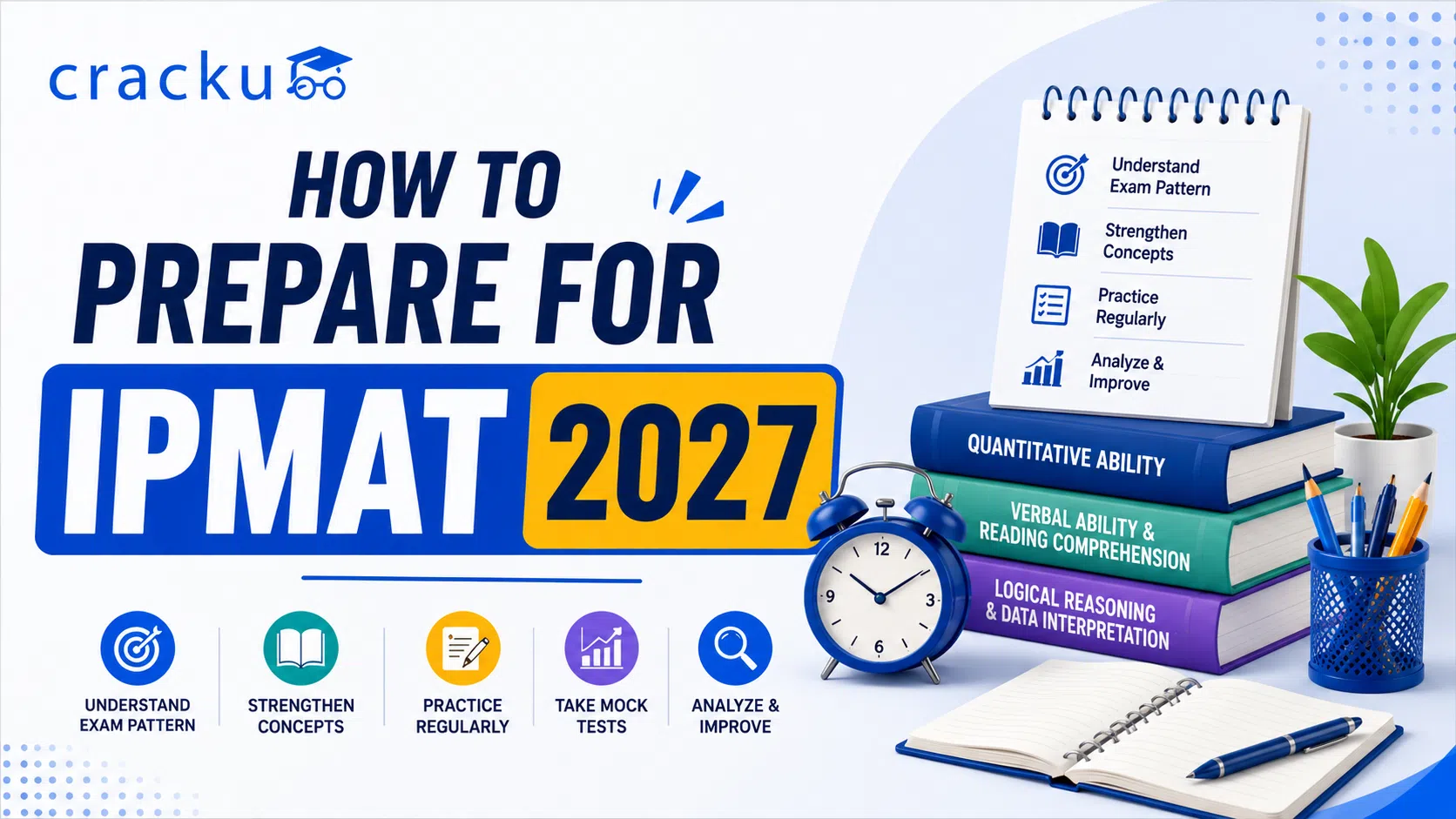
How to Prepare for IPMAT 2027?
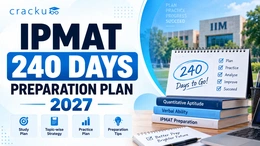
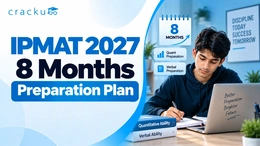
A robust strategy to prepare for IPMAT 2027 depends on four core pillars:Conceptual clarity,Timed practice, Mock Test analysis and Continuous Revision. Below is a way to plan your preparation for the entire year:
1. Structured Planning with Proper Timeline:
Phase | Duration | Focus Area |
Foundation | Months 1-3 | Concept-building in Quant, Grammar, and Vocabulary |
Skill-Building | Months 4-6 | Topic-wise practice, speed-building, Logical Reasoning basics |
Intensive Practice | Months 7-9 | Full-length mocks, sectional tests, error analysis |
Final Revision | Months 10-11 | Formula sheets, weak-area drilling, exam-day simulation |
Exam Readiness | Final month | Light revision, mental conditioning, full mocks under real conditions |
2. Identify Your weak spots: Before you even start preparation take one full-length mock to check your current standing on Quant, Verbal and LR sections. This mock will help you determine your area-specific preparation time and avoid equal allocation across sections as a norm
3. NCERT First, Then Advanced topics: Quantitative Aptitude is built on class 8th- 10th NCERT curriculum for number systems, percentage, ratio, algebra and geometry. Focus on these first before looking into advanced books as hurried preparation for harder material may cause slow calculation on exam day.
4. Mock Tests Are Indispensable: Aim for at least one IPMAT mock test every week once you cross 60% syllabus coverage. The frequency may increase to two to three mock tests per week during the last two months. Mocks assess and build your stamina for the 120 minute- examination format, apart from pointing out management gaps in your preparation strategy.
5.Track your improvements, not just the scores: After every mock, maintain an error log for questions. Note down the type of the question, what made you get that question wrong (conceptual gap, error in calculation, or time constraint), and the solution for that. Following this single habit has helped candidates to increase their accuracy manifolds.
IPMAT 2027 Study Plan and Syllabus PDF
How to Prepare for IPMAT Indore
The bar for difficulty is extremely high for IPMAT Indore, particularly in its Quantitative Ability segments. You are not required to answer every question, and the test primarily measures your ability to use strategy and filters-that is, to be able to identify easy problems by skipping the difficult ones and arrive at the answerable questions that guarantee marks.
Know the Exam Blueprint:
IPMAT Indore follows the rule of strict time constraints for each section, allowing a maximum of 40 minutes per section which cannot be carried forward.
Section Type | Number of Questions | Format | Scoring Metrics | Section Window |
Quantitative Ability (SA) | 15 Questions | Short Answer (TITA) | +4 / 0 (No Penalty) | 40 Minutes |
Quantitative Ability (MCQ) | 30 Questions | Multiple Choice | +4 / -1 Negative | 40 Minutes |
Verbal Ability (MCQ) | 45 Questions | Multiple Choice | +4 / -1 Negative | 40 Minutes |
Key strategies for IPMAT Indore:
- Target higher Mathematics syllabus: IPMAT Indore focuses on higher level mathematics from the 11th and 12th syllabus of CBSE. Focus on studying the chapters of Matrices & Determinants, Functions & Relations, Logarithms, P&C;, Probability, Vectors and Set Theory.
- Focus on the SA block of questions: The Short Answer section is the score booster for IPMAT as there is no negative marking. Because these are direct, written numerical answers where options aren't shown to the user, you'll need to concentrate on perfect calculation methods and clean, clear scratch work.
- Set Realistic Sectional Benchmarks: In such a tough paper, sectional cut-offs will be low. Generally, answering 40%-50% of the questions with decent accuracy will get you comfortably over the initial score-gates. Focus on selecting questions and not on brute-forcing as many questions as you can.
Read More: IPMAT Preparation Strategy, Section-Wise Tips for Exam
How to Prepare for IPMAT Rohtak
Quickness of response, calculation ability and mental stamina would be considered for IPMAT Rohtak over elaborate theory. In a timed period of 120 minutes, the major hurdle would be answering 120 questions, meaning a very quick decision-making approach for each question.
Know the Exam Blueprint:
It appears from recent exam papers for IIM Rohtak, unlike for IIM Indore, that there will be sectional timing, and each section is allotted 40 minutes. The question is therefore designed in a manner where only 60 seconds are available to you for each question.
Section Focus | Number of Questions | Format | Scoring Metrics | Time Limit |
Quantitative Ability | 40 Questions | MCQs Only | +4 / -1 Negative | 40 Minutes |
Logical Reasoning | 40 Questions | MCQs Only | +4 / -1 Negative | 40 Minutes |
Verbal Ability | 40 Questions | MCQs Only | +4 / -1 Negative | 40 Minutes |
IPMAT Rohtak-Core Strategies:
- Build Arithmetic Ability: The Quant section here emphasizes on commercial arithmetic. Ensure you can solve questions relating to percentages, Simple and Compound Interest, Profit, loss and discount, ratio, mixtures and allegations, Time-speed-distance and Time and Work in not more than 45 secs.
- Train for speed pattern recognition: LR section requires familiarity with standard reasoning models from the outset. Solve at least 20 to 30 custom problem sets for blood relations, direction sense, syllogisms, coding-decoding, clock & calendar and matrix arrangements.
- Minimize Avg. Processing Time: Since there are no integer type answers, all questions are MCQ. If it is a long question with a lengthy text or computations, mark it for review and move on immediately to secure your overall attempt.
Section-Wise IPMAT Preparation Strategy
Regardless of which IIM you are appearing for, thoroughness with individual sections is the key to a good composite score. Follow this preparation strategy for each section:
Quantitative Ability (QA):
- Key concepts to study: Number systems, percentages, profit & loss, ratio and proportion, time-speed-distance, algebra, geometry, mensuration, probability, and permutation & combinations.
- Develop speed by learning shortcut techniques: not guessing shortcuts. Understand mathematical techniques for calculation like squaring, approximation, digit sum checks, and the like but only if your concept is crystal clear.
- Study Short Answer type questions separately: If you are preparing for IPMAT Indore-Writing precise answers requires accuracy whereas eliminating option type questions focuses more on understanding the concepts.
Verbal Ability (VA):
- Reading comprehension: Read for a few minutes each day an article/editorial section of any newspaper (The Hindu, Indian Express) so that you are able to increase speed as well as inference capability.
- Vocabulary: Maintain a weekly list of new words with sentence usage, not isolated definitions because learning vocabulary using the context gives better results during the exam time.
- Grammar and sentence correction: Revising rules like subject-verb agreement, tenses, modifiers etc and practicing error spot-ability questions on a regular basis will increase accuracy significantly.
- Para-jumbles and critical reasoning: Train yourself to identify connectors and topic sentences for effective solving and to avoid time wastage.
Logical Reasoning (LR)-Mainly for IPMAT Rohtak:
- Focus areas: Seating arrangements, blood relations, syllogisms, coding-decoding, data sufficiency and analytical puzzles.
- Build pattern recognition: It is only through seeing a large number of questions of a type that speed can be increased, not with genius. Volume practice can be useful for the LR section.
- Time box: Cap your attempts per LR question by limiting it to 60-90 seconds to build the reflex to move on and to avoid spending too much time on one specific question.
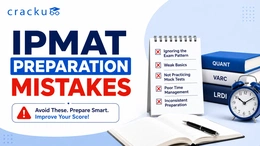
IPMAT Preparation Strategy Mistakes to Avoid
Your intensive preparation strategy can be foiled by basic planning and execution errors. Do not fall into the 5 common strategy traps described below:
Fatal Strategy Mistakes to Avoid During the IPMAT Preparation:
Not Analyzing the Mocks thoroughly: Stopping at simply checking your final scores means your areas of weakness remain unaddressed. Your test analysis post-test should be as important as one of your study modules. Keep a dedicated tracker of errors as they fall into categories of 'Conceptual Gap', 'Execution/Calculation error', or 'Time Crunch', that then informs your week-to-week study changes.
Underestimating Verbal Ability Sectionals: Almost every candidate spends the entirety of their prep time tackling difficult math problems, forgetting that strong math alone will not compensate for missing the minimum sectional cut-off for the verbal ability section. Allocate time evenly between both sections.
Not leaving challenging problems: Trying to solve a particular problem at a live test is a test taker's greatest obstacle to time management. If a math or LR question will take you longer than 90 seconds, and does not seem to have a clear solution on its way, cut your losses, mark it for later review, and move ahead.
Over-relying on the Virtual Calculator: While IPMAT Indore provides an on-screen calculator, clicking numbers with a mouse can impede your flow and make you lose speed. Use your mental calculation skills, and scratchpad, keeping the online calculator handy only for those complicated divisions.
Ignoring the Interview Foundations until after the written test: Writing aptitude tests and cracking them is just the first hurdle. The second part to selection in both IIM Indore and IIM Rohtak has significant weight given to the Personal Interview round. Make sure you are abreast with current affairs and revising your high school subjects throughout.
Read More: IPMAT Previous Year Question Papers, Download PDF
How to Prepare for IPMAT 2027: Conclusion
Preparing for IPMAT 2027 requires a balanced approach that combines conceptual learning, regular practice, mock test analysis, and continuous revision. Since both IPMAT Indore and IPMAT Rohtak have different exam patterns and difficulty levels, candidates should customize their preparation strategy accordingly. Building a strong foundation in Quantitative Ability, Verbal Ability, and Logical Reasoning remains the key to achieving a competitive score.
A well-planned study schedule, consistent mock test practice, and systematic error analysis can significantly improve performance over time. Candidates who focus on accuracy, time management, and gradual improvement while avoiding common preparation mistakes will have a much stronger chance of securing admission to their preferred IIM through IPMAT 2027.