IPMAT WhatsApp Group


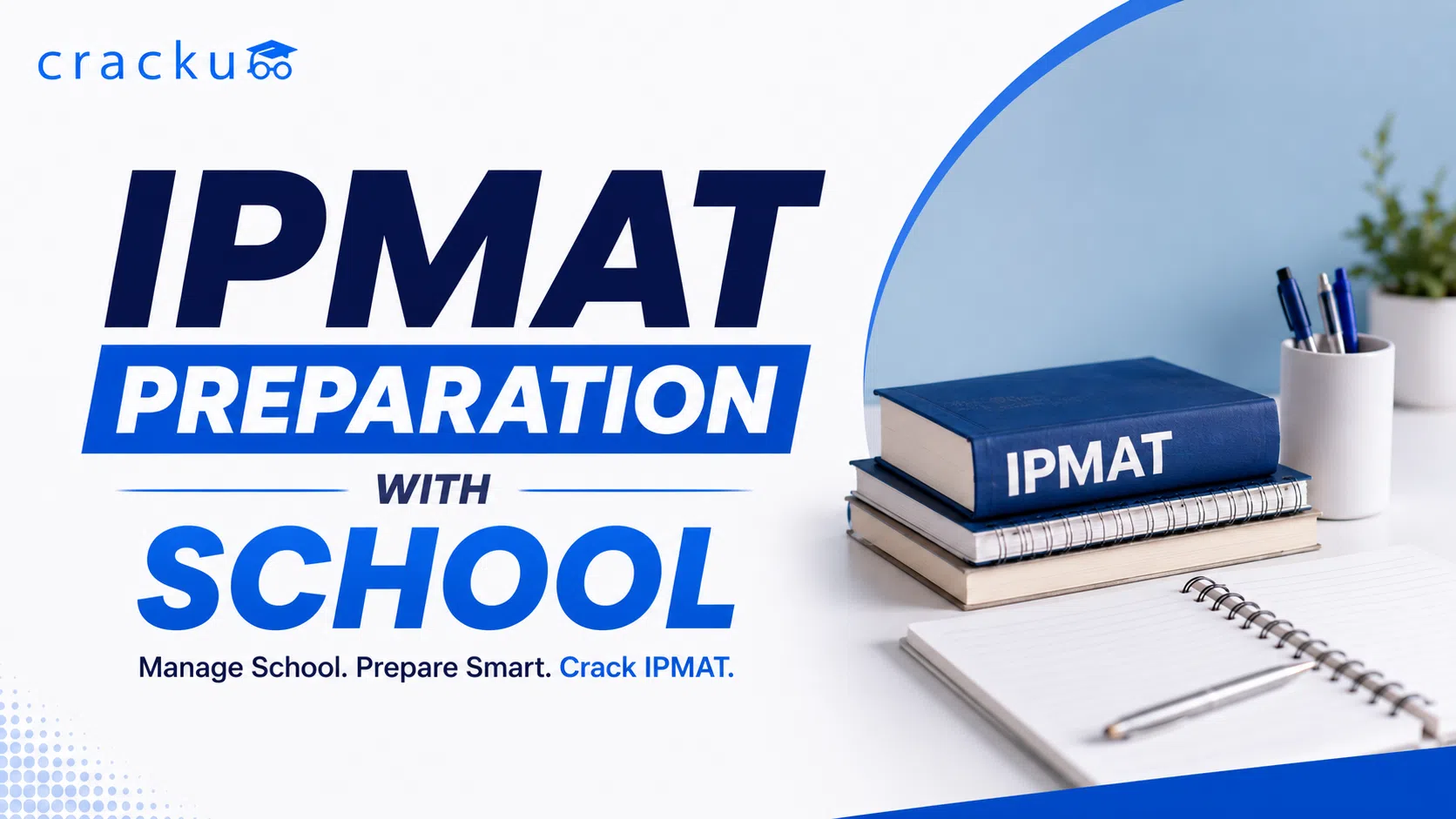
IPMAT Preparation with School
It’s completely possible to prepare for the IPMAT exam along with school, especially if we view the exam not as a last-minute sprint but as a long-term, concurrent race. Since most serious IPMAT 2027 aspirants attempt the test immediately after Class 12, it is in their best interest to start developing essential skills from Class 11 itself-a period when their board syllabus isn’t overwhelming and exam stress is comparatively less.
The fundamental approach here is integration, not competition. A number of school subjects, such as Mathematics and English, significantly overlap with the Quantitative Ability and Verbal Ability sections of the IPMAT. Instead of viewing IPMAT preparation strategy as an added burden, aspirants who align both benefit with faster and more consistent progress.
How to Prepare for IPMAT While in School
The key to preparing for IPMAT in school involves intelligent allocation of time across three domains: board exam academics, skill-building specific to IPMAT mock test practice. Here's a subject-wise plan that’s practical and easy to follow.
Quantitative Ability (QA):
- Get a solid grip on Class 10, 11, and 12 NCERT math concepts as they form the backbone of IPMAT QA.
- Dedicate extra time to arithmetic (percentages, profit-loss, time-speed-distance), algebra, and modern math (permutations, probability, sets).
- Practice mental calculation daily to enhance speed. This skill is crucial in IPMAT, far more so than in board exams.
Verbal Ability (VA):
- Read newspapers, editorials, and long-form articles on a daily basis to improve comprehension speed and vocabulary.
- Review grammar rules (tenses, parts of speech, sentence correction) along with your school English lessons.
- Weekly practice of para-jumbles, critical reasoning, and vocabulary questions is recommended.
Logical Reasoning and DILR (if applicable)
- Solve puzzles, seating arrangements, blood relations, and data interpretation sets regularly.
- Focus on time management-reasoning questions demand speed and accuracy equally.
Aspirants should treat these three areas as ongoing habits rather than as discrete study sessions. A consistent, small effort made most days of the week accumulates more effectively than intermittent, long study marathons.
Balancing Schoolwork with IPMAT Preparation
A common concern among school students preparing for IPMAT is that it might consume too much time needed for homework, projects, and internal exams. In reality, the overlap between school academics and IPMAT content reduces this concern-provided your study time is well-planned.
- During board exam weeks, concentrate solely on your boards and resume IPMAT practice after the exams are over.
- Set aside dedicated time each day for IPMAT prep as if it were a class. Treat it not as an optional add-on but as a non-negotiable appointment.
- Communicate your ambitions with parents and teachers. Most schools and mentors are supportive once they understand your long-term plan.
- Avoid parallel coaching for multiple unrelated competitive exams, as spreading your focus too thin can hinder progress in all areas.
IPMAT Preparation Strategy
The Three-Pillar Architecture A smart IPMAT preparation strategy consists of the synergy of three critical pillars: conceptually thorough understanding, ruthless speed building and effective utilization of mocks.
Pillar 1: Conceptual Foundation (Months 1-6)
For this phase, be blissfully ignorant of your problem solving speed. What you should do is focus completely on understanding the ‘why’ behind each and every formula or rule that you learn.
- Quantitative Aptitude: Try to divide the section into distinct topics like Arithmetic (Percentages, Profit and Loss, Ratios, Average, Mixture and Allegations, Time Speed and Distance etc.), Algebra (Linear & Quadratic Equations, functions, logarithm etc.), Geometry, Modern Math (sets, P&C;, probability)
- Verbal Ability: It is imperative to shift your answer selection process from subjective to objective/rule based. Learn the principles of subject verb agreement, parallelism, modifiers, tenses etc. With absolute precision. Learn how to approach Reading Comprehensions by identifying the central theme of the paragraph, tone of the author and keywords which signal transition in thoughts (eg. However, furthermore, despite etc.).
Pillar 2: The Art of the Filter (Months 7-9)
IPMAT is an elimination test, just as it is a selection test. During this phase of IPMAT preparation, it’s essential to develop a rapid ability to scan the question within 5 seconds and categorize the question into one of these three categories:
- Solve Immediately;
- Review Later;
- Skip Completely.
Alternative approaches to question solving including option substitution, checking boundary values, or using digital root should be actively developed and applied to avoid long computations.
Pillar 3: Mock Strategy and the Error Log (Month 10 Onwards)
This final phase is entirely focused on your capacity for test-taking endurance and data processing power.
- Consistent Simulation: Appear for 2-3 full length mock tests every week exactly at the time your IPMAT call can happen, in order to calibrate your circadian rhythms.
- Post- Mock Deconstruction Methodology: After every 2 hours spent taking the IPMAT mock test, spend 4 hours deconstructing your performance. Do not just look at the final score. Record every single error in a log, with a category - conceptual error, calculation error, or timing mistake.
IPMAT Study Plan for Class 11 and 12 Students
A structured month-wise study schedule for aspirants A structured, year-wise study plan ensures aspirants neither study too less, nor get exhausted. Here’s a month-wise study plan for Class 11 and 12 Students:
Phase | Class | Approximate Duration | Key Focus |
Foundation Phase | Class 11 (first half) | Months 1- 5 | NCERT concept building in Math and English; light vocabulary building |
Skill-Building Phase | Class 11 (second half) | Months 6- 10 | Topic-wise practice sets; introduce reasoning puzzles; first mock test |
Consolidation Phase | Class 12 (first half) | Months 11- 15 | Balance board revision with IPMAT topic revision; monthly mocks |
Acceleration Phase | Class 12 (second half) | Months 16 - 19 | Intensive timed practice; weekly mocks; previous year paper analysis |
Final Sprint | Class 12 (pre-exam) | Last 4- 6 weeks | Full revision, error-log clearing, exam-day simulation |
Class 11 Study Plan:
- Spend 60-70% of the non-school hours of studying for concept building instead of mocks.
- Practice one daily reading (newspaper editorial or one article on any given topic).
- Gradually introduce one DI or reasoning puzzle on a weekly basis to build familiarity with this section.
- End the year with a diagnostic mock to gauge the areas of improvement.
Class 12 Study Plan:
- Switch to timed practice and take up full-length mock tests, especially from the beginning of your board pre-boards.
- Make an error log to record all kinds of silly mistakes, conceptual errors, and issues with time management.
- Go through previous year question papers of IIM Indore and IIM Rohtak to get an idea about pattern and difficulty level of the paper.
- The last few weeks before the actual exam day should be dedicated entirely for revision; there is no point taking up a new topic at this juncture.
What is the Best Daily Schedule for School Students Preparing for IPMAT?
You must automate the study process, be so habitual, disciplined and free of distractions that you automatically go about the activities planned each day. Here are 2 such plans, built in to the natural flow of the typical Indian school curriculum:
The Standard Weekday (Mon-Fri)
Time Block | Activity |
Morning (40-50 min) | Newspaper articles Reading |
School Hours | Board syllabus, classroom learning |
Evening (60-90 min) | IPMAT concept study or topic-wise practice (QA/VA/LR rotation) |
Post-Dinner (30-45 min) | Timed problem sets or vocabulary/reading practice |
Before Bed (15-30 min) | Error-log review or quick revision of the day's topics |
This plan works best if you have regular school hours (approx 8 AM- 2.30 PM). It allows you the afternoons for necessary school homework & projects and creates a focused evening block for test prep.
06:00 AM - 06:40 AM (40 Mins) - The Cognitive Kickstart:
Read two comprehensive editorials in a quality newspaper or online journal. Make note of words you do not recognize - learn their origins, synonym, and antonym. Record these in your preparation diary.
08:00 AM - 02:30 PM - School Focus Zone:
Work on school lectures diligently, especially when you are in Mathematics, Accountancy, or Economics class as they develop Analytical skills that directly assist Quantitative Aptitude preparation.
03:30 PM - 05:30 PM - School Board & Homework Alignment:
Clean out all school work (homework, projects) and prepare for school tests, exams or assessments for that week to avoid doing this at late hours in the night.
06:30 PM - 08:30 PM (2 hrs) - The Core IPMAT Deep-Dive:
- 1st 60 Minutes: Learn a new topic in depth from one of the three sections and understand various forms and approaches.
- Next 60 Minutes: Solve 25-30 questions in that topic under timed, soft-countdown setting.
09:30 PM-10:00 PM (30 mins) - The Maintenance Wrap-Up:
Practice 5-7 Para-jumbles and 1-2 sets of Reading Comprehension, or do some quick Mental Maths/Number Drill.
The High-Yield Weekend (Sat-Sun):
Time Block | Activity |
Morning (2-3 hours) | Focus on Quantitative topics |
Afternoon (1 - 2 hours) | Verbal Ability & Reading Comprehension |
Post Lunch (2- 3 hours) | Full-length or sectional mock test |
Evening ( 2 hours) | Mock test analysis - review every wrong and guessed answer |
Remaining Time | Rest, hobbies, and family time to avoid burnout |
The weekend is your chance to delve into complex topics, revise, and attempt mock tests without school interfering.
08:30 AM -11:00 AM (2.5 hours)- The Heavy Quantitative Block:
Focus on hard, abstract topics such as Combinations and Permutations, Probability or Algebra. Build your way through complexity, solving questions of varied patterns to understand how underlying structures are altered in questions.
11:30 AM - 01:00 PM (1.5 hours) - Verbal Mechanics & Reading Comprehension:
Practice at least three complex and substantial RCs in diverse domains (e.g. Psychology, Technology, Politics, Literature). Ensure you attempt reading comprehension with questions focused on inference where options seem closely placed.
03:00 PM - 05:00 PM (2 hours) - Simulated Mock Testing / Sectional Quizzes:
Attempt 2 Sectional Tests - one of the three main areas each day (e.g., one day QA-MCQ, other day VA). Stick to the time constraints and simulate the real test environment - no rough sheets allowed etc.
06:00 PM-07:30 PM (1.5 hours) - Deep Diagnostic Review:
Analyze every single question attempted in your mock tests. Retake the missed questions without seeing solutions until you derive it yourself. Note down new lessons learned in your Error Log.
IPMAT Preparation with School: Conclusion
Preparing for IPMAT along with school is manageable when students follow a consistent and realistic plan. Instead of treating IPMAT preparation as an additional burden, aspirants should connect school Mathematics and English with Quantitative and Verbal Ability preparation. Daily reading, topic-wise question practice, mental calculation drills, and regular revision can gradually build the skills required for the examination.
A successful IPMAT preparation strategy should progress from concept building to timed practice and mock-test analysis. Class 11 students can focus on developing strong fundamentals, while Class 12 students should increase sectional tests, previous-year paper practice, and full-length mocks. With disciplined time management, a detailed error log, and balanced preparation, students can perform well in both board exams and IPMAT.