91- 6303239042
 IPMAT WhatsApp Group




 Preferred Source

 Google Discover
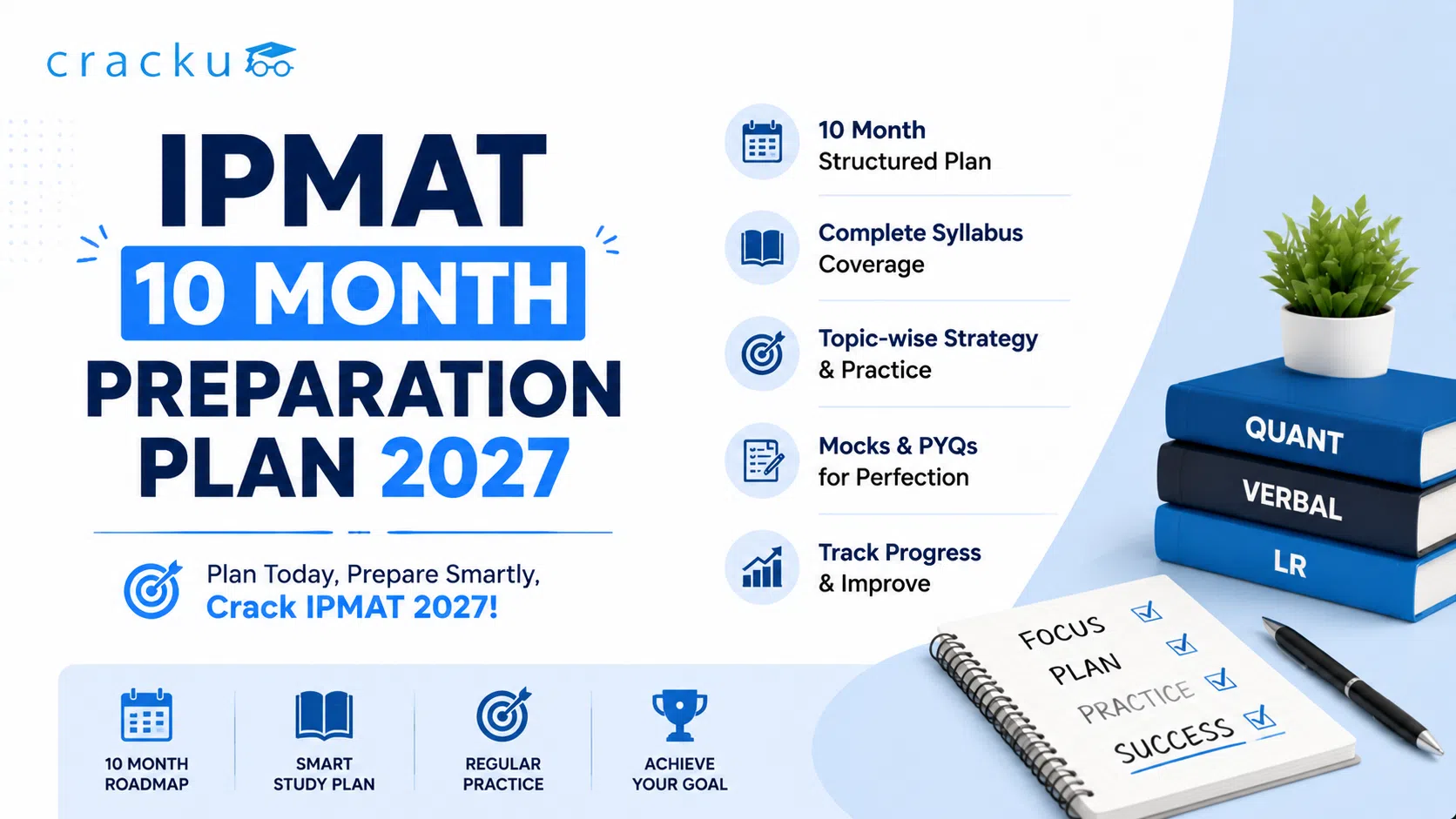
IPMAT 10 Month Preparation Plan 2027
Ten months of preparation for the IPMAT exam seems like a very long stretch, both for preparation for the faraway exam and for when mocks start showing you the kind of score you deserve for all your preparation. This article gives IPMAT 10 month preparation plan 2027 which includes what to do during those ten months, section by section, month by month, its test strategy and some of its best resources for preparation from Cracku.
Is 10 Months Enough to Prepare for IPMAT 2027?
Yes with intention. IPMAT 2027 comprises Quantitative Ability (MCQ and Short Answer) and Verbal Ability, both of which are based on subjects you've already been introduced to in your Class 10/11 Mathematics and common English. While engineering/medical exams require years of layering concepts, IPMAT rewards accuracy, speed and smart test-taking over raw volume of knowledge.
Here's why 10 months are more than enough to prep:
- 40 weeks in total you can cover each subject twice - first concept building and then a revision cycle.
- This leaves you with 8-10 weeks entirely for mock tests and error analysis. The most scores improve in this phase.
- Allows you to balance Board Exam prep (for Class 12) with last minute panic, as most concepts align with your CBSE/state board Maths and English syllabus.
- Gives you the scope to take sectionals multiple times and improve upon a specific weakness instead of starting from scratch under pressure.
Note: 10 months are enough only if you work with a plan and not the casual, ‘I'll study a bit everyday and see’. Aimless daily practice without a defined monthly target is the top reason why candidates feel ‘running out of time’ despite starting well in advance.
Read More: How to Prepare for IPMAT 2027, Section-Wise Strategy, Tips
Why a 10 Month IPMAT 2027 Preparation Plan Works
A well-paced 10-month strategy is effective because it reflects how learning occurs naturally - concept learning, practice, application, and refinement, rather than cramming the entire syllabus in the last two months. What makes this particular structure effective for IPMAT:
- Separates learning from testing: The first phase of this plan is dedicated solely to understanding the conceptual nuances of both Quant and Verbal sections, without the constraint of time pressure. The second phase then brings in section-wise tests under timed conditions. The last few months are then solely focused on full-length mock tests. This strategy avoids the premature risk of taking mock tests too early in your preparation and getting demoralized due to poor scores that simply reflect the portion of the syllabus yet to be covered.
- Builds in multiple revision cycles: 10 months allows you ample time to revise the topics in Quantitative Ability (Arithmetic, Algebra, Geometry, and Modern Math) and Verbal (Reading Comprehension, Vocabulary, Grammar) twice over. Repetition at appropriate intervals boosts retention power much more effectively than repeated learning once or twice in a compressed timeframe.
- Caters to the dual nature of the IPMAT Paper: IPMAT (Indore) includes both MCQ and Short Answer type Quant questions, the former allowing for educated guessing and the latter requiring more certainty since you can’t eliminate options. With a 10-month approach, you can dedicate special attention to drilling the Short Answer type questions, which are often ignored in late preparations.
- Accommodates slip-ups: All aspirants hit a phase at some point or the other when their scores seem to stagnate despite putting in the effort. In a compressed preparation plan of 3-4 months, there is no buffer for such instances. The 10-month plan will smoothly absorb these phases without impacting your overall readiness for the exam.
IPMAT 10 Month Preparation Plan 2027 (Month Wise Breakdown)
Let’s assume that the IPMAT 2027 exam will be held in May 2027 and break down your preparation into 10 months starting around July / August 2026.
Phase | Duration | Focus Area | Key Activities |
Phase 1: Foundation | Month 1 - 2 | Concept building in Quant & Verbal basics | NCERT-level Maths revision, vocabulary building, grammar fundamentals, daily reading habit |
Phase 2: Core Build | Month 3 - 5 | Topic-wise mastery, Quant sub-areas, RC practice | Chapter-wise practice sets, timed topic tests, Cracku topic-wise question banks |
Phase 3: Application | Month 6 - 7 | Sectional tests, Short Answer Quant drilling | Sectional mocks, error log maintenance, speed-building drills |
Phase 4: Mock Intensive | Month 8 - 9 | Full-length mocks, weak-area fixing | 2 - 3 mocks/week, detailed analysis, revising formula sheets |
Phase 5: Final Revision | Month 10 | Exam-day readiness, light revision | Previous year papers, quick-revision notes, mental conditioning, no new topics |
Section-Wise IPMAT 2027 Preparation Strategy
The IPMAT, in its broader essence, covers two main areas - Quantitative Ability (QA) and Verbal Ability (VA). Some institutions consider 12th-grade marks or conduct additional rounds, but the entrance exam primarily focuses on these two domains. Here is an efficient strategy for tackling each section:
Quantitative Ability (QA) Strategy:
QA generally consists of two types of questions: MCQ (Multiple-Choice Questions) and Non-MCQ (Short Answer questions), more so in the case of IPMAT Indore. Treat these as distinct competencies:
- Arithmetic (Highest Weightage): Cover concepts like Percentages, Profit & Loss, Time-Speed-Distance, Time & Work, Ratios, and Averages comprehensively. These topics often appear in both MCQ and Short Answer questions and should be mastered first.
- Algebra: Regularly practice linear and quadratic equations, functions, inequalities, and progressions as these are predominantly found in Short Answer questions where approximation or option elimination methods are not effective.
- Geometry & Mensuration: Concentrate on key formulas and concepts related to triangles, circles, coordinate geometry, and 3D mensuration. Prepare a concise formula sheet and review it weekly.
- Modern Maths: Permutations & Combinations, Probability, and Set Theory, though carrying less weightage, can be high-scoring if you have a clear understanding of the concepts. Do not ignore them.
- Number System: Master topics like LCM-HCF, divisibility rules, and remainder theorems. These are often tested in Short Answer format because they cannot be solved through option elimination.
Cultivate the habit of practicing Short Answer questions even when solving sets of MCQs. This helps in developing the calculation endurance required for non-MCQ questions.
Verbal Ability (VA) Strategy:
- Reading Comprehension (RC): Dedicate at least 20-30 minutes each day to reading an editorial or a long-form article from a reputed English publication. Practice summarizing each paragraph in a single line to enhance your skimming speed, crucial for IPMAT RCs.
- Vocabulary: Aim to learn 15-20 new words each week by utilizing root-word associations rather than just memorizing lists. Revise the previous weeks’ vocabulary every Sunday.
- Grammar: Focus on common areas like error-spotting, sentence correction, and para-jumbles. These topics yield significant results through systematic, rule-based practice.
- Verbal Reasoning: Critical reasoning and para-completion questions require practice with elimination logic.
Avoid relying solely on intuition. Verbal Ability thrives on consistency. Consistent daily practice (20-30 minutes of reading and vocabulary) for ten months is far more effective than a last-minute cram session.
Logical Reasoning (LR):
Note: this section is separate in IPMAT Rohtak & JIPMAT; IIM Indore's paper has basic DI within this section.
- Construct Standard Puzzle habits: Solve 2-3 logic arrangements (linear, circular, matrix type) every day.Know to represent difficult constraints with help of grids and symbols.
- Aim at high scoring subtopics: Study of typical reasoning topics - Syllogism, Blood relation, coding decoding, direction sense, etc. The questions here take less time and so one can quickly gather some points in the section.
Read More: IPMAT Preparation Strategy, Section-Wise Tips for Exam
Best Cracku Resources for IPMAT 2027 Preparation
Cracku is currently one of the most used resources for IPMAT candidates since the content is designed exclusively for IPMAT, rather than general MBA entrance content. You can divide the usage of Cracku resources into your 10-month plan:
- Topic-wise Question Banks During Phase 2 ( Month 3-5), you should focus on building your depth in individual Quant and Verbal topics prior to timed practice.
- IPMAT Previous Year Papers Practice at least the last 5-7 years papers for IPMAT Indore and IPMAT Rohtak. This will give you a sense of the real difficulty level and pattern of questions.
- Sectional Mock Tests During Phase 3 (Month 6-7) these are appropriate when you are testing speed and accuracy in either Quantor Verbal individually prior to mixing the sections.
- IPMAT Mock Tests Cracku's full-length mocks are made very close to the IPMAT pattern (difficulty and layout), so these greatly minimise the risks on exam day.
- Cracku’s Video Solutions & Concept Videos.Use these to understand the underlying logic behind a question when you have answered incorrectly, rather than just seeing the answer.
- Performance Analytics Dashboard. This will show the percentile trend, accuracy by topic and time spent on each question after each mock,and this is how you will mostly gauge your improvement.
Make sure to follow the order - do not immediately jump into full mocks or PYPs in Month 2 when the same is made available to you,as your fundamentals will not yet have the depth to be tested meaningfully.
IPMAT Mock Test Strategy
Mocks aren’t about practice-they are diagnostic tools. A student taking 25 mocks without review would likely improve less than one taking 12 mocks and reviewing each critically. Here’s the mock test strategy follows you through preparation phases:
Start with sectional, move to full-length: Take sectional mocks (Quant only or Verbal only) beginning around month 6, transitioning to full-length mocks (120 minutes) by month 8, so you replicate the exam structure and interface.
Work with a constant mock-to-analysis ratio: For every mock you take, invest an equal-or longer-amount of time in analyzing it. A 60-minute sectional mock requires an hour of review, breaking down your silly mistakes, conceptual weaknesses, and time-management gaps into discrete lists.
Maintain a detailed error log: Keep an Excel file (or document) listing every wrong answer, segmented by the topic of the question, and classified into reason: conceptual error, calculation mistake or time pressure error. Revisit this document at least weekly, using it as your go-to resource for focused revision.
Emulate the test environment: In month 9 and onwards, aim to take one mock a week at the time of your actual exam, in a quiet environment, and without breaks, in order to build test-taking stamina and focus.
Identify trends, not individual scores: A single low-scoring mock is not indicative of failure, nor is a single high-score indicative of readiness. Track your percentile rank and accuracy across blocks of 4 - 6 mocks to gauge your progress.
By month 12, you should aim to have taken 15 - 20 full-length mocks, supplementing your sectional testing. It’s this volume coupled with diligent review that typically distinguishes well-prepared candidates from those who have only “gone through” the syllabus.
Read More: IPMAT Previous Year Question Papers, Download PDF
IPMAT 10 Month Preparation Plan 2027: Conclusion
Preparing for IPMAT 2027 in 10 months gives aspirants enough time to build strong fundamentals, practise consistently, and improve their exam performance. A well-planned IPMAT 10 Month Preparation Plan helps students divide their syllabus into manageable phases, covering Quantitative Ability, Verbal Ability, and Logical Reasoning with proper revision cycles. Starting early allows candidates to focus on accuracy, speed, and effective problem-solving techniques instead of rushing through concepts.
A successful IPMAT preparation strategy requires consistency, regular practice, and continuous performance evaluation. By following a month-wise study plan, solving previous year papers, taking mock tests, and analysing mistakes, students can significantly improve their chances of securing admission into top IIM undergraduate programmes. The right approach combined with dedicated preparation can help aspirants confidently face the IPMAT 2027 examination.