IPMAT WhatsApp Group



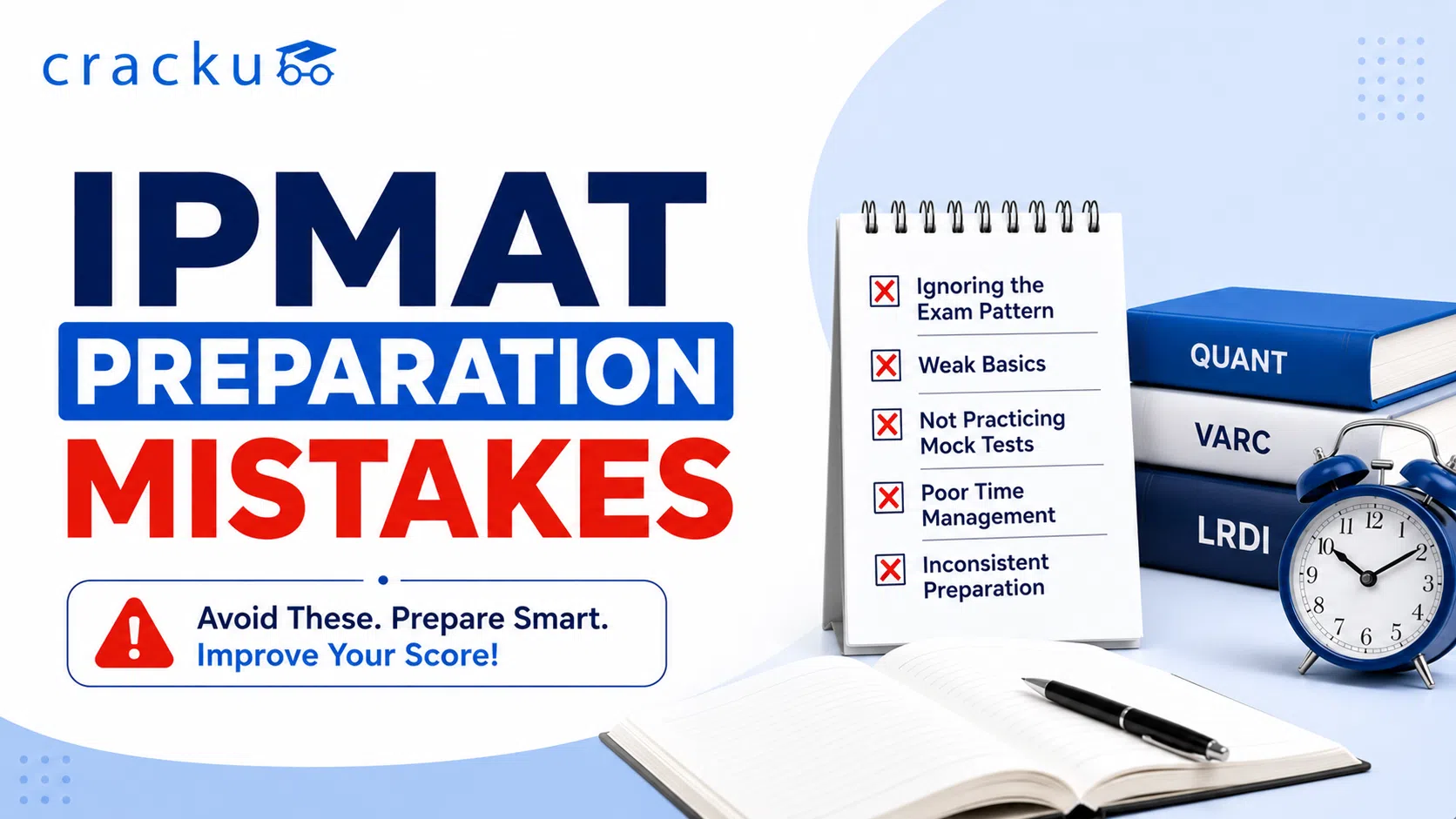
IPMAT Preparation Mistakes
The IPMAT exam is neither a syllabus-intensive exam nor is it purely a concept-based one. It's an exam designed to test a candidate's speed, accuracy and temperament on a foundation of class 8-10 level mathematics with reasonably high-end verbal ability. And because of this seemingly "simple" IPMAT syllabus, many aspirants often under-rate it and commit unpardonable blunders in their approach to it. The failures, at most times, stem not from a lack of knowledge, but from strategy, time management and self-awareness.
This article gives information about the IPMAT Preparation Mistakes which includes its preparation strategy, common mistakes to avoid by the aspirants, reason for the failure of the majority of the students.
Common Mistakes in IPMAT Preparation
Here is a compilation of the peculiar and often repetitive errors made by aspirants even after extensive months of preparation that lead to low scores.
Considering IPMAT as a board exam and not an aptitude test: Students often try to recall formulae and theory as they would for a school exam, neglecting ample practice of application-based and timed questions. IPMAT rewards quickness and an ability to identify patterns rather than memorising.
Lack of Sectional Balance: Trying to dedicate an overwhelming amount of time to one section over the other, like Quant over Verbal and Comprehension. Ignoring that many IPM programs(e.g., IIM Indore) have a sectional cutoff - a great total score will not help you if one section is below par. Not attempting Short Answer(non-MCQ) questions in the Quant section as these questions attract no negative marks and are free marks.
Not Taking or Analysing Mock Tests: The act of taking an IPMAT mock test without the subsequent in-depth analysis of it is among the most ignored mistakes in IPMAT preparation. Aspirants usually look at the marks obtained and proceed, missing an opportunity to spot similar silly mistakes, weak areas, or time sinks.
Unproductive time management during practice: Wasting 3-4 minutes on one particularly difficult question instead of simply marking it and returning to it later. Not practising with a time limit to keep your nerves from fraying on the day of the exam. Disregarding the requirement for a strategy of personal “attempt order”.
Too many study resources: Trying to use five different books and ten different YouTube channels with multiple test series. This usually results in confusion rather than clarity. A more focused approach, using 2-3 trustworthy study resources thoroughly, yields better results.
Lack of Reading: A reading ability and the pace at which one can comprehend cannot be developed overnight. Most students wait until the final month to read anything other than the basics. Such candidates often face difficulty answering the Comprehension questions within the given time limits.
Not measuring attempt rates vs accuracy rate: Many more attempts with poor accuracy can significantly reduce your total score compared to getting a moderate amount of correct answers, especially when negative marks are involved. Most aspirants do not focus on this aspect during preparation.
IPMAT Preparation Strategy
The following table gives insights about the IPMAT Indore and IPMAT Rohtak:
Metric | IPMAT Indore Blueprint | IPMAT Rohtak Blueprint |
Tested Core Sections | QA (Short Answer), QA (MCQ), Verbal Ability | Quantitative Aptitude, Logical Reasoning, Verbal Ability |
Total Question Count | 90 Questions | 120 Questions |
Time Allocation Matrix | 120 Minutes (Strict 40-Min Sectional Limits) | 120 Minutes (Open-ended, Self-Managed Timing) |
Marking Mechanics | +4 for Correct / -1 for MCQ Errors / 0 for SA Errors | +4 for Correct / -1 for All Errors |
Core Testing Focus | Advanced Higher Math, Conceptual Depth | Arithmetic Dominance, Speed, Verbal Pacing |
An well structured, multi-phased IPMAT Preparation Strategy should be executed across three clear phases:
Phase 1: Conceptualization Foundation (Months 1-4)
Your utmost and first priority must be 100% conceptual understanding. You don’t need to focus on speed, shortcuts or mock scores at this point.
- Quantitative aptitude: If you’re from a non-mathematics background, start by revising the NCERT mathbooks (class VIII to X). Understand the nuances of “Percentage”, “Profit and Loss”, “Simple and Compound Interest”, “Ratio” and “Average”. These 5 topics cover all of ‘Arithmetic’ and are fundamental for ‘Data Interpretation’. Simultaneously, gradually build up base on “Algebra” and “Higher Math” (Permutations and Combinations, Probability, Logarithms, Matrices).
- Verbal ability: Develop an uncompromisable daily ritual of reading top quality, long form news articles (The Hindu or The Indian Express editorials, Aeon, or The Economist). This will improve your inherent reading speed and contextual vocabulary without requiring you to churn memorisation of a giant dictionary.
Step 2: Speed & Topic Consolidation (Months 5-7)
When your concepts become comfortable enough to work without external aids,shift from untamed study sessions to restricted environments.
Sectional Testing: Now, practice 40-minute, individual section tests. This trains your brain to work under pressure and practice quick question assessment.
Three-Bucket Technique: Train your eyes to categorise the questions in these three buckets within 5 seconds:
- Bucket A (Solve Right Away) - Topic covered and calculation simple.
- Bucket B (Save for Later) - Solution understood, but needs heavy calculations.
- Bucket C (Forget About It) - Not understood, or structure extremely complex.
Step 3: Mock Simulation Marathon (Final 2-3 Months)
This final phase is entirely focused on your capacity for test-taking endurance and data processing power.
- Consistent Simulation: Appear for 2-3 mock tests every week exactly at the time your IPMAT call can happen, in order to calibrate your circadian rhythms.
- Post-Mock Deconstruction Methodology: After every 2 hours spent taking a test, spend 4 hours deconstructing your performance. Do not just look at the final score. Record every single error in a log, with a category – conceptual error, calculation error, or timing mistake.
How to Prepare for IPMAT 2027
From scratch and without a plan “If I have nothing and want to start from zero/change my approach, this is what I’ll do:
Step 1: Get the Blueprint Right
Know the number of questions, the marking scheme, cutoff trends and the relative weightage of each section for your desired IIM, and then build your preparation.
Step 2: Build a Realistic Plan
You should spend your day in 2-3 blocks: morning block on VA and QA, evening block on RC. Not the 'I’ll do QA today and tomorrow’ method, but in rotation” and make sure to take one day in the week to revise.
Step 3: Practice strategically
You should solve question-banks of each topic first, then go to full length mocks.
The most crucial aspect is the error log. A simple notebook or an excel sheet listing all errors, why they were made and the correction.
Step 4: Take Full-Length Mocks at the Correct Time
Just like how you take the exam. Sitting at the same time of the day, for the whole duration, at one stretch without breaks.This builds my endurance and decreases your anxiety on the exam day.
Step 5: Don't Just Redo the Paper
You should sit with the paper for at least 30-40 mins and review everything you should have marked wrong and understand why you marked it wrong."
Why do Students Fail to Crack IPMAT Despite Preparation?
This is the most common fear that plagues genuine candidates - "I prepared for months, so why did I not cross the cutoff?" The most honest answer to that question lies not in the amount of preparation but in the quality and nature of that preparation.
Important reasons of under-performance:
- Preparation without feedback: Studying in an isolated environment without mock test, mentor or peer feedback. Without it, there are no means of rectifying mistakes.
Familiarity versus competence: Realising that concept while revision does not equate with the ability to answer the question under pressure within time limit. - Lack of psychological preparation: Students often fail in exams not because of insufficient preparation but because of a lack of mental strength. Anxiety on the day of the exam, losing grip over oneself seeing tough questions, lack of sleep on the preceding night could make a mess out of any diligent preparation.
- Lack of flexibility: Having a rigid approach of attempting questions in the prescribed order even when not comfortable with the section is not a practical approach. Need to change approach with real-time situations.
- Miscalculating section cut-off: Even with good overall marks, one might fail in one section and lose a chance in IIM Indiore, etc. Where there is a stringent section-cut off.
How the gap is created: Students prepare in such a manner that builds more confidence in them, but does not actually hone their skill to crack such tests.
How to prepare for IPMAT effectively and avoid mistakes?
Here’s a consolidated checklist to prepare effectively while sidestepping the common mistakes discussed above.
Do This | Avoid This |
Balance QA, VA, and RC practice weekly | Focusing on only your strongest section |
Analyse every mock test in detail | Just checking scores and moving on |
Practise Short Answer QA daily | Ignoring the no-negative-marking zone |
Build a personal attempt-order strategy | Attempting questions in a fixed, rigid sequence |
Read diverse material for RC stamina | Starting reading habits only in the final month |
Use 2-3 trusted resources deeply | Collecting too many books and test series |
Track accuracy alongside attempt rate | Focusing only on number of questions attempted |
All comes down to one simple equation to achieve a killer score strategy: Smart Work + Iron Discipline. Master the game with these three golden rules to stitch it all up together.
1. Accuracy before Speed, at First: In the beginning, do not get bogged down by the fact that a math problem took you 4 minutes. Just focus on getting it right. Speed follows when you have complete conceptual understanding; it cannot be bought.
2. Turn QA-SA into a Game of Rewards: Make use of the absence of negative marking in the QA-SA section to your maximum benefit. Force yourself to be offensive but extremely accurate to gather as many clean points as you can with no fear.
3. Preserve Your Mental reserves: The mental strain of preparing for a competitive exam and boards studies at the same time is immense. Take good care of your sleep patterns, and keep taking adequate physical breaks. A fatigued mind cannot possibly infer minute nuances of context in dense reading comprehension passages.
IPMAT Preparation Mistakes: Conclusion
Avoiding common IPMAT preparation mistakes is just as important as completing the syllabus. Aspirants should maintain a proper balance between Quantitative Aptitude, Verbal Ability, Logical Reasoning, and Reading Comprehension. Regular practice, limited but reliable study resources, detailed mock-test analysis, and consistent reading can significantly improve overall performance.
A successful IPMAT preparation strategy should focus on accuracy before speed, followed by timed sectional practice and full-length exam simulations. Students should maintain an error log, track their attempt and accuracy rates, and develop a flexible question-selection strategy. Smart preparation, disciplined revision, and strong exam temperament can help candidates improve their chances of clearing IPMAT.