91- 6303239042
 IPMAT WhatsApp Group




 Preferred Source

 Google Discover
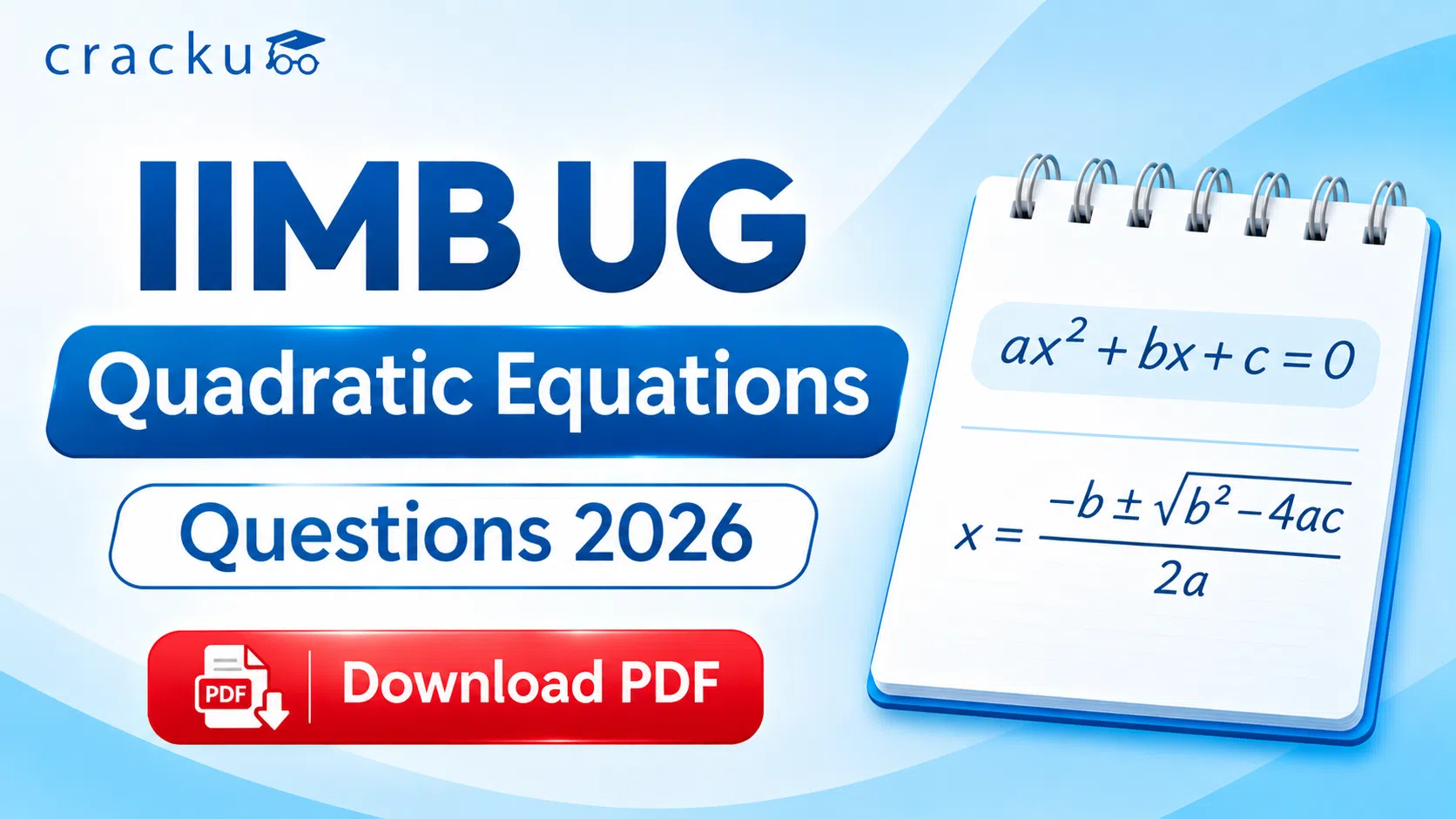
IIMB UG Quadratic Equations Questions 2026
Quadratic Equations are among the most scoring algebra topics in the IIMB UG Quantitative Aptitude and Data Interpretation section. This section has 30 of the paper's 60 questions, and the computer-based test runs for 135 minutes on the NCERT Class X to XII syllabus. Each correct answer earns 3 marks and each wrong answer costs 1, so a sure method beats a lucky guess.
Most questions rest on one idea: you rarely need the roots themselves. The sum of roots, the product of roots and the discriminant answer most questions directly. Common patterns include nature of roots, symmetric expressions, forming equations, maximum and minimum values, signs of roots, quadratic inequalities and find-k questions. Solve 10 to 15 questions daily, aiming for about a minute each, to bank time for DI sets.
IIMB UG Quadratic Equations Questions PDF
The PDF puts every important pattern in one place, with a step-by-step solution for each question. It covers nature of roots, sum and product of roots, forming and transforming equations, roots in a ratio, common roots, maximum and minimum values, quadratic inequalities, disguised quadratics and integer-root questions. Solve it in a timed setting, note where a formula below would have saved time, and revisit wrong answers after a few days.
Download IIMB UG Quadratic Equations Questions PDF
How to Solve IIMB UG Quadratic Equations Questions
Learn these four tables by heart; together they answer most IIMB UG quadratic questions without solving for the roots. For ax² + bx + c = 0, the roots are α and β.
Core formulas:
Concept | Formula |
Roots | x = [−b ± √(b² − 4ac)] ÷ 2a |
Sum of roots | α + β = −b/a |
Product of roots | αβ = c/a |
Discriminant | D = b² − 4ac |
Equation from roots | x² − (α + β)x + αβ = 0 |
Difference of roots | α − β = √D ÷ a (a > 0, α the larger root) |
Extreme value | (4ac − b²) ÷ 4a at x = −b/2a; minimum if a > 0, maximum if a < 0 |
Symmetric expressions:
Expression | In terms of sum and product |
α² + β² | (α + β)² − 2αβ |
(α − β)² | (α + β)² − 4αβ |
α³ + β³ | (α + β)³ − 3αβ(α + β) |
1/α + 1/β | (α + β) ÷ αβ = −b/c |
α/β + β/α | (α² + β²) ÷ αβ |
Nature and signs of roots:
Condition | What it means |
D > 0 | Real and distinct roots |
D = 0 | Real and equal roots, each −b/2a |
D < 0 | No real roots (complex conjugate pair) |
D a perfect square, rational coefficients | Rational roots |
Both roots positive | D ≥ 0, −b/a > 0, c/a > 0 |
Both roots negative | D ≥ 0, −b/a < 0, c/a > 0 |
Roots of opposite signs | c/a < 0 |
One root zero | c = 0 |
Roots reciprocal to each other | c = a |
Roots equal in size, opposite in sign | b = 0 |
k lies between the roots | a × f(k) < 0 |
Transformed roots:
New roots | Replace x with |
1/α, 1/β | 1/x (reverse the coefficients) |
−α, −β | −x |
α + k, β + k | x − k |
kα, kβ | x/k |
Write everything in sum and product: If α and β are the roots of x² − 7x + 3 = 0, then α² + β² = 7² − 2 × 3 = 43.
Find k with the discriminant: For x² + kx + 9 = 0 to have equal roots, k² − 36 = 0, so k = ±6.
Use the sign rule for inequalities: When a > 0, the expression is negative between the roots and positive outside them. So x² − 5x + 6 < 0 gives 2 < x < 3.
Spot disguised quadratics: For 4^x − 6 × 2^x + 8 = 0, put y = 2^x to get y² − 6y + 8 = 0, so x = 1 or 2.
Reject extraneous roots: Squaring √(x + 3) = x − 3 gives x = 1 or 6, but only x = 6 satisfies the original. Wrong options are often these rejected roots.
Guess carefully under negative marking: A wrong answer costs 1 mark against 3 for a correct one. Guess only after eliminating at least two options; otherwise move on.
Question 1
The roots $$\alpha, \beta$$ of the equation $$3x^2 + \lambda x - 1 = 0$$, satisfy $$\cfrac{1}{\alpha^2} + \cfrac{1}{\beta^2} = 15$$.
The value of $$(\alpha^3 + \beta^3)^2$$, is
correct answer:- 2
Question 2
lf the equations $$x^{2}+mx+9=0, x^{2}+nx+17=0$$ and $$x^{2}+(m+n)x+35=0$$ have a common negative root, then the value of $$(2m+3n)$$ is
correct answer:- 38
Question 3
Let $$x, y,$$ and $$z$$ be real numbers satisfying
$$4(x^{2}+y^{2}+z^{2})=a,$$
$$4(x-y-z)=3+a$$
The a equals
correct answer:- 1
Question 4
The number of non-negative integer values of k for which the quadratic equation $$x^{2}-5x+k=0$$ has only integer roots, is
correct answer:- 3
Question 5
If $$\left( x^{2}+\frac{1}{x^{2}} \right)=25$$ and $$x>0$$, then the value of $$\left( x^{7}+\frac{1}{x^{7}} \right)$$ is
correct answer:- 1

Question 6
The equations $$3x^{2}-5x+p=0$$ and $$2x^{2}-2x+q=0$$ have one common root. The sum of the other roots of this equations is
correct answer:- 1
Question 7
If $$9^{x^{2}+2x-3}-4(3^{x^{2}+2x-2})+27=0$$ then the product of all possible values of x is
correct answer:- 2
Question 8
A value of $$c$$ for which the minimum value of $$f(x)=x^{2}-4cx+8c$$ is greater than the maximum value of $$g(x)=-x^{2}+3cx-2c$$, is
correct answer:- 2
Question 9
If x and y are real numbers such that $$4x^2 + 4y^2 - 4xy - 6y + 3 = 0$$, then the value of $$(4x + 5y)$$ is
correct answer:- 7
Question 10
lf the equations $$x^{2}+mx+9=0, x^{2}+nx+17=0$$ and $$x^{2}+(m+n)x+35=0$$ have a common negative root, then the value of $$(2m+3n)$$ is
correct answer:- 38

Question 11
Let $$x, y,$$ and $$z$$ be real numbers satisfying
$$4(x^{2}+y^{2}+z^{2})=a,$$
$$4(x-y-z)=3+a$$
The a equals
correct answer:- 1
Question 12
The sum of all possible values of x satisfying the equation $$2^{4x^{2}}-2^{2x^{2}+x+16}+2^{2x+30}=0$$, is
correct answer:- 4
Question 13
The equation $$x^{3} + (2r + 1)x^{2} + (4r - 1)x + 2 =0$$ has -2 as one of the roots. If the other two roots are real, then the minimum possible non-negative integer value of r is
correct answer:- 2
Question 14
A quadratic equation $$x^2 + bx + c = 0$$ has two real roots. If the difference between the reciprocals of the roots is $$\frac{1}{3}$$, and the sum of the reciprocals of the squares of the roots is $$\frac{5}{9}$$, then the largest possible value of $$(b + c)$$ is
correct answer:- 9
Question 15
Let $$\alpha$$ and $$\beta$$ be the two distinct roots of the equation $$2x^{2} - 6x + k = 0$$, such that ( $$\alpha + \beta$$) and $$\alpha \beta$$ are the distinct roots of the equation $$x^{2} + px + p = 0$$. Then, the value of 8(k - p) is
correct answer:- 6

Question 16
Let k be the largest integer such that the equation $$(x-1)^{2}+2kx+11=0$$ has no real roots. If y is a positive real number, then the least possible value of $$\frac{k}{4y}+9y$$ is
correct answer:- 6
Question 17
Suppose one of the roots of the equation $$ax^{2}-bx+c=0$$ is $$2+\sqrt{3}$$, Where a,b and c are rational numbers and $$a\neq0$$. If $$b=c^{3}$$ then $$\mid a\mid$$ equals.
correct answer:- 2
Question 18
Suppose hospital A admitted 21 less Covid infected patients than hospital B, and all eventually recovered. The sum of recovery days for patients in hospitals A and B were 200 and 152, respectively. If the average recovery days for patients admitted in hospital A was 3 more than the average in hospital B then the number admitted in hospital A was
correct answer:- 35
Question 19
Consider the pair of equations: $$x^{2}-xy-x=22$$ and $$y^{2}-xy+y=34$$. If $$x>y$$, then $$x-y$$ equals
correct answer:- 4
Question 20
If r is a constant such that $$\mid x^2 - 4x - 13 \mid = r$$ has exactly three distinct real roots, then the value of r is
correct answer:- 1

Question 21
The number of integers that satisfy the equality $$(x^{2}-5x+7)^{x+1}=1$$ is
correct answer:- 1
Question 22
The number of distinct real roots of the equation $$(x+\frac{1}{x})^{2}-3(x+\frac{1}{x})+2=0$$ equals
correct answer:- 1
Question 23
How many disticnt positive integer-valued solutions exist to the equation $$(x^{2}-7x+11)^{(x^{2}-13x+42)}=1$$ ?
correct answer:- 4
Question 24
Let m and n be positive integers, If $$x^{2}+mx+2n=0$$ and $$x^{2}+2nx+m=0$$ have real roots, then the smallest possible value of $$m+n$$ is
correct answer:- 2
Question 25
The product of the distinct roots of $$\mid x^2 - x - 6 \mid = x + 2$$ is
correct answer:- 1