91- 6303239042
 IPMAT WhatsApp Group




 Preferred Source

 Google Discover
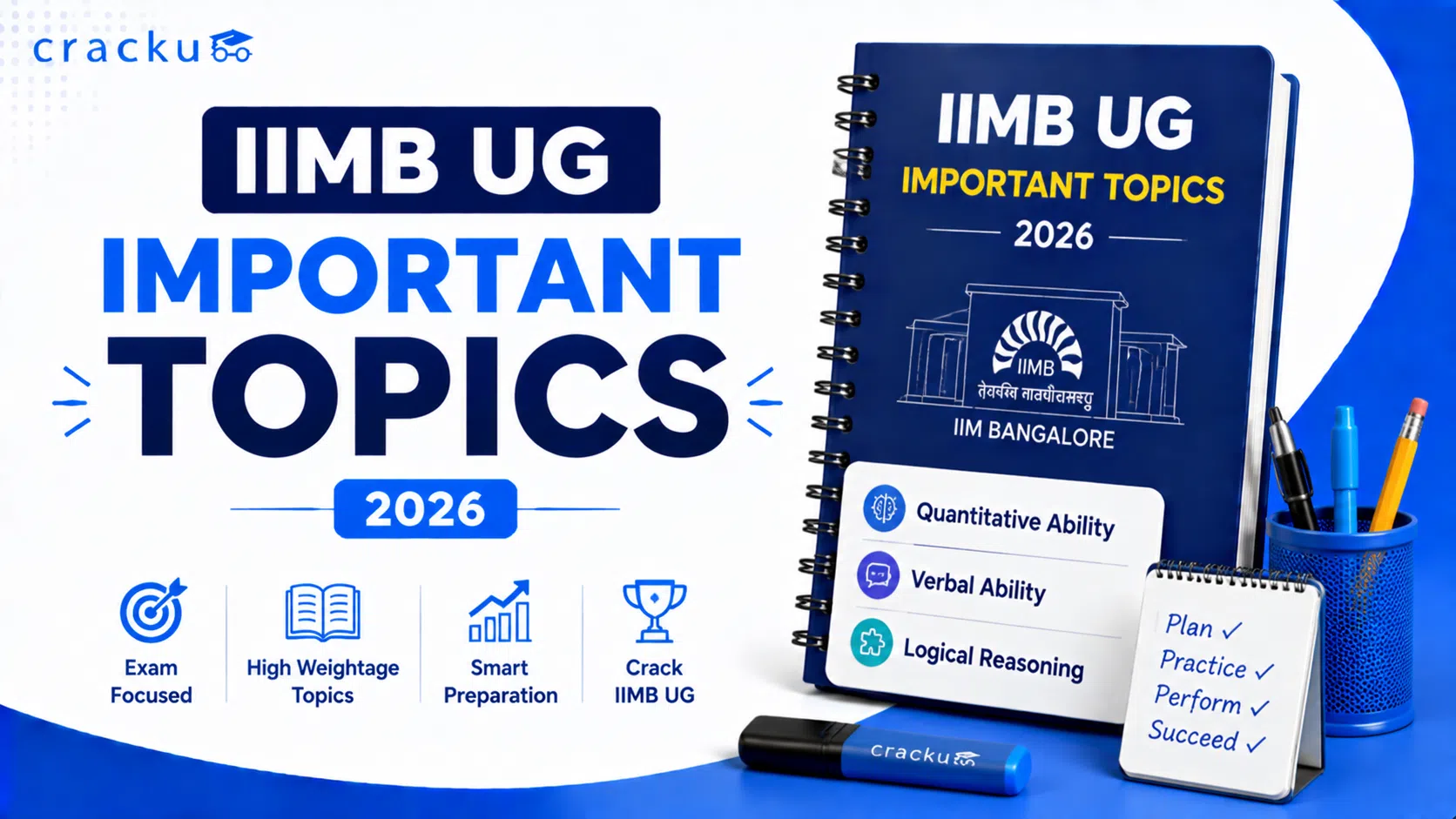
IIMB UG Important Topics 2026
Identifying the exact IIMB UG Important Topics 2026 directs your daily preparation toward actual scoring areas instead of spreading effort evenly. Targeted study plans work best. By knowing the important topics, you can boost your score and feel confident. This breakdown covers the tested topics and section weightages to help you prioritize effectively.
IIMB UG Topic-wise Weightage
How are the sixty questions split? The IIMB UG topic-wise weightage reveals they are distributed across three mandatory sections. Quant and Data Interpretation run the whole show here. 30 out of 60 questions come from this section alone; that's half your paper. Logical Reasoning and Verbal Ability split the rest evenly, with 15 questions each and 25% weightage.
Every correct answer earns +3 marks toward your final test result. Incorrect attempts cost -1 mark. The marking scheme penalizes random guessing heavily across the entire 180 total marks available. Unattempted questions safely receive zero marks. Since the math section dictates half the score, budget half your practice time exactly there.
Section | Number of Questions | Weightage | Marks per Correct Answer | Total Marks Available |
Quantitative & Data Interpretation | 30 | 50% | +3 | 90 |
Logical Reasoning | 15 | 25% | +3 | 45 |
Verbal Ability (English Comprehension) | 15 | 25% | +3 | 45 |
Total | 60 | 100% | -1 for incorrect | 180 |
Reviewing the IIMB UG exam pattern details turns this numerical weightage into a structured weekly schedule. Splitting your remaining study hours evenly between the reasoning and verbal sections ensures balanced preparation. You need a clear plan. A well-organised topic breakdown lets you prioritise actual high-weightage subjects rather than relying on guesswork.
If you don’t know the answer, you can skip it. Leaving questions blank protects your score. Blind guessing destroys hard-earned totals rapidly during the test. You must evaluate your certainty carefully before locking in any answer on the computer screen.
Read More: IIMB UG 5 Month Preparation Plan 2026, Section-wise Strategy
IIMB UG Important Topics: Quantitative Ability
The Quantitative Ability section follows the NCERT Class 10-12 mathematics syllabus closely. Many students face unexpected hurdles here. Testing covers integration and differentiation alongside determinants and vectors.
Four broad quantitative areas demand entirely different study approaches. Arithmetic and algebra categories heavily reward calculation speed during the exam. Higher mathematics topics shock many students. The first conducted exam felt substantially more calculative, meaning timed practice matters immensely.
Arithmetic:
- Number System, Averages, and Percentages form the foundation
- Roots, Indices, Surds, Simple and Compound Interest
- Profit and Loss, Ratio and Proportion, Partnership
- Mixtures and Allegations, Speed and Distance
- Work-related Problems, Pipes and Cisterns
Algebra:
- Algebraic Formulae and Quadratic Equations
- Permutations, Combinations, and Probability
Geometry & Mensuration:
- Lines, Angles, and Triangles
- Polygons, Circles, and Mensuration
Higher Mathematics (Class 12):
- Determinants and Vectors
- Integration and Differentiation
Tackling these specific arithmetic and algebra groups builds the speed needed for the first half of the paper. Learning advanced math helps you get points in the calculus section. You must secure marks across all four areas to maximize that fifty percent weightage effectively.
IIMB UG Important Topics: Logical Reasoning
The Logical Reasoning section tests pattern recognition across three distinct practice buckets. Quick-scoring fundamentals form the core foundation. Arrangement sets and statement-based reasoning demand highly careful reading.
Puzzle and arrangement sets can quickly eat up your allocated clock. Practicing under a strict timer builds the speed necessary to spot the correct arrangement instantly. Time vanishes rapidly when grids mismatch. Statement-based reasoning questions require you to strictly separate factual deductions from mere unstated assumptions.
Core Reasoning Fundamentals:
- Series, Age, and Blood Relations questions
- Directions, Clock, and Calendar problems
- Venn Diagrams, Analogy, and Coding-Decoding
Arrangement & Puzzles:
- Arrangement sets requiring quick pattern spotting
- Cubes and spatial reasoning grids
Statement-based Reasoning:
- Deduction and Inference extraction
- Statements: Assumptions and Conclusions analysis
- Assertions, Reasons, and Syllogism sets
Core reasoning fundamentals provide reliable scoring opportunities early in the timer. Arrangement sets demand immediate pattern recognition before committing minutes to a grid. Getting stuck ruins your limit. Moving past stalled arrangements protects your remaining time for the important deduction and inference questions.
IIMB UG Important Topics: English Comprehension
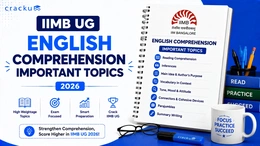
The English Comprehension section evaluates multiple English skills together. It tests reading comprehension, grammar, vocabulary, and basic verbal reasoning simultaneously. This section appeared slightly easier than other sections during the first cycle.
Reading comprehension passages heavily feature inference-based questions rather than direct-recall prompts. Practice sessions should focus on understanding the author's intent instead of just locating surface facts. Regular reading habits build this skill. Memorizing standalone vocabulary lists alone cannot replace actual passage reading practice for this specific exam.
Reading Comprehension:
- Reading Comprehension passage analysis
- Inference-based Passages focusing on author intent
Grammar:
- Noun, Pronoun Errors, and Subject-Verb Agreement
- Prepositions, Conjunctions, and Tenses
- Modifiers and Parallelism structure rules
Vocabulary:
- Etymology, Word Roots, and Foreign Words
- Idioms, Phrases, and Analogies
- Antonyms and Synonyms
Verbal Reasoning:
- Syllogisms and Logical Consistency
- Deductive Reasoning applications
Grammar rules offer concrete scoring chances when passage inferences feel ambiguous. Vocabulary knowledge decodes complex reasoning statements rapidly before your thirty minutes expire. Do not ignore grammar. Building these distinct areas concurrently ensures a balanced English Comprehension score across the entire section.
IIMB UG Exam 2026
Understanding the IIMB UG Exam 2026 shapes how you schedule the topic-wise preparation discussed earlier. The test operates as a computer-based exam featuring 60 MCQs within a 120-minute window. Individual section timers enforce pacing. Every section runs on its own fixed clock rather than one shared countdown.
Final selection combines the written test performance with a personal interview phase. Test preparation and interview readiness require parallel attention rather than a sequential approach. The official notification remains unpublished currently. Based on the previous cycle's pattern, the next notification is expected around mid-to-late 2026.
The official exam date likely falls around December 2026, though exact dates are eagerly awaited. The admissions page will publish the timeline. Fixed sectional timing prevents you from borrowing minutes from the verbal section to finish the mathematics section. You must manage each segment independently.
Section | Number of Questions | Time Allotted |
English Comprehension (Verbal Ability) | 15 | 30 minutes |
Logical Reasoning | 15 | 30 minutes |
Quantitative Ability & Data Interpretation | 30 | 60 minutes |
Total | 60 | 120 minutes |
IIMB UG Important Topics 2026: Conclusion
Understanding the IIMB UG Important Topics 2026 allows candidates to focus on the most relevant and high-scoring areas of the entrance examination. Since Quantitative Ability and Data Interpretation account for half of the paper, students should prioritise arithmetic, algebra, geometry, probability and higher mathematics while also improving calculation speed and accuracy.
A balanced preparation plan should also include regular practice of IIMB UG Logical Reasoning topics, reading comprehension, grammar and vocabulary. Following the IIMB UG topic-wise weightage, solving timed questions and avoiding unnecessary guesses can help candidates improve their overall score and approach the examination with greater confidence.