91- 6303239042
 IPMAT WhatsApp Group



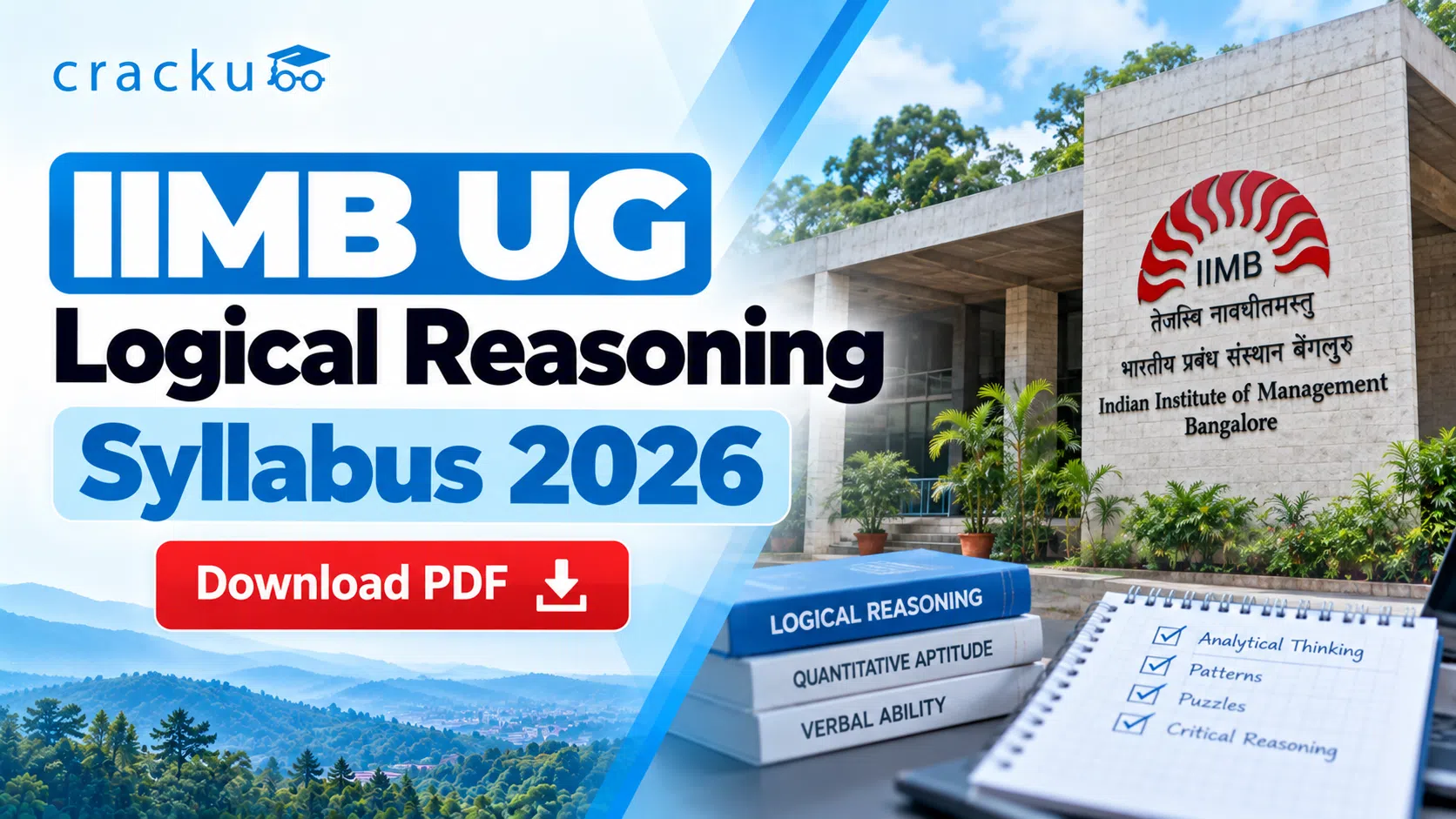
IIMB UG Logical Reasoning Syllabus 2026
A Logical Reasoning syllabus lays out exactly which question formats you need to master and recognise on sight. It covers arrangements, relationships, coding patterns, and structured statements formats built to test how quickly a mind can organise scattered information into one clear answer. Knowing the IIMB UG Syllabus ahead of time turns a vague instruction to practice reasoning into a focused list of formats. Every hour of study time goes toward the exact skills the test rewards.
IIMB UG Logical Reasoning Important Topics 2026
Every important topic inside Logical Reasoning is a question format with its own repeatable solving pattern. This list reads differently from a mathematics or English syllabus. Formats such as blood relations, coding-decoding, and series questions follow the same underlying pattern each time. They turn into quick, reliable marks once practised.
Arrangement and puzzle-type questions take longer to work through. These reward patience and structured working over raw speed. The IIMB UG Study Material organises each of these formats into topic-wise notes, which is where a format on this list turns into an actual solving routine.
Topic Area | Topics Covered |
Core Reasoning Fundamentals | Series, Age-based Problems, Blood Relations, Directions, Clock & Calendar, Venn Diagrams, Analogy, Coding-Decoding |
Arrangement & Puzzles | Arrangement, Cubes & Visual Puzzles, Grid Puzzles, Sequencing |
Statement-based Reasoning | Deduction, Inference, Statements: Assumptions & Conclusions, Assertions & Reasons, Syllogism, Critical Reasoning, True or False |
Applied & Puzzle-based Reasoning | Input & Output, Binary Logic, Games & Tournaments, Word Problems, Quant-based Reasoning |
The Applied & Puzzle-based Reasoning group blends reasoning with basic arithmetic and everyday scenarios. These include input-output machines, tournament schedules, and simple word problems. It stands on the same logical footing as the other three groups, just applied to a different setting.
These four groups make up the complete published topic list. Odd-one-out and letter-series questions sit inside the Core Reasoning Fundamentals formats such as analogy and series, so revision can stay focused on what is listed here.
Read More: IIMB UG Important Topics 2026, Check Topic-wise Weightage
IIMB UG Logical Reasoning Topic-Wise Weightage
Logical Reasoning carries 15 of the paper's 60 questions, taking a quarter of the total. It uses the same marking as the rest of the paper: 3 marks for a correct answer and 1 mark deducted for a wrong one. That makes the section worth 45 of the paper's 180 marks on its own. The clearest planning reference available for a topic-wise weightage split is how the section's question types actually distributed in the first conducted test in December 2025.
Topic Area | Pattern in the First Conducted Test |
Core Reasoning Fundamentals (series, coding-decoding, blood relations, directions, clock & calendar) | Carried the largest share of the section's questions |
Arrangement & Puzzles | A smaller, standalone group, each question independent of the others |
Statement-based & Applied Reasoning (syllogisms, assumptions, critical reasoning, input-output) | Made up the remaining handful of questions, testing careful reading over speed |
That format mix features several short, quick-turnaround groups alongside one time-heavy group. This is what let well-prepared students attempt most of the section. Weighting practice toward the quick-scoring groups first pays off before moving to the time-heavy ones.Key Insight for Students: This pattern comes from a single conducted test. Treat it as a working guide rather than a fixed rule, and keep practice spread across every topic group instead of skipping any one of them.
How to Prepare for IIMB UG Logical Reasoning 2026?
The published test structure gives Logical Reasoning 15 of the paper's 60 questions. The practical starting point to prepare is a personal time target for that block rather than treating it as open-ended. Formats inside Core Reasoning Fundamentals repeat their underlying pattern from one question to the next. Regular timed practice turns them into fast, reliable marks.
Arrangement and puzzle questions take longer to work through. Build the habit of sizing up a puzzle within a fixed time and moving on if it looks tangled, returning to it only if time remains. Statement-based reasoning rewards reading the statement literally. Most wrong answers here come from an assumption brought in from outside the statement, not from weak reasoning itself.
Topic Group | Topics | Study Priority |
Core Reasoning Fundamentals | Series, blood relations, directions, clock & calendar, analogy, coding-decoding | High - quick, reliable marks once the pattern is familiar |
Arrangement & Puzzles | Arrangement, cubes & visual puzzles, grid puzzles, sequencing | High - needs daily timed drills |
Statement-based Reasoning | Deduction, inference, assumptions & conclusions, syllogism, critical reasoning | Medium to High - rewards careful, literal reading |
Applied & Puzzle-based Reasoning | Input & output, binary logic, games & tournaments, word problems | Medium - practise once the other three groups are solid |
Each Logical Reasoning question stands on its own, independent of the others. A simple selection habit protects overall accuracy better than solving strictly in order. Read every question once, answer what is immediately clear, and come back to the rest.A wrong answer costs a third of what a correct one earns. An elimination-based attempt rule, practised consistently in every mock, is worth more to the final score than any single topic drill.
Is IIMB UG Logical Reasoning Difficult?
No, going by the one test conducted so far, Logical Reasoning turned out to be one of the more approachable sections on the paper. The IIMB UG Exam Analysis of that test shows most well-prepared students comfortably attempted 12 or more of the 15 questions in this section. The section was rated easy to moderate in the December 2025 test. Most of its questions stood alone, each independent of the others, so a student could work through them in whichever order suited them best.
The section still carried a genuine surprise: an unusually high share of odd-one-out and alphabet-based questions. These formats from the core fundamentals group get far less attention in typical practice than arrangements or blood relations. The manageable reputation holds mainly for students who have actually practised the full spread of formats. Skipping practice on any single format leaves it capable of costing time, even a familiar-sounding one.A wrong answer still costs a mark even inside an easier section. The sensible target is a high proportion of correct answers among whatever gets attempted, rather than rushing through every question just because the section feels manageable.Treat this as the working difficulty benchmark until a second test is conducted. Keep practice spread across every format on the list rather than assuming the section will stay this straightforward.
IIMB UG Logical Reasoning Syllabus 2026: Conclusion
The IIMB UG Logical Reasoning Syllabus 2026 covers a broad mix of core reasoning, arrangements, puzzles, statement-based reasoning, and applied logical problems. Topics such as series, coding-decoding, blood relations, directions, syllogisms, critical reasoning, arrangements, and puzzles should be included in a balanced preparation plan. Since Logical Reasoning contributes 15 questions to the exam, consistent practice can make a meaningful difference to the overall score.
Students preparing for IIMB UG Logical Reasoning 2026 should first strengthen the frequently repeated question formats and then move towards time-consuming puzzles and advanced reasoning sets. Topic-wise practice, timed question solving, error analysis, and regular mock tests can help improve both speed and accuracy. Avoid relying too heavily on the previous test's topic distribution, as the 2026 paper may have a different mix of Logical Reasoning questions.