91- 6303239042
 IPMAT WhatsApp Group




 Preferred Source

 Google Discover

IIMB UG Preparation Strategy 2026
Every year a multitude of Class 12 students compete for the extremely few seats on IIMB UG programmes. Three section structure with a compulsory cut-off in General Awareness and a written exam, carrying as much as 60% of the final selection, the IIMB UG exam has no place for last-minute learning but has an ample reward for structured, disciplined planning. This article proposes a section-wise IIMB UG Preparation Strategy 2026 for the IIMB UG Entrance 2026 that provides a section-wise strategy, a mock test schedule, high yielding topics and how to avoid mistakes that lead to reduced scores and hence rank each year.
IIMB UG Preparation Strategy 2026: Overview
The IIMB UG Admissions test is one of the most competitive, online tests in the country and aims to evaluate the candidate’s proficiency in language, data skills, and logical prowess. Getting acquainted with the structure of the exam is the first major milestone in creating a working study plan:
Exam Aspect | Details |
Conducting Body | Indian Institute of Management Bangalore (IIM Bangalore) |
Programme | B.Sc. (Hons.) in Economics and B.Sc. (Hons.) in Data Science |
Mode | Online / Computer-Based Test |
Total Questions | 60 MCQs |
Total Marks | 180 Marks |
Total Duration | 120 minutes (with sectional time limit) |
Sections | VARC, Quantitative Aptitude & DI, Logical Reasoning |
Marking Scheme | +3 Marks for every correct answer, -1 for every wrong answer |
Selection Weightage | Written Test 60% + Personal Interview 40% |
How Can I Prepare for IIMB UG 2026?
A solid IIMB UG preparation strategy 2026 relies on 4 pillars: understanding the exam format, building section by section fundamentals, timed practice and reviewing performance data post-attempt. Here is how you can sequence this across a realistic preparation window.
The most successful aspirants divide the preparation process not as one extended grinds but rather into a 3 stage process. First, it's a diagnostic stage identifying where you are currently in each of the four sections. The second stage is a building phase -- methodically strengthening weak areas and maintaining strength in strong ones through practice. Finally, it's a refining stage focusing on speed, accuracy and exam day temperament by taking frequent full-length mocks. Attempting to shoehorn these three stages into the final month before the exam is one of the most frequent reasons why candidates under-perform from their true potential.
- Start with NCERT Fundamentals: Class 9-12 Math & English fundamentals form the bedrock for Quant, DI and VARC. It prevents gaps from emerging at the time of taking mocks.
- Build a Subject-wise Baseline: Take one full-length mock or a sectional test in the first week to understand where you start off before starting your preparation.
- Develop a Rotational Weekly Timetable: Have fixed daily time slots for all 4 sections rather than sticking to one subject for many days. It simulates the nature of the actual exam which requires frequent switching.
- Incorporate Daily Current Affairs: The general awareness section is one which cannot be prepared in the last month of the exam; it is a game of months.
- Start Taking Frequent Mocks in the Last Six to Eight Weeks Before the Exam: Move from sectionals to IIMB UG mock tests to gain speed and stamina.
- Do not Simply Attend Mocks: Review every mock with an error log, jot down mistakes made (silly or conceptual), and track down time wasted.
Section-Wise IIMB UG Preparation Tips 2026
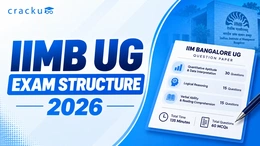
The following table illustrates some insights about the IIMB UG exam pattern 2026:
Section | Number of Questions | Total Marks | Sectional Time |
Quantitative Ability & DI | 30 | 90 | 60 Mins |
Logical Reasoning | 15 | 45 | 30 Mins |
Verbal Ability & RC | 15 | 45 | 30 Mins |
Total | 60 | 180 | 120 Mins |
A section-wise IIMB UG prep strategy is far better than treating the syllabus as a whole undifferentiated block. Each of the three sections requires and rewards different kinds of practice.
English Comprehension:
- Read editorials and opinion pieces every day to develop reading speed and comprehension stamina.
- Practice RC passages of varied lengths, including abstract and fact-based ones, as IIMB passages tend to test inferences rather than recall.
- Revise grammar rules (parts of speech, tenses, subject-verb agreement) with small daily exercises rather than prolonged grammar study sessions.
- Develop your vocabulary by reading contextual matter and referring to word lists; focus on their usage rather than memorization.
- Practice para-jumbles and sentence-correction questions to develop the ability to identify logical coherence.
Quantitative Aptitude & Data Interpretation (QA & DI):
- Focus on building a strong foundation in arithmetic (percentages, ratios, averages, profit and loss) first, as they often form the basis of advanced questions.
- Brush up on algebra, number systems, and geometry from Classes 9-12 NCERT textbooks.
- Practice DI sets based on tables, bar and line graphs under time constraints to build calculation speed.
- Maintain a notebook for formulas and shortcuts for rapid revision in the final weeks.
Accuracy is more important than answering every question, as negative marking penalizes guessing.
Logical Reasoning (LR):
- Solve puzzles, seating arrangements, and Venn diagrams on a daily basis to develop your ability to identify patterns.
- Solve syllogisms and blood-relation questions using structured, step-by-step deduction, avoiding intuition.
- Time each reasoning set during practice to prevent becoming stuck on one puzzle for too long.
- Analyze wrongly solved puzzles to understand where the logical flaw occurred, not just to learn the correct solution.
IIMB UG Preparation Strategy with Mock Tests
The only way to bridge the preparation-examination performance gap is by the constant use of Mock tests. It prepares you for the test environment and the test's time dynamics and will help build mental fortitude required for a 60-question sectional time limit test.
Preparation Phase | Mock Test Focus | Frequency |
Foundation Phase (first month) | Sectional tests, one section at a time | 2 - 3 per week |
Building Phase (middle months) | Mixed sectional tests combining two sections | 3 - 4 per week |
Full-Length Phase (final 6 - 8 weeks) | Complete full-length mocks under timed, exam-like conditions | 2 - 3 per week |
Final Week | Light full-length mocks plus revision of error logs | 1 - 2 mocks, rest revision |
Analysing Mock Test:
Review the test thoroughly, ideally taking a minimum of the same amount of time as the test. This study should focus on identifying sections that took more time, recurring topic failures and identifying whether they were silly errors or conceptual. It is this iterative process of trial and error that differentiates candidates who stagnate with time and those who constantly improve their scores.
IIMB UG Preparation Strategy 2026: Important Topics
Utilise your precious time wisely and tackle the high yielding topics first! The following table highlights theIIMB UG important topics in the paper that hold substantial weightage in the exam:
Section | High-Priority Topics |
VARC | Reading comprehension (fact-based and inferential), para jumbles, grammar correction, vocabulary in context, sentence completion |
Quant & DI | Percentages, ratio and proportion, profit and loss, time-speed-distance, averages, number systems, basic algebra, table and bar-graph DI sets |
Logical Reasoning | Seating arrangement, puzzles, syllogisms, blood relations, Venn diagrams, coding-decoding, direction sense |
Read More: IIMB UG 5 Month Preparation Plan 2026, Section-wise Strategy
IIMB UG Preparation Strategy Time Management Tips
At 60 questions in 120 minutes with sectional cap, time management during IIMB UG is not just about answering quickly, but about order of sections as much as it is about question-speed. On paper this seems to mean just 1.5 minutes per question; but of course it doesn’t work out quite that mechanical in real life - some questions warrant 20s, others 2 min - the challenge is to pick out which is which rapidly, not approach everything with the same degree of zeal.
- Go with your strongest section first: There’s nothing like starting with your strongest section to get into a flow, build momentum, and to nail those early, certain scores.
- Make some ‘soft’ time limits for each section: While there’s no official sectional limit, there should ideally be a soft time allocation for each section (say, around 20-25 mins each) that ensures one section does not run away with the entire test time.
- Leave it and come back: If a particular question or a puzzle seems to be eating up time beyond the optimal, make a note and leave it; it often gets solved much quicker when approached with a fresh mind.
- Practice in timed sets not untimed sets: Only practice without time constraint may lead to higher accuracy; however to perform at actual exam speed,Timed sectional and sectional practice is crucial.
- Save the last 5-10 mins for a quick review: Spend the last few minutes rechecking the problems you marked. It helps to catch silly errors as well as missed questions. Do not attempt new problems if it’s just a few minutes left!
IIMB UG Preparation Strategy Mistakes to Avoid
Some smart candidates lose scores to these common silly mistakes. Be mindful of these IIMB UG Preparation Strategy 2026 mistakes:
- Wasting excessive time on one tough puzzle or DI set: not being able to move forward and return later.
- Practicing tests are only un-timed which give a false feeling of confidence but the same pace is not maintained in the examination.
- Not analysing mocks: Directly moving to next mocks.
- Not studying the basics of grammar and vocabulary in VARC but only concentrating on RC.
- Attempting all questions in Quant & DI: In a bid to attempt all, you end up taking a blind guess and lose marks.
- Starting IIMB UG Preparation late i.e., just before the registration closes. If you have to take up the IIMB UG 2026, you do not have time for a proper mock tests cycle.
IIMB UG Preparation Strategy 2026: Conclusion
Preparing for IIMB UG 2026 requires a balanced approach combining conceptual clarity, regular practice, and strategic time management. Since the exam tests Quantitative Ability, Data Interpretation, Logical Reasoning, and Verbal Ability, students should follow a structured preparation plan instead of relying on last-minute revision. Building strong fundamentals, practising important topics, and analysing mock tests regularly can significantly improve performance.
A well-planned IIMB UG Preparation Strategy 2026 helps aspirants understand their strengths, identify weaknesses, and develop the confidence required for the entrance exam. Starting early, maintaining consistency, and focusing on accuracy over random attempts can help students maximise their chances of securing admission to IIM Bangalore’s undergraduate programmes.