91- 6303239042
 IPMAT WhatsApp Group




 Preferred Source

 Google Discover
IIMB UG BSc Economics 2027
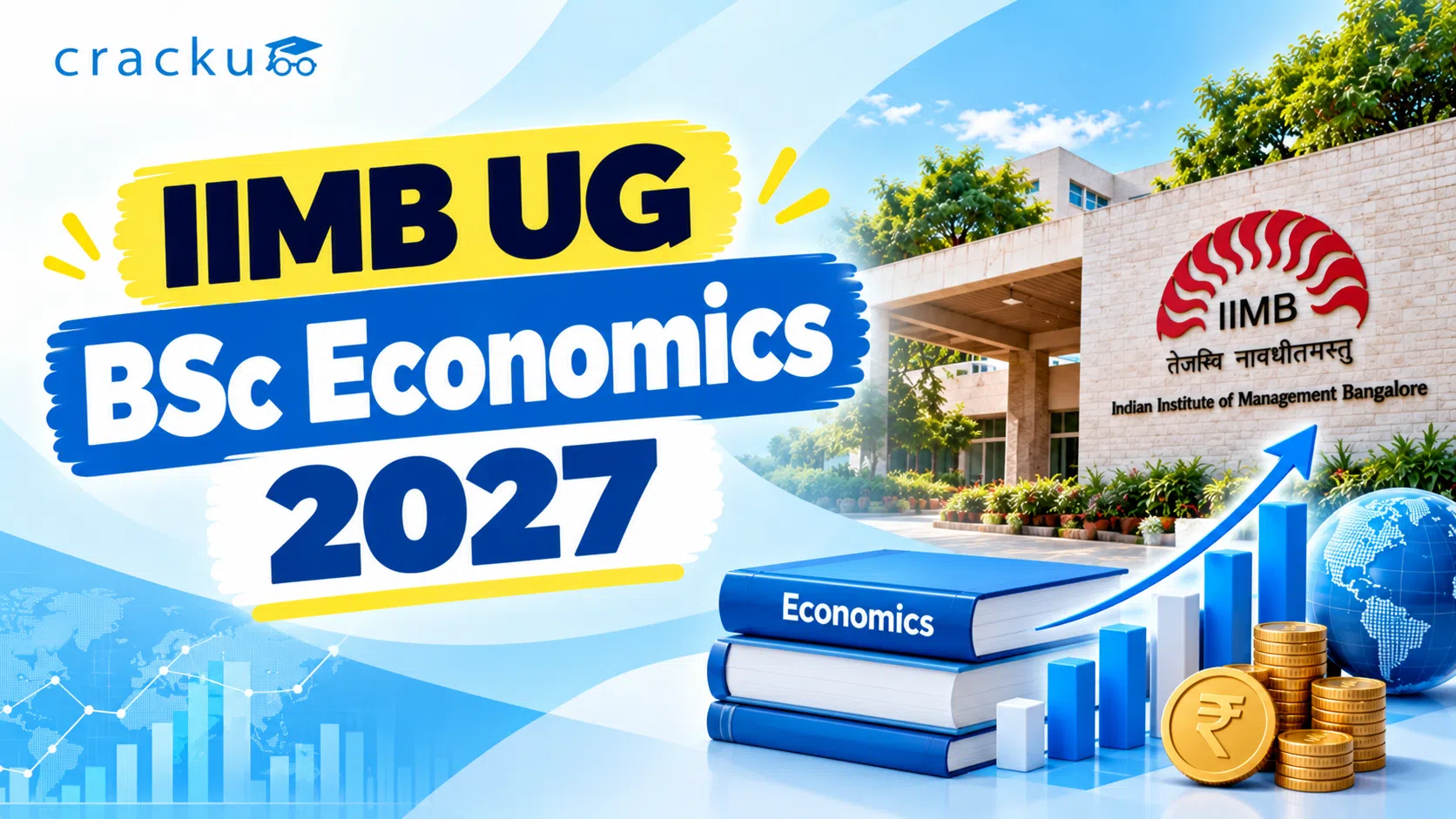
The B. Sc. (Hons) Economics programme is provided by the School of Multidisciplinary Studies, IIM Bangalore. The programme is on-campus, 4-year, and full-time and has been created according to the guidelines of the NEP. IIMB introduced its UG programmes with the academic year 2026-27; hence, the candidates applying for 2027 are aiming for the second batch (2027-31). This article gives information about IIMB UG BSc Economics 2027 program, which includes the admission process, eligibility, fees, syllabus, course structure and placements.
IIM Bangalore BSc Economics Admission Process 2027
Admission to the IIM Bangalore B.Sc Economics program is highly competitive and a multi-stage process that aims to assess the candidate's logical thinking ability, critical understanding and maturity of the candidate. IIM Bangalore BSc Economics Admission Process 2027 is a unique entrance process as IIMB conducts its own entrance examination, and thus IIMB does NOT have any intake through IPMAT (Indore/ Rohtak) or CUET.
Stage 1: The Online Application Period
The aspirants can register on the IIMB undergraduate admission portal, ug.iimb.ac.in. It is available from August 17, 2026 and ends on October 17, 2026. Applicants have to provide validated Class 10 scores, final Class 12 grade scores, category proof, and statements.
Application Fee:
- General/EWS/NC-OBC- Rs. 3,000/-
- SC/ST/PwD- Rs. 1,500/-
Stage 2: The IIMB Undergraduate Admission Test (UG-AT)
The Entrance test is the first and most significant filter. The exam was a computer-based test that was held at certain examination centres in the biggest cities in India. The questions are less about memorizing information than about problem-solving at a higher level. The following table gives IIMB UGAT Exam Pattern:
Section | Number of Questions | Time Duration |
Quantitative Ability & Data Interpretation (QADI) | 30 | 60 Mins |
Logical Reasoning (LR) | 15 | 45 Mins |
Verbal Ability & Reading Comprehension (VARC) | 15 | 30 Mins |
Total | 60 Questions | 135 Minutes |
Stage 3: Shortlist & Diversity Balancing
Only those candidates who clear IIMB UG minimum sectional and aggregate cutoffs are further called for the interview stage. IIM Bangalore has gender diversity points (generally 5 points) added to the first shortlisting index so that both genders are evenly represented in the interview stage.
Component | Weight - Shortlist (Pre-PI) |
UG Admissions Test (QADI + LR + VARC) | 70 (QADI 30 + LR 20 + VARC 20) |
Class 10 overall score (standardised) | 15 |
Class 10 Mathematics score (standardised) | 10 |
Gender Diversity | 5 |
Stage 4: Personal Interview (PI)
Candidates short-listed after the written exam are called for a comprehensive personal interview before a panel of IIMB professors and domain leaders. The interview panel evaluates the candidates on:
- Mathematical & Economic Temperament: At ease with abstractions, functions, probability puzzles, and contemporary fiscal/monetary developments.
- Communication & Articulation: Competent to communicate complex thinking concisely and with quality, clarity, and conciseness, with no 'filler' or jargon.
- Curiosity & Intellectual Depth: Recognizing the importance of economics in society and possessing authentic enthusiasm for research and data.
Stage 5: Final Composite Score Generation
The final merit list offers admission under admissions based on a clear and visible composite weightage formula in the following manner.
Component | Final Weightage |
UG Admissions Test (QADI + LR + VARC) | 40 |
Personal Interview | 40 |
Class 10 overall score (standardised) | 10 |
Class 10 Mathematics score (standardised) | 10 |
Read More: IIMB UG Exam Pattern 2026, Marking Scheme, Latest Changes
IIMB UG BSc Economics Eligibility Criteria 2027
The criteria for the 2027 round are based on age, passing board exams, and a mandatory Mathematics qualification.
Criterion | Requirement |
Age | 20 years or younger as of 1 August 2027 |
Qualification | Class 12 or equivalent from a recognised board (passed) |
Mathematics | Mandatory as a subject in Class 10 and Class 12 |
Class 10 marks | Minimum 60% marks in Mathematics |
Entrance test | Must appear for the IIMB UG-AT |
IIM Bangalore BSc Economics Fees and Hostel Charges
The following table gives IIMB B.Sc. (Hons.) in Economics (4-Year Full-Time Residential) year-wise fees:
Academic Stage | Base Tuition & Academic Fee | Hostel & Campus Facility Fee | Total Annual Cost (Approx.) |
Year 1 | ₹7,00,000 | ₹1,50,000 | ₹8,50,000 |
Year 2 | ₹7,00,000 | ₹1,50,000 | ₹8,50,000 |
Year 3 | ₹7,25,000* | ₹1,55,000* | ₹8,80,000* |
Year 4 | ₹7,50,000* | ₹1,60,000* | ₹9,10,000* |
4-Year Cumulative | ₹28,75,000 | ₹6,15,000 | ₹34,90,000 |
*Note: These are approximate standard annually adjusted board-approved fee increases for Years 3 and 4, in line with inflation trends, with ongoing service improvements, expected at between 3-5% annually.
IIMB UG BSc Economics Syllabus and Course Structure
The IIMB UG BSc Economics Syllabus and Course Structure is distinguished from all the legacy university courses around the country. In traditional arts colleges, models of economics are understood as theoretical ideologies; at IIMB, economics is rooted in code, modeling and data sets.
Under the 4-year National Education Policy (NEP) framework, students have the choice to study for a 4-year degree leading to a B. Sc. (Honours) in Economics with a Minor in Data Sciences or exit after Year 3 with a normal Bachelor of Science in Economics.
IIMB UG B.Sc Economics Program Semester Wise Curriculum Breakdown
The curriculum balances core economics, mathematical and data tools, and interdisciplinary management electives.
Year 1: Mathematical Foundations & Computational Literacy
- Semester I:
- Calculus and its Applications
- Probability and Statistics
- Algorithmic Thinking & Programming I (Python/R)
- Principles of Microeconomics
- Academic Writing and Professional Discourse
- Semester II:
- Linear Algebra and Matrix Operations
- Principles of Macroeconomics
- Algorithmic Thinking & Programming II (Data Handling & Structures)
- Foundations of Management and Indian Business Landscape
- Ethics, Technology, and Society
Year 2: Intermediate Theory & Applied Quantitative Analytics
- Semester III:
- Intermediate Microeconomic Theory
- Introductory Econometrics (Ordinary Least Squares & Regression Diagnostics)
- Stochastic Processes and Random Variables
- Financial Accounting and Corporate Valuation
- Data Mining and Decision Trees
- Semester IV:
- Intermediate Macroeconomics (Open Economy & Monetary Systems)
- Applied Econometrics II (Panel Data, Instrumental Variables)
- Machine Learning for Social Sciences
- Money, Banking, and Financial Markets
- Human Behaviour and Cognitive Psychology
Year 3: Advanced Specializations & Empirical Research
- Semester V:
- Game Theory and Mechanism Design
- International Trade and Global Macroeconomic Policy
- Behavioral Economics and Decision Architecture
- Operations Management and Quantitative Logistics
- Elective I (e.g., Public Finance, Environmental Economics, Health Economics)
- Semester VI:
- Development Economics and Growth Dynamics
- Financial Economics and Portfolio Analytics
- Managerial Decision Making under Uncertainty
- Deep Learning and AI Applications (Data Science Minor Track)
- Mandatory Summer Corporate/Research Internship (8–10 Weeks)
Year 4 (Honours Year): Research Thesis, Policy Labs & Masterclasses
- Semester VII:
- Advanced Time Series Econometrics & Forecasting
- Policy Evaluation and Randomized Controlled Trials (RCTs)
- Big Data Engineering and Cloud Systems
- Honours Dissertation Seminar (Topic Formulation & Literature Review)
- Semester VIII:
- Senior Honours Thesis (Independent empirical research supervised by an IIMB faculty member)
- Capstone Practicum: Applied Policy and Business Laboratory
- Advanced Electives in Macroeconomic Forecasting or Quantitative Asset Pricing
Read More: IIMB UG Fee Structure 2026, Total Fees, Scholarships
IIM Bangalore BSc Economics Placements and Career Opportunities
The B. Sc. (Hons.) in Economics is a brand-new programme, and IIMB is quite clear that it has not designed this to be a 'placement' degree - the marketed goal is intellectual rigour and preparing students for leadership roles, with career mentoring and internships rather than a campus-placement cell as the main selling point. As the first batch joined only in 2026, currently there are no passing-out statistics - average package, highest package, etc. - for this programme.
Major Recruiters & Placement Sectors:
1. Strategic Management Consulting
Our economics degree is highly regarded by global consultancy companies who want our students to develop structural market hypotheses and test them using their world-leading big data.
Major Recruiters: McKinsey & Company, The Boston Consulting Group (BCG), Bain & Company, Kearney, Strategy&.
Target Jobs: Business Analyst, Strategy Associate, Economic Insights Analyst.
2. Quantitative Finance & Investment Banking
Key Recruiters J.P. Morgan, Goldman Sachs, Morgan Stanley, Citadel, DE Shaw, Barclays.
Potential Positions: Quantitative Research Analyst, Equity Research Associate, Risk Modeling Analyst.
3. Technology & Product Data Science
High-tech companies create products based on network effects, auction design, behavioural economics, and algorithmic pricing- topics that are included in the curriculum.
Leading Employers: Amazon, Google, Uber, Swiggy, Flipkart, Microsoft.
Target Jobs: Product Analyst, Econometrician, Operations Research Analyst, Data Scientist.
4. Economic Advisory & Policy Research
Students concerned with macroeconomic policy, international development, and developmental finance have clear roads to policy institutions.
Major Recruiters: NITI Aayog Reserve Bank of India (RBI) World Bank International Monetary Fund (IMF) Brookings India
Target Positions: Policy Research Associate, Economic Adviser, Development Research Fellow.
International Postgraduate Pathways
For those who are more academically inclined, the four-year honours degree is considered equivalent to the requirements for a seamless stream into the world's leading institutions:
- MSc / PhD in Economics: LSE, Oxford, Harvard, MIT, Stanford.
- Master of Finance / Financial Engineering: Princeton University, Columbia University, Carnegie Mellon University.
- MBA Career Pathways: The ultimate management education, globally recognized.
IIMB UG BSc Economics 2027: Conclusion
IIMB UG BSc Economics 2027 offers students an opportunity to study economics at IIM Bangalore through a four-year undergraduate honours programme. The course combines economic theory, mathematics, statistics, data science and research-based learning. Students planning to apply should understand the IIM Bangalore BSc Economics admission process, eligibility criteria, entrance exam pattern and selection stages before starting their preparation.
The IIMB UG BSc Economics programme can be a suitable choice for students interested in economics, finance, analytics and higher education. Candidates should also review the IIM Bangalore BSc Economics fees, syllabus, hostel facilities and potential career opportunities before applying. Since the programme is relatively new, applicants should rely on official IIM Bangalore updates for confirmed admission dates, fee details and placement information.