
Join Our JEE Preparation Group
Prep with like-minded aspirants; Get access to free daily tests and study material.
Sign in
Please select an account to continue using cracku.in
↓ →
Join Our JEE Preparation Group
Prep with like-minded aspirants; Get access to free daily tests and study material.
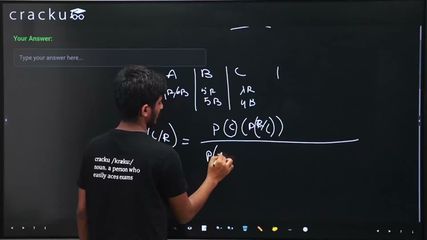
The urns $$A$$, $$B$$ and $$C$$ contains 4 red, 6 black; 5 red, 5 black and $$\lambda$$ red, 4 black balls respectively. One of the urns is selected at random and a ball is drawn. If the ball drawn is red and the probability that it is drawn from urn $$C$$ is 0.4, then the square of length of the side of largest equilateral triangle, inscribed in the parabola $$y^2 = \lambda x$$ with one vertex at vertex of parabola is
Correct Answer: 432
Let $$R$$ be the event of drawing a red ball. The urns $$A, B,$$ and $$C$$ contain:
Urn A: 4 red, 6 black (Total = 10)
Urn B: 5 red, 5 black (Total = 10)
Urn C: $$\lambda$$ red, 4 black (Total = $$\lambda + 4$$)
Since one urn is selected at random, the probability of selecting any urn is $$P(A) = P(B) = P(C) = \frac{1}{3}$$.
The conditional probabilities of drawing a red ball from each urn are:
$$P(R|A) = \frac{4}{10} = 0.4$$
$$P(R|B) = \frac{5}{10} = 0.5$$
$$P(R|C) = \frac{\lambda}{\lambda + 4}$$
Given that the probability of drawing from urn $$C$$ given the ball is red is $$P(C|R) = 0.4$$, we use Bayes' Theorem:
$$P(C|R) = \frac{P(C)P(R|C)}{P(A)P(R|A) + P(B)P(R|B) + P(C)P(R|C)}$$
$$0.4 = \frac{\frac{1}{3} \cdot \frac{\lambda}{\lambda+4}}{\frac{1}{3}(0.4 + 0.5 + \frac{\lambda}{\lambda+4})}$$
$$0.4(0.9 + \frac{\lambda}{\lambda+4}) = \frac{\lambda}{\lambda+4}$$
$$0.36 + \frac{0.4\lambda}{\lambda+4} = \frac{\lambda}{\lambda+4} \implies 0.36 = \frac{0.6\lambda}{\lambda+4}$$
$$0.36\lambda + 1.44 = 0.6\lambda \implies 0.24\lambda = 1.44 \implies \lambda = 6$$
The parabola is $$y^2 = 6x$$. Let an equilateral triangle with one vertex at $$(0,0)$$ have side length $$a$$. The other vertices are $$(x, y)$$ and $$(x, -y)$$. Since the triangle is equilateral, the height is $$\frac{\sqrt{3}}{2}a$$ and the base is $$a$$ (from $$y$$ to $$-y$$, so $$2y = a \implies y = \frac{a}{2}$$).
The vertex $$(x, y)$$ lies on the parabola: $$y^2 = 6x \implies \left(\frac{a}{2}\right)^2 = 6x \implies x = \frac{a^2}{24}$$
The height of the triangle is the $$x$$-coordinate, so $$\frac{\sqrt{3}}{2}a = x$$:
$$\frac{\sqrt{3}}{2}a = \frac{a^2}{24} \implies a = 12\sqrt{3}$$
$$a^2 = (12\sqrt{3})^2 = 144 \times 3 = 432$$
Click on the Email ☝️ to Watch the Video Solution
Create a FREE account and get:
_1.webp)

Educational materials for JEE preparation

Ask our AI anything

AI can make mistakes. Please verify important information.
AI can make mistakes. Please verify important information.


