
Join Our JEE Preparation Group
Prep with like-minded aspirants; Get access to free daily tests and study material.
Sign in
Please select an account to continue using cracku.in
↓ →
Join Our JEE Preparation Group
Prep with like-minded aspirants; Get access to free daily tests and study material.
A uniform electric field $$E = \frac{8m}{e}$$ V m$$^{-1}$$ is created between two parallel plates of length 1 m as shown in figure, (where $$m$$ = mass of electron and $$e$$ = charge of electron). An electron enters the field symmetrically between the plates with a speed of 2 m s$$^{-1}$$. The angle of the deviation $$\theta$$ of the path of the electron as it comes out of the field will be
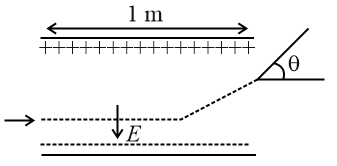
We need to find the angle of deviation $$\theta$$ of the path of the electron as it emerges from the electric field between two parallel plates.
The uniform electric field is given as $$E = \frac{8m}{e}\text{ V m}^{-1}$$, where $$m$$ is the mass of the electron and $$e$$ is the magnitude of its charge.
The force experienced by the electron due to the electric field is directed perpendicular to its initial motion and is given by: $$F = eE = e \left(\frac{8m}{e}\right) = 8m$$.
According to Newton's second law, the acceleration of the electron in the vertical direction ($$y$$-axis) is: $$a_y = \frac{F}{m} = \frac{8m}{m} = 8\text{ m s}^{-2}$$.
The electron enters symmetrically with an initial horizontal speed $$v_x = 2\text{ m s}^{-1}$$. Since there is no force acting in the horizontal direction, this horizontal velocity remains constant throughout the motion: $$v_x = 2\text{ m s}^{-1}$$.
The length of the plates is $$L = 1\text{ m}$$. The time $$t$$ taken by the electron to travel through the plates is determined by its horizontal motion: $$t = \frac{L}{v_x} = \frac{1}{2} = 0.5\text{ s}$.
The vertical velocity $$v_y$$ acquired by the electron as it comes out of the field can be calculated using the first equation of motion: $$v_y = a_y t = 8 \times 0.5 = 4\text{ m s}^{-1}$$.
The angle of deviation $$\theta$$ is the angle that the final velocity vector makes with the horizontal axis, which is given by the relation: $$\tan\theta = \frac{v_y}{v_x}$$.
Substituting the values of $$v_y$$ and $$v_x$$ gives: $$\tan\theta = \frac{4}{2} = 2$$.
Taking the inverse tangent on both sides yields the final angle of deviation: $$\theta = \tan^{-1}(2)$$.
Therefore, the correct answer is Option B: tan-1(2).
Was this solution helpful?
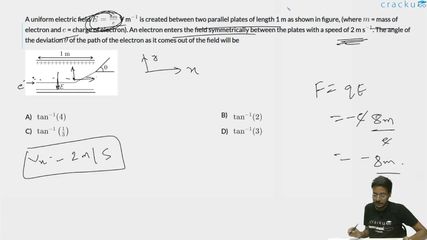
Click on the Email ☝️ to Watch the Video Solution
Create a FREE account and get:
_1.webp)

Educational materials for JEE preparation

Ask our AI anything

AI can make mistakes. Please verify important information.
AI can make mistakes. Please verify important information.
