
Join Our JEE Preparation Group
Prep with like-minded aspirants; Get access to free daily tests and study material.
Sign in
Please select an account to continue using cracku.in
↓ →
Join Our JEE Preparation Group
Prep with like-minded aspirants; Get access to free daily tests and study material.
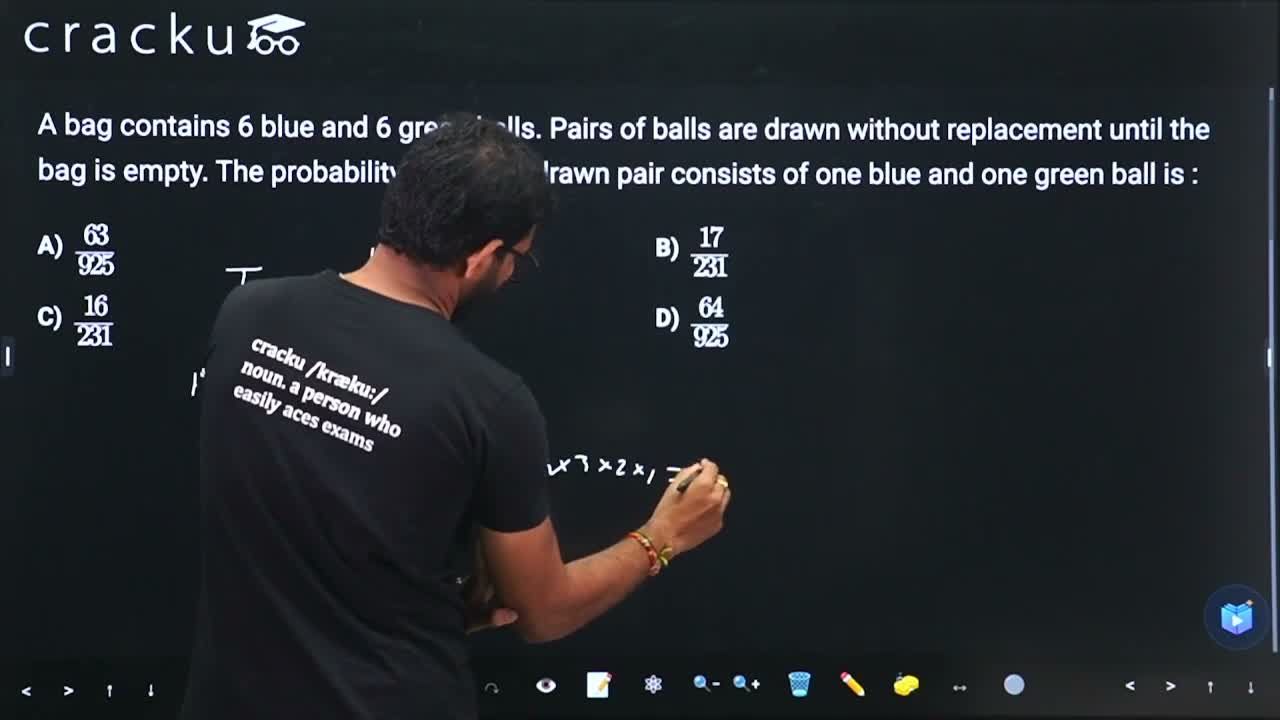
A bag contains 6 blue and 6 green balls. Pairs of balls are drawn without replacement until the bag is empty. The probability that each drawn pair consists of one blue and one green ball is :
The number of ways to divide 12 objects into 6 unordered pairs is given by the formula for partitions into equal-sized groups:
$$n(S) = \frac{12!}{(2!)^6 \times 6!}$$
For each of the 6 pairs to have exactly one blue ball and one green ball, we must pair each of the 6 unique blue balls with one of the 6 unique green balls.
The first blue ball has 6 choices of green balls to pair with.
The second blue ball has 5 choices of remaining green balls.
The third blue ball has 4 choices, and so on.
$$n(E) = 6! = 6 \times 5 \times 4 \times 3 \times 2 \times 1 = 720$$
$$\text{Probability} = \frac{n(E)}{n(S)} = \frac{6!}{\frac{12!}{2^6 \times 6!}} = \frac{(6! \times 6!) \times 2^6}{12!}$$
$$\text{Probability} = \frac{16}{231}$$
Was this solution helpful?
Click on the Email ☝️ to Watch the Video Solution
Create a FREE account and get:
_1.webp)

Educational materials for JEE preparation

Ask our AI anything

AI can make mistakes. Please verify important information.
AI can make mistakes. Please verify important information.
