
Join Our JEE Preparation Group
Prep with like-minded aspirants; Get access to free daily tests and study material.
Sign in
Please select an account to continue using cracku.in
↓ →
Join Our JEE Preparation Group
Prep with like-minded aspirants; Get access to free daily tests and study material.
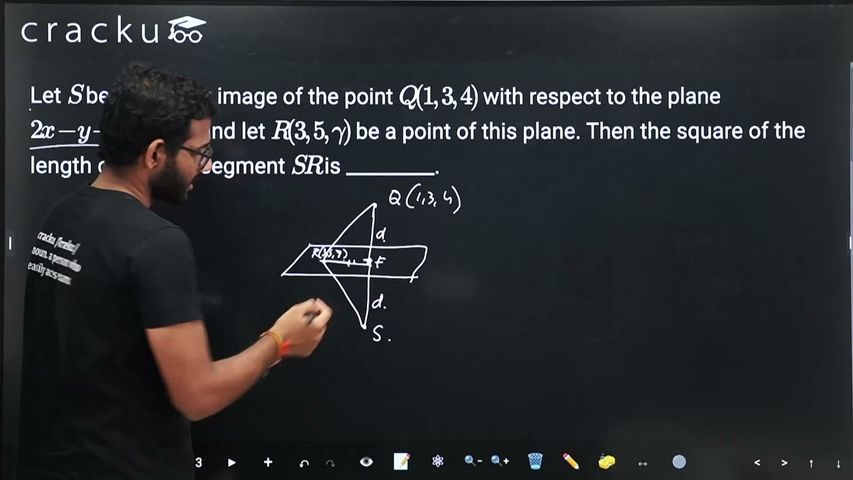
Let $$S$$ be the mirror image of the point $$Q(1, 3, 4)$$ with respect to the plane $$2x - y + z + 3 = 0$$ and let $$R(3, 5, \gamma)$$ be a point of this plane. Then the square of the length of the line segment $$SR$$ is _________.
Correct Answer: 72
We have the plane $$2x - y + z + 3 = 0$$, which can be written in the standard form $$ax + by + cz + d = 0$$ with $$a = 2,\; b = -1,\; c = 1,\; d = 3$$. The given point whose image we need is $$Q(1,\,3,\,4)$$.
For the mirror image of a point with respect to a plane, we first recall the reflection formula. If $$P(x,\,y,\,z)$$ is any point and $$P'(x',\,y',\,z')$$ is its reflection in the plane $$ax + by + cz + d = 0$$, the coordinates of $$P'$$ are obtained from:
$$ \begin{aligned} x' &= x - \dfrac{2a(ax + by + cz + d)}{a^{2} + b^{2} + c^{2}},\\[4pt] y' &= y - \dfrac{2b(ax + by + cz + d)}{a^{2} + b^{2} + c^{2}},\\[4pt] z' &= z - \dfrac{2c(ax + by + cz + d)}{a^{2} + b^{2} + c^{2}}. \end{aligned} $$
We now compute the scalar $$ax + by + cz + d$$ for the point $$Q(1,\,3,\,4)$$:
$$ ax + by + cz + d = 2(1) + (-1)(3) + 1(4) + 3 = 2 - 3 + 4 + 3 = 6. $$
The denominator appearing in the formula is $$a^{2} + b^{2} + c^{2}$$:
$$ a^{2} + b^{2} + c^{2} = 2^{2} + (-1)^{2} + 1^{2} = 4 + 1 + 1 = 6. $$
Hence the factor $$\dfrac{2(ax + by + cz + d)}{a^{2} + b^{2} + c^{2}}$$ simplifies to
$$ \dfrac{2 \times 6}{6} = 2. $$
Substituting into the reflection formula gives the coordinates of the image point $$S(x',\,y',\,z')$$:
$$ \begin{aligned} x' &= 1 - 2 \times 2 = 1 - 4 = -3,\\ y' &= 3 - (-1) \times 2 = 3 + 2 = 5,\\ z' &= 4 - 1 \times 2 = 4 - 2 = 2. \end{aligned} $$
So, $$S(-3,\,5,\,2)$$ is the mirror image of $$Q$$ in the given plane.
Next, the point $$R(3,\,5,\,\gamma)$$ is also stated to lie on the same plane, so its coordinates must satisfy the plane equation. Substituting $$x = 3,\; y = 5,\; z = \gamma$$ gives
$$ 2(3) - 5 + \gamma + 3 = 0 \;\Longrightarrow\; 6 - 5 + \gamma + 3 = 0 \;\Longrightarrow\; 4 + \gamma = 0. $$
Thus $$\gamma = -4$$, and the exact coordinates of $$R$$ are $$R(3,\,5,\,-4)$$.
We can now compute the vector $$\overrightarrow{SR}$$ from $$S$$ to $$R$$:
$$ \overrightarrow{SR} = (\,3 - (-3),\; 5 - 5,\; -4 - 2\,) = (\,6,\; 0,\; -6\,). $$
The square of the length of this vector, i.e., the required $$SR^{2}$$, is obtained by the distance-squared formula $$\|\overrightarrow{SR}\|^{2} = (\Delta x)^{2} + (\Delta y)^{2} + (\Delta z)^{2}$$:
$$ SR^{2} = 6^{2} + 0^{2} + (-6)^{2} = 36 + 0 + 36 = 72. $$
Hence, the correct answer is Option C.
Click on the Email ☝️ to Watch the Video Solution
Create a FREE account and get:
_1.webp)

Educational materials for JEE preparation

Ask our AI anything

AI can make mistakes. Please verify important information.
AI can make mistakes. Please verify important information.


