
Join Our JEE Preparation Group
Prep with like-minded aspirants; Get access to free daily tests and study material.
Sign in
Please select an account to continue using cracku.in
↓ →
Join Our JEE Preparation Group
Prep with like-minded aspirants; Get access to free daily tests and study material.
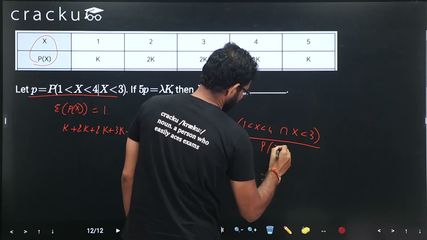
The probability distribution of random variable $$X$$ is given by

Let $$p = P(1 < X < 4 | X < 3)$$. If $$5p = \lambda K$$, then $$\lambda$$ is equal to _________.
Correct Answer: 30
We have a discrete random variable $$X$$ that can take the five values $$1, 2, 3, 4, 5$$ with probabilities $$K, 2K, 2K, 3K, K$$ respectively.
Because these five probabilities must add up to $$1$$, we first write the normalisation condition:
$$K + 2K + 2K + 3K + K = 1.$$
Combining like terms on the left-hand side gives
$$9K = 1.$$
Dividing both sides by $$9$$, we obtain
$$K = \frac{1}{9}.$$
Now we define two events that appear in the required conditional probability.
Event $$A : (1 < X < 4).$$ In words, $$X$$ must be strictly greater than $$1$$ and strictly less than $$4$$, so the possible values are $$X = 2$$ or $$X = 3$$.
Event $$B : (X < 3).$$ This means $$X$$ can be $$1$$ or $$2$$.
The conditional probability we want is
$$p = P\!\bigl(1 < X < 4 \,\bigl|\, X < 3\bigr) = P(A\,|\,B).$$
The definition of conditional probability says
$$P(A\,|\,B) = \frac{P(A \cap B)}{P(B)}.$$
So, we need both $$P(A \cap B)$$ and $$P(B).$$
The intersection $$A \cap B$$ consists of those $$X$$ that satisfy both conditions simultaneously. Event $$A$$ allows $$X = 2, 3,$$ while event $$B$$ allows $$X = 1, 2.$$ The only common value is $$X = 2.$$ Therefore
$$P(A \cap B) = P(X = 2) = 2K.$$
Next, for the denominator, we compute the probability of $$B$$:
$$P(B) = P(X = 1) + P(X = 2) = K + 2K = 3K.$$
Substituting these two results into the conditional-probability formula, we have
$$p = \frac{P(A \cap B)}{P(B)} = \frac{2K}{3K}.$$
The factor $$K$$ cancels, giving
$$p = \frac{2}{3}.$$
Now the problem states that $$5p = \lambda K$$. Substituting $$p = \dfrac{2}{3}$$ on the left and $$K = \dfrac{1}{9}$$ on the right, we get
$$5 \times \frac{2}{3} = \lambda \times \frac{1}{9}.$$
This simplifies to
$$\frac{10}{3} = \frac{\lambda}{9}.$$
Multiplying both sides by $$9$$ to isolate $$\lambda$$, we obtain
$$\lambda = 9 \times \frac{10}{3} = 3 \times 10 = 30.$$
So, the answer is $$30$$.
Was this solution helpful?
Click on the Email ☝️ to Watch the Video Solution
Create a FREE account and get:
_1.webp)

Educational materials for JEE preparation

Ask our AI anything

AI can make mistakes. Please verify important information.
AI can make mistakes. Please verify important information.
