
Join Our JEE Preparation Group
Prep with like-minded aspirants; Get access to free daily tests and study material.
Sign in
Please select an account to continue using cracku.in
↓ →
Join Our JEE Preparation Group
Prep with like-minded aspirants; Get access to free daily tests and study material.
Let a tangent to the curve $$9x^2 + 16y^2 = 144$$ intersect the coordinate axes at the points $$A$$ and $$B$$. Then, the minimum length of the line segment $$AB$$ is ______
Correct Answer: 7
The equation of the curve is:
$$9x^2 + 16y^2 = 144$$
Dividing both sides by $$144$$:
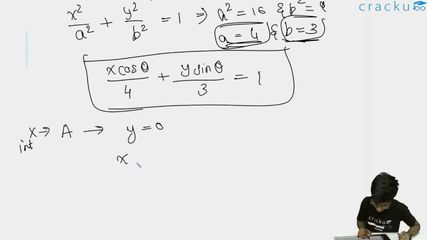
$$\frac{x^2}{16} + \frac{y^2}{9} = 1$$
This is a standard ellipse $$\frac{x^2}{a^2} + \frac{y^2}{b^2} = 1$$, where:
Any parametric point on this ellipse can be represented as $$(a \cos\theta, b \sin\theta) = (4 \cos\theta, 3 \sin\theta)$$.
The equation of the tangent to the ellipse at this parametric point is given by:
$$\frac{x \cos\theta}{a} + \frac{y \sin\theta}{b} = 1$$
Substituting $$a = 4$$ and $$b = 3$$:
$$\frac{x \cos\theta}{4} + \frac{y \sin\theta}{3} = 1$$
The tangent line intersects the coordinate axes at points $$A$$ (on the x-axis) and $$B$$ (on the y-axis).
Using the distance formula, the length $$L$$ of the segment $$AB$$ is:
$$L = \sqrt{\left(\frac{4}{\cos\theta} - 0\right)^2 + \left(0 - \frac{3}{\sin\theta}\right)^2}$$ $$L = \sqrt{\frac{16}{\cos^2\theta} + \frac{9}{\sin^2\theta}}$$
To minimize $$L$$, we can minimize $$L^2$$:
$$f(\theta) = L^2 = 16\sec^2\theta + 9\csc^2\theta$$
Using the standard identity $$\sec^2\theta = 1 + \tan^2\theta$$ and $$\csc^2\theta = 1 + \cot^2\theta$$:
$$f(\theta) = 16(1 + \tan^2\theta) + 9(1 + \cot^2\theta)$$ $$f(\theta) = 25 + 16\tan^2\theta + 9\cot^2\theta$$
Using the AM-GM Inequality ($$A \geq G$$) on the variable terms $$16\tan^2\theta$$ and $$9\cot^2\theta$$:
$$\frac{16\tan^2\theta + 9\cot^2\theta}{2} \geq \sqrt{16\tan^2\theta \cdot 9\cot^2\theta}$$ $$16\tan^2\theta + 9\cot^2\theta \geq 2 \cdot \sqrt{144 \cdot (\tan^2\theta \cdot \cot^2\theta)}$$
Since $$\tan^2\theta \cdot \cot^2\theta = 1$$:
$$16\tan^2\theta + 9\cot^2\theta \geq 2 \cdot 12 = 24$$
Substituting this back into our expression for $$f(\theta)$$:
$$f(\theta)_{\text{min}} = 25 + 24 = 49$$
Since $$L^2 \geq 49$$, the minimum length $$L$$ is:
$$L_{\text{min}} = \sqrt{49} = 7$$
Answer:
7
Was this solution helpful?
Click on the Email ☝️ to Watch the Video Solution
Create a FREE account and get:
_1.webp)

Educational materials for JEE preparation

Ask our AI anything

AI can make mistakes. Please verify important information.
AI can make mistakes. Please verify important information.
