
Join Our JEE Preparation Group
Prep with like-minded aspirants; Get access to free daily tests and study material.
Sign in
Please select an account to continue using cracku.in
↓ →
Join Our JEE Preparation Group
Prep with like-minded aspirants; Get access to free daily tests and study material.
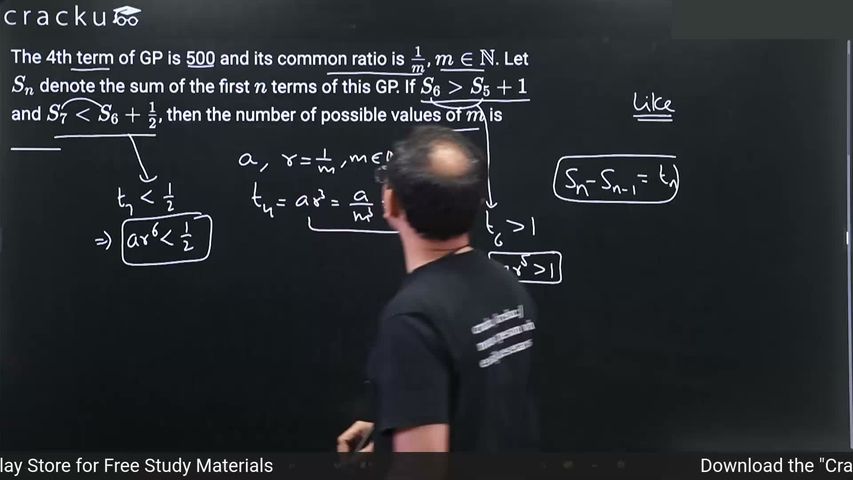
The 4th term of GP is 500 and its common ratio is $$\frac{1}{m}$$, $$m \in \mathbb{N}$$. Let $$S_n$$ denote the sum of the first $$n$$ terms of this GP. If $$S_6 > S_5 + 1$$ and $$S_7 < S_6 + \frac{1}{2}$$, then the number of possible values of $$m$$ is ______
Correct Answer: 12
Here is the complete solution fully formatted in LaTeX:
Let the first term of the Geometric Progression (GP) be $$a$$ and the common ratio be $$r = \frac{1}{m}$$, where $$m \in \mathbb{N}$$.
The $$n$$-th term of a GP is given by the formula:
$$T_n = a r^{n-1}$$
We are given that the 4th term ($$T_4$$) is $$500$$:
$$T_4 = a r^3 = 500 \implies a \left(\frac{1}{m}\right)^3 = 500 \implies a = 500m^3$$
We know that the relation between the sum of first $$n$$ terms and the $$n$$-th term is:
$$S_n - S_{n-1} = T_n$$
Therefore, the first inequality $$S_6 > S_5 + 1$$ can be rewritten as:
$$S_6 - S_5 > 1 \implies T_6 > 1$$
Substituting the expressions for $$T_6$$, $a$, and $$r$$:
$$a r^5 > 1$$ $$(500m^3) \cdot \left(\frac{1}{m}\right)^5 > 1$$ $$\frac{500}{m^2} > 1 \implies m^2 < 500$$
Since $$m \in \mathbb{N}$$ and $$\sqrt{500} \approx 22.36$$, we establish the upper bound:
$$m \leq 22$$
Similarly, the second inequality $$S_7 < S_6 + \frac{1}{2}$$ can be rewritten as:
$$S_7 - S_6 < \frac{1}{2} \implies T_7 < \frac{1}{2}$$
Substituting the expressions for $$T_7$$, $$a$$, and $$r$$:
$$a r^6 < \frac{1}{2}$$ $$(500m^3) \cdot \left(\frac{1}{m}\right)^6 < \frac{1}{2}$$ $$\frac{500}{m^3} < \frac{1}{2} \implies m^3 > 1000$$
Since $$10^3 = 1000$$, for $$m^3 > 1000$$ where $$m \in \mathbb{N}$$, we find the lower bound:
$$m \geq 11$$
Combining both inequalities for $$m \in \mathbb{N}$$:
$$11 \leq m \leq 22$$
The possible values for $m$ are:
$$m \in \{11, 12, 13, 14, 15, 16, 17, 18, 19, 20, 21, 22\}$$
The total number of possible values of $$m$$ is:
$$22 - 11 + 1 = 12$$
Answer:
12
Was this solution helpful?
Click on the Email ☝️ to Watch the Video Solution
Create a FREE account and get:
_1.webp)

Educational materials for JEE preparation

Ask our AI anything

AI can make mistakes. Please verify important information.
AI can make mistakes. Please verify important information.
