
Join Our JEE Preparation Group
Prep with like-minded aspirants; Get access to free daily tests and study material.
Sign in
Please select an account to continue using cracku.in
↓ →
Join Our JEE Preparation Group
Prep with like-minded aspirants; Get access to free daily tests and study material.
Let $$x_1, x_2, x_3, \ldots, x_{20}$$ be in geometric progression with $$x_1 = 3$$ and the common ratio $$\frac{1}{2}$$. A new data is constructed replacing each $$x_i$$ by $$(x_i - i)^2$$. If $$\bar{x}$$ is the mean of new data, then the greatest integer less than or equal to $$\bar{x}$$ is
Correct Answer: 142
Given,
$$x_1=3,\qquad r=\frac12$$
Hence,
$$x_i=3\left(\frac12\right)^{i-1}$$
The new data is
$$y_i=(x_i-i)^2$$
Mean of new data is
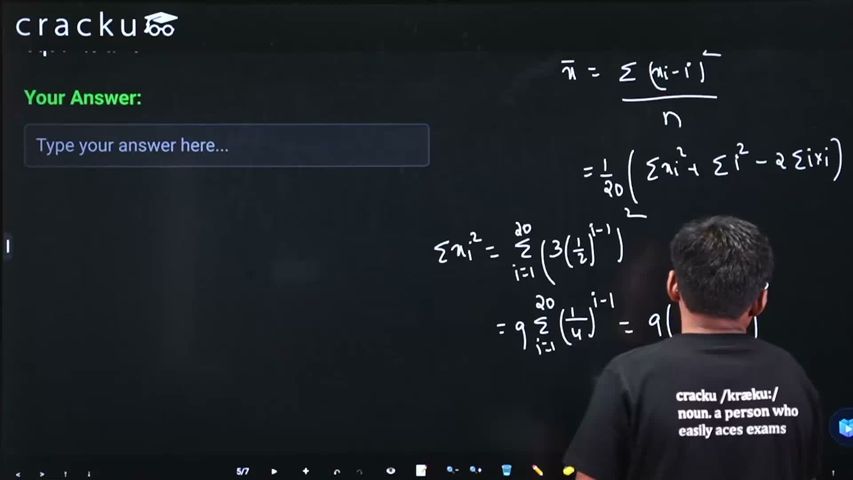
$$\bar x=\frac1{20}\sum_{i=1}^{20}(x_i-i)^2$$
Expanding,
$$\bar x=\frac1{20}\left(\sum x_i^2+\sum i^2-2\sum ix_i\right)$$
Now,
$$x_i=3\left(\frac12\right)^{i-1}$$
Therefore,
$$x_i^2=9\left(\frac14\right)^{i-1}$$
Hence,
$$\sum_{i=1}^{20}x_i^2=9\sum_{i=1}^{20}\left(\frac14\right)^{i-1}$$
Using GP sum,
$$=9\cdot\frac{1-\left(\frac14\right)^{20}}{1-\frac14}$$
$$=12\left(1-\frac1{4^{20}}\right)$$
Also,
$$\sum_{i=1}^{20}i^2=\frac{20\cdot21\cdot41}{6}=2870$$
Now compute
$$\sum ix_i=3\sum_{i=1}^{20}\frac{i}{2^{i-1}}$$
Using
$$\sum_{i=1}^{n}ir^{i-1}=\frac{1-(n+1)r^n+nr^{n+1}}{(1-r)^2}$$
with
$$r=\frac12,\qquad n=20,$$
$$\sum_{i=1}^{20}\frac{i}{2^{i-1}} =\frac{1-\frac{21}{2^{20}}+\frac{20}{2^{21}}}{\left(\frac12\right)^2}$$
$$=4\left(1-\frac{11}{2^{20}}\right)$$
Hence,
$$\sum ix_i=12\left(1-\frac{11}{2^{20}}\right)$$
Therefore,
$$\bar x=\frac1{20}\left[12\left(1-\frac1{4^{20}}\right)+2870-24\left(1-\frac{11}{2^{20}}\right)\right]$$
$$=\frac1{20}\left(2858+\frac{264}{2^{20}}-\frac{12}{4^{20}}\right)$$
Since
$$0<\frac{264}{2^{20}}-\frac{12}{4^{20}}<1,$$
we get
$$142.9<\bar x<143$$
Hence,
$$\lfloor\bar x\rfloor=142$$
Therefore, the required answer is
$$\boxed{142}$$.
Was this solution helpful?
Click on the Email ☝️ to Watch the Video Solution
Create a FREE account and get:
_1.webp)

Educational materials for JEE preparation

Ask our AI anything

AI can make mistakes. Please verify important information.
AI can make mistakes. Please verify important information.
