
Join Our JEE Preparation Group
Prep with like-minded aspirants; Get access to free daily tests and study material.
Sign in
Please select an account to continue using cracku.in
↓ →
Join Our JEE Preparation Group
Prep with like-minded aspirants; Get access to free daily tests and study material.
Let the centre of a circle, passing through the points $$(0, 0)$$, $$(1, 0)$$ and touching the circle $$x^2 + y^2 = 9$$, be $$(h, k)$$. Then for all possible values of the coordinates of the centre $$(h, k)$$, $$4(h^2 + k^2)$$ is equal to _________
Correct Answer: 9
Let the required circle have centre $$(h,k)$$ and radius $$R$$.
The circle passes through $$(0,0)$$ and $$(1,0)$$, so
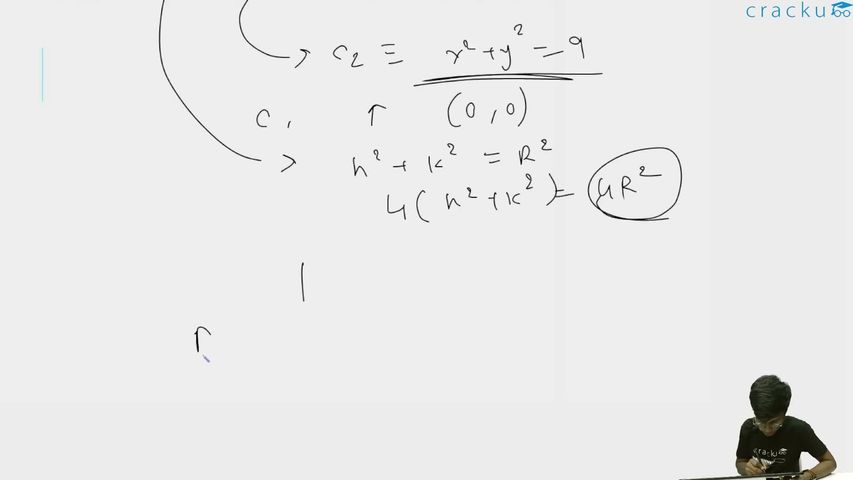
$$h^{2}+k^{2}=R^{2} \quad -(1)$$
$$(h-1)^{2}+k^{2}=R^{2} \quad -(2)$$
Subtract $$(1)$$ from $$(2)$$:
$$(h-1)^{2}-h^{2}=0 \;\Longrightarrow\; h^{2}-2h+1-h^{2}=0 \;\Longrightarrow\; -2h+1=0$$
$$h=\frac12$$.
The given circle $$x^{2}+y^{2}=9$$ has centre $$(0,0)$$ and radius $$3$$. Distance between the two centres is therefore
$$D=\sqrt{h^{2}+k^{2}}=R \quad\text{(from }(1)\text{)}.$$
For two circles to be tangent internally, the distance between their centres equals the difference of their radii: $$|3-R|=D$$.
Substituting $$D=R$$ gives $$|3-R|=R$$, which splits into
$$3-R=R \;\Longrightarrow\; 3=2R \;\Longrightarrow\; R=\frac32$$
$$R=\frac32$$, and from $$(1)$$
$$h^{2}+k^{2}=R^{2}=\left(\frac32\right)^{2}=\frac94.$$(Since $$h=\frac12$$)
$$\left(\frac12\right)^{2}+k^{2}=\frac94 \;\Longrightarrow\; \frac14+k^{2}=\frac94 \;\Longrightarrow\; k^{2}=2 \;\Longrightarrow\; k=\pm\sqrt2.$$
$$4(h^{2}+k^{2})=4\left(\frac94\right)=9.$$
Was this solution helpful?
Click on the Email ☝️ to Watch the Video Solution
Create a FREE account and get:
_1.webp)

Educational materials for JEE preparation

Ask our AI anything

AI can make mistakes. Please verify important information.
AI can make mistakes. Please verify important information.
