
Join Our JEE Preparation Group
Prep with like-minded aspirants; Get access to free daily tests and study material.
Sign in
Please select an account to continue using cracku.in
↓ →
Join Our JEE Preparation Group
Prep with like-minded aspirants; Get access to free daily tests and study material.
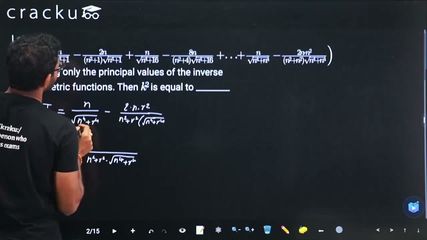
Let $$\lim_{n \to \infty} \left(\frac{n}{\sqrt{n^4+1}} - \frac{2n}{(n^2+1)\sqrt{n^4+1}} + \frac{n}{\sqrt{n^4+16}} - \frac{8n}{(n^2+4)\sqrt{n^4+16}} + \ldots + \frac{n}{\sqrt{n^4+n^4}} - \frac{2n \cdot n^2}{(n^2+n^2)\sqrt{n^4+n^4}}\right)$$ be $$\frac{\pi}{k}$$, using only the principal values of the inverse trigonometric functions. Then $$k^2$$ is equal to ________
Correct Answer: 32
1. Simplify the general term of the summation
Let us write the given expression as a summation from r = 1 to r = n:
$$L = \lim_{n \to \infty} \sum_{r=1}^{n} \left( \frac{n}{\sqrt{n^4+r^4}} - \frac{2n \cdot r^2}{(n^2+r^2)\sqrt{n^4+r^4}} \right)$$
We can combine the terms inside the summation by taking a common denominator:
$$\frac{n}{\sqrt{n^4+r^4}} \left( 1 - \frac{2r^2}{n^2+r^2} \right) = \frac{n}{\sqrt{n^4+r^4}} \left( \frac{n^2 + r^2 - 2r^2}{n^2+r^2} \right) = \frac{n(n^2 - r^2)}{(n^2+r^2)\sqrt{n^4+r^4}}$$
2. Express as a Riemann sum
To convert this into a definite integral, we factor out powers of n to express it in terms of \frac{r}{n}:
$$\frac{n \cdot n^2 (1 - \frac{r^2}{n^2})}{n^2 (1 + \frac{r^2}{n^2}) \cdot n^2 \sqrt{1 + \frac{r^4}{n^4}}} = \frac{1}{n} \cdot \frac{1 - \frac{r^2}{n^2}}{(1 + \frac{r^2}{n^2})\sqrt{1 + \frac{r^4}{n^4}}}$$
As $$n \to \infty, we replace \frac{1}{n}$$ with dx and $$\frac{r}{n}$$ with x. The limits of integration go from x = 0 to x = 1:
$$L = \int_0^1 \frac{1-x^2}{(1+x^2)\sqrt{1+x^4}} \, dx$$
3. Evaluate the definite integral
Divide both the numerator and the denominator of the integrand by $$x^2$$:
$$L = \int_0^1 \frac{\frac{1}{x^2}-1}{(x+\frac{1}{x})\sqrt{x^2+\frac{1}{x^2}}} \, dx$$
Let us use the substitution t = x + $$\frac{1}{x}$$. Differentiating both sides gives:
$$dt = \left(1 - \frac{1}{x^2}\right)dx \implies -dt = \left(\frac{1}{x^2} - 1\right)dx$$
We also express the term inside the square root in terms of t:
$$t^2 = x^2 + \frac{1}{x^2} + 2 \implies x^2 + \frac{1}{x^2} = t^2 - 2$$
Now find the new limits of integration:
When $$x \to 0^+, t \to \infty$$.
When x = 1, t = 1 + 1 = 2.
Substitute these into the integral:
$$L = \int_{\infty}^2 \frac{-dt}{t\sqrt{t^2-2}} = \int_2^{\infty} \frac{dt}{t\sqrt{t^2-2}}$$
4. Apply trigonometric substitution
Let t = $$\sqrt{2}\sec\theta$$, then dt = $$\sqrt{2}\sec\theta\tan\theta \, d\theta$$.
When t = 2, $$\sec\theta = \sqrt{2} \implies \theta = \frac{\pi}{4}$$.
When $$t \to \infty, \theta \to \frac{\pi}{2}$$.
Substitute these values into the integral:
$$L = \int_{\pi/4}^{\pi/2} \frac{\sqrt{2}\sec\theta\tan\theta \, d\theta}{\sqrt{2}\sec\theta \sqrt{2\sec^2\theta-2}} = \int_{\pi/4}^{\pi/2} \frac{\sqrt{2}\sec\theta\tan\theta \,d\theta}{\sqrt{2}\sec\theta \cdot \sqrt{2}\tan\theta}$$
Simplifying the integrand gives:
$$L = \int_{\pi/4}^{\pi/2} \frac{1}{\sqrt{2}} \, d\theta = \frac{1}{\sqrt{2}} \left[ \theta \right]_{\pi/4}^{\pi/2} = \frac{1}{\sqrt{2}} \left( \frac{\pi}{2} - \frac{\pi}{4} \right) =\frac{\pi}{4\sqrt{2}}$$
5. Determine the value of $$k^2$$
We are given that the limit value is equal to $$\frac{\pi}{k}$$:
$$\frac{\pi}{k} = \frac{\pi}{4\sqrt{2}} \implies k = 4\sqrt{2}$$
Squaring both sides gives:
$$k^2 = (4\sqrt{2})^2 = 16 \cdot 2 = 32$$
Was this solution helpful?
Click on the Email ☝️ to Watch the Video Solution
Create a FREE account and get:
_1.webp)

Educational materials for JEE preparation

Ask our AI anything

AI can make mistakes. Please verify important information.
AI can make mistakes. Please verify important information.
