
Join Our JEE Preparation Group
Prep with like-minded aspirants; Get access to free daily tests and study material.
Sign in
Please select an account to continue using cracku.in
↓ →
Join Our JEE Preparation Group
Prep with like-minded aspirants; Get access to free daily tests and study material.
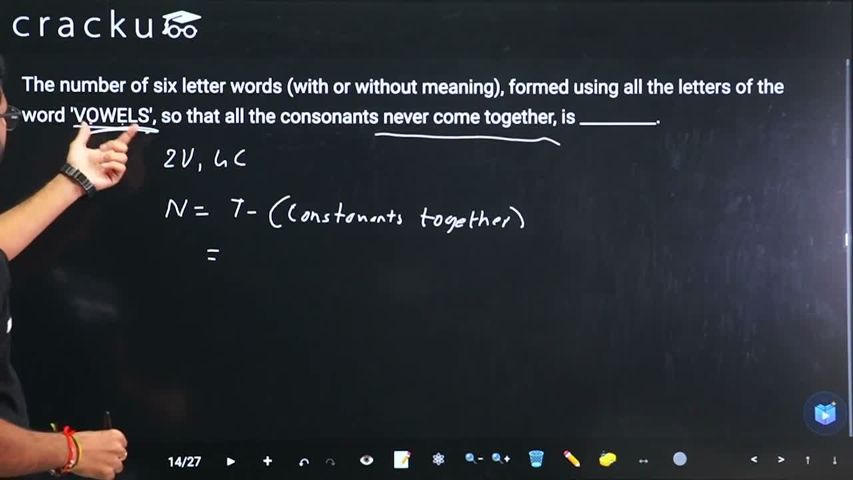
The number of six letter words (with or without meaning), formed using all the letters of the word 'VOWELS', so that all the consonants never come together, is _________.
Correct Answer: 576
We first look at the word ‘VOWELS’. It has $$6$$ distinct letters: $$V,\,O,\,W,\,E,\,L,\,S$$. Out of these, $$O$$ and $$E$$ are vowels, while $$V,\,W,\,L,\,S$$ are consonants.
We wish to count all possible six-letter arrangements that can be made with these letters, but in such a way that the four consonants never come together in one single block.
To obtain this count, it is convenient to use the basic counting principle
Total required number $$=\ ($$ Total permutations of all six letters $$)\;-\;($$ Permutations in which all consonants are together $$).$$
We now evaluate each term separately.
1. The formula for the number of permutations of $$n$$ distinct objects is $$n!$$ (“$$n$$ factorial”). Here $$n=6$$, so
Total permutations of all six letters $$=6!$$ $$=6\times5\times4\times3\times2\times1$$ $$=720.$$
2. Next, we count the unwanted arrangements in which all four consonants $$V,\,W,\,L,\,S$$ stand side by side. Treat these four consonants as a single super-letter or block. Together with the remaining two vowels $$O$$ and $$E$$, we now have only $$3$$ “letters” to arrange:
[VWLS] , O , E.
The number of ways to arrange $$3$$ distinct objects is $$3!$$. Inside the block [VWLS] the four consonants themselves can be permuted in $$4!$$ ways. By the multiplication principle, the total number of such “all-consonants-together” words is
$$3!\times4!$$ $$=(3\times2\times1)\times(4\times3\times2\times1)$$ $$=6\times24$$ $$=144.$$
3. Finally, we subtract these unwanted cases from the total:
Required number $$=720-144$$ $$=576.$$
So, the answer is $$576$$.
Click on the Email ☝️ to Watch the Video Solution
Create a FREE account and get:
_1.webp)

Educational materials for JEE preparation

Ask our AI anything

AI can make mistakes. Please verify important information.
AI can make mistakes. Please verify important information.


