
Join Our JEE Preparation Group
Prep with like-minded aspirants; Get access to free daily tests and study material.
Sign in
Please select an account to continue using cracku.in
↓ →
Join Our JEE Preparation Group
Prep with like-minded aspirants; Get access to free daily tests and study material.
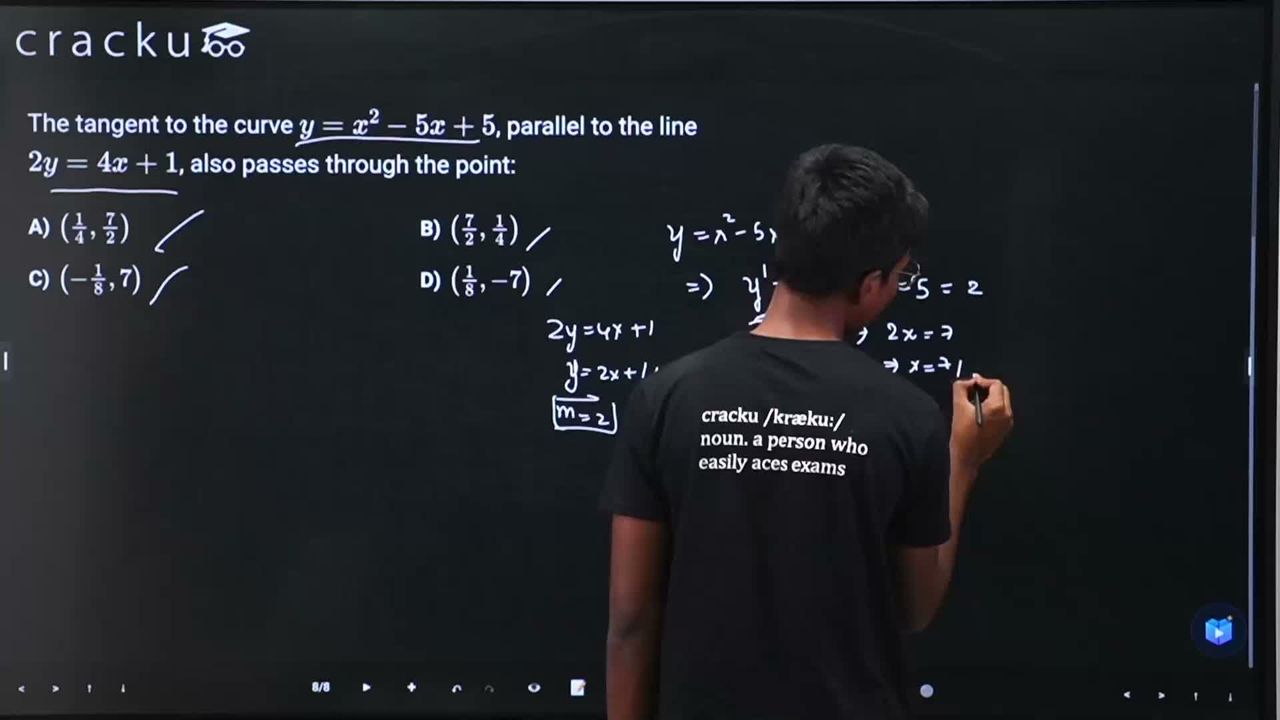
The tangent to the curve $$y = x^2 - 5x + 5$$, parallel to the line $$2y = 4x + 1$$, also passes through the point:
First, we recall that the slope of any straight line written in the form $$ax+by+c=0$$ is given by the formula $$m=-\dfrac{a}{b}.$$
The line whose equation is $$2y=4x+1$$ can be rewritten as $$4x-2y+1=0.$$ Using the formula above, its slope comes out as $$m=-\dfrac{4}{-2}=2.$$ Hence every line parallel to $$2y=4x+1$$ must also have slope $$2.$$
Now we turn to the curve $$y=x^2-5x+5.$$ For a tangent drawn to this curve, the slope equals the derivative of $$y$$ with respect to $$x$$ at the point of contact. We compute
$$\dfrac{dy}{dx}=2x-5.$$
Because the desired tangent is parallel to the given line, its slope must be $$2.$$ Therefore we must have
$$2x-5 = 2.$$
Solving for $$x$$ step by step:
$$2x = 2 + 5,$$
$$2x = 7,$$
$$x = \dfrac{7}{2}.$$
We substitute this $$x$$-value back into the curve to find the corresponding $$y$$-coordinate:
$$y = \left(\dfrac{7}{2}\right)^2 - 5\left(\dfrac{7}{2}\right) + 5.$$
We now simplify term by term.
First square: $$\left(\dfrac{7}{2}\right)^2 = \dfrac{49}{4}.$$
Next product: $$5\left(\dfrac{7}{2}\right) = \dfrac{35}{2}.$$
Express every fraction with denominator $$4$$ so that we can combine them easily:
$$\dfrac{35}{2} = \dfrac{70}{4}, \quad 5 = \dfrac{20}{4}.$$
Hence
$$y = \dfrac{49}{4} - \dfrac{70}{4} + \dfrac{20}{4} = \dfrac{49 - 70 + 20}{4} = \dfrac{-1}{4}.$$
Thus the point of contact of the tangent and the curve is $$\left(\dfrac{7}{2}, -\dfrac{1}{4}\right).$$
Next, we write the equation of the tangent line using the point-slope form $$y - y_1 = m(x - x_1).$$ Here $$(x_1,y_1)=\left(\dfrac{7}{2}, -\dfrac{1}{4}\right)$$ and $$m=2.$$ Substituting, we get
$$y - \left(-\dfrac{1}{4}\right) = 2\left(x - \dfrac{7}{2}\right).$$
Simplifying first the left side and then the right side:
$$y + \dfrac{1}{4} = 2x - 2\cdot\dfrac{7}{2},$$
$$y + \dfrac{1}{4} = 2x - 7.$$
Subtracting $$\dfrac{1}{4}$$ from both sides gives the tangent in slope-intercept form:
$$y = 2x - 7 - \dfrac{1}{4} = 2x - \dfrac{29}{4}.$$
To discover which of the four given points lies on this line, we substitute the coordinates of each option into the equation $$y = 2x - \dfrac{29}{4}.$$
Option A: $$\left(\dfrac{1}{4}, \dfrac{7}{2}\right).$$ Put $$x=\dfrac{1}{4}$$:
Right-hand side $$=2\cdot\dfrac{1}{4}-\dfrac{29}{4}=\dfrac{1}{2}-\dfrac{29}{4}=\dfrac{2-29}{4}=-\dfrac{27}{4}.$$ Left-hand side $$=\dfrac{7}{2}=\dfrac{14}{4}.$$ Since $$\dfrac{14}{4}\neq-\dfrac{27}{4},$$ this point does not lie on the line.
Option B: $$\left(\dfrac{7}{2},\dfrac{1}{4}\right).$$ Put $$x=\dfrac{7}{2}$$:
Right-hand side $$=2\cdot\dfrac{7}{2}-\dfrac{29}{4}=7-\dfrac{29}{4}=\dfrac{28-29}{4}=-\dfrac{1}{4}.$$ Left-hand side $$=\dfrac{1}{4}.$$ Since $$\dfrac{1}{4}\neq-\dfrac{1}{4},$$ this point does not lie on the line.
Option C: $$\left(-\dfrac{1}{8},7\right).$$ Put $$x=-\dfrac{1}{8}$$:
Right-hand side $$=2\cdot\left(-\dfrac{1}{8}\right)-\dfrac{29}{4}=-\dfrac{1}{4}-\dfrac{29}{4}=-\dfrac{30}{4}=-\dfrac{15}{2}.$$ Left-hand side $$=7.$$ Since $$7\neq-\dfrac{15}{2},$$ this point does not satisfy the equation.
Option D: $$\left(\dfrac{1}{8},-7\right).$$ Put $$x=\dfrac{1}{8}$$:
Right-hand side $$=2\cdot\dfrac{1}{8}-\dfrac{29}{4}=\dfrac{1}{4}-\dfrac{29}{4}=-\dfrac{28}{4}=-7.$$ Left-hand side $$=-7.$$ Both sides are equal, so this point lies exactly on the tangent.
Only Option D satisfies the equation of the tangent line.
Hence, the correct answer is Option D.
Was this solution helpful?
Click on the Email ☝️ to Watch the Video Solution
Create a FREE account and get:
_1.webp)

Educational materials for JEE preparation

Ask our AI anything

AI can make mistakes. Please verify important information.
AI can make mistakes. Please verify important information.


