
Join Our JEE Preparation Group
Prep with like-minded aspirants; Get access to free daily tests and study material.
Sign in
Please select an account to continue using cracku.in
↓ →
Join Our JEE Preparation Group
Prep with like-minded aspirants; Get access to free daily tests and study material.
Let f be a differentiable function such that $$f(1) = 2$$ and $$f'(x) = f(x)$$ for all $$x \in R$$. If $$h(x) = f(f(x))$$, then $$h'(1)$$ is equal to:
We have a differentiable function that satisfies the first-order linear differential equation $$f'(x)=f(x)$$ for every real number $$x$$.
First, we recall the general solution of the differential equation $$y'=y$$. The standard result is:
$$\text{If } y'=y,\ \text{then } y=C e^{x},$$
where $$C$$ is a constant of integration. Applying this to our function, we obtain
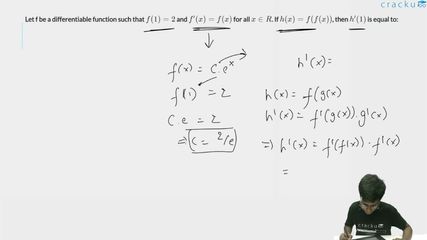
$$f(x)=C e^{x}.$$
We now use the given initial value $$f(1)=2$$ to determine the constant $$C$$. Substituting $$x=1$$ and $$f(1)=2$$ in the expression for $$f(x)$$ we get
$$2 = C e^{1} \quad \Longrightarrow \quad C = \frac{2}{e}.$$
Hence the explicit form of the function is
$$f(x)=\frac{2}{e}\,e^{x}=2e^{x-1}.$$
Next, we define the composite function $$h(x)=f(f(x))$$. Our task is to compute $$h'(1)$$. To differentiate the composition, we employ the chain rule, which states:
$$\text{If } h(x)=f(g(x)),\ \text{then } h'(x)=f'(g(x))\cdot g'(x).$$
In our setting, $$g(x)=f(x)$$, so
$$h'(x)=f'(f(x))\cdot f'(x).$$
But we already know from the original differential equation that $$f'(x)=f(x)$$ for every $$x$$. Therefore we can rewrite the derivative as
$$h'(x)=f(f(x))\cdot f(x).$$
Now we evaluate this expression at $$x=1$$. We first compute individual values of $$f$$.
Since $$f(1)=2$$ (given), we have
$$f(1)=2.$$
Next we need $$f(2)$$. Using the explicit formula $$f(x)=2e^{x-1}$$, we substitute $$x=2$$:
$$f(2)=2e^{2-1}=2e.$$
The derivative of $$h$$ at $$x=1$$ is therefore
$$h'(1)=f\bigl(f(1)\bigr)\cdot f(1)=f(2)\cdot 2=(2e)\cdot 2=4e.$$
Hence, the correct answer is Option C.
Was this solution helpful?
Click on the Email ☝️ to Watch the Video Solution
Create a FREE account and get:
_1.webp)

Educational materials for JEE preparation

Ask our AI anything

AI can make mistakes. Please verify important information.
AI can make mistakes. Please verify important information.


