
Join Our JEE Preparation Group
Prep with like-minded aspirants; Get access to free daily tests and study material.
Sign in
Please select an account to continue using cracku.in
↓ →
Join Our JEE Preparation Group
Prep with like-minded aspirants; Get access to free daily tests and study material.
If the function f given by $$f(x) = x^3 - 3(a-2)x^2 + 3ax + 7$$, for some $$a \in R$$ is increasing in (0, 1] and decreasing in [1, 5), then a root of the equation, $$\frac{f(x) - 14}{(x-1)^2} = 0$$, $$(x \neq 1)$$ is:
We have the cubic function
$$f(x)=x^{3}-3(a-2)x^{2}+3ax+7,\qquad a\in\mathbb R.$$
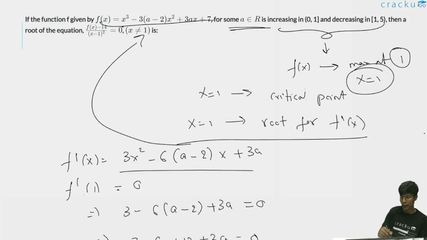
The question tells us that this function is strictly increasing on the open interval $$(0,1]$$ and strictly decreasing on the interval $$[1,5).$$ These two pieces of information mean that the point $$x=1$$ is a local maximum. In differential-calculus language, the derivative must satisfy two conditions:
1. $$f'(1)=0$$ so that the tangent is horizontal at $$x=1$$ (stationary point).
2. $$f'(x)\gt 0$$ for $$0\lt x\lt 1$$ and $$f'(x)\lt 0$$ for $$1\lt x\lt 5,$$ so that the graph first rises up to $$x=1$$ and then falls.
We begin by differentiating $$f(x)$$. Term-by-term differentiation gives
$$f'(x)=\dfrac{d}{dx}\bigl[x^{3}\bigr]-\dfrac{d}{dx}\bigl[3(a-2)x^{2}\bigr]+\dfrac{d}{dx}\bigl[3ax\bigr]+\dfrac{d}{dx}[7].$$
Using the standard rules $$\dfrac{d}{dx}[x^{n}]=nx^{n-1},\quad \dfrac{d}{dx}[kx]=k,$$ we obtain
$$f'(x)=3x^{2}-6(a-2)x+3a.$$ Putting the common factor $$3$$ outside,
$$f'(x)=3\bigl[x^{2}-2(a-2)x+a\bigr].$$
To make $$x=1$$ a stationary point we set $$f'(1)=0.$$ Substituting $$x=1$$ in the derivative,
$$f'(1)=3\Bigl[1^{2}-2(a-2)\cdot1+a\Bigr] =3\bigl[1-2(a-2)+a\bigr].$$
Simplifying inside the bracket,
$$1-2(a-2)+a =1-2a+4+a =5-a.$$
Thus
$$f'(1)=3(5-a).$$
Setting this equal to zero,
$$3(5-a)=0\quad\Longrightarrow\quad 5-a=0\quad\Longrightarrow\quad a=5.$$
Now we verify that with $$a=5$$ the derivative is positive for $$0\lt x\lt 1$$ and negative for $$1\lt x\lt 5.$$ Substitute $$a=5$$ in $$f'(x):$$
$$f'(x)=3\bigl[x^{2}-2(5-2)x+5\bigr] =3\bigl[x^{2}-6x+5\bigr].$$
The quadratic inside can be rewritten by completing the square:
$$x^{2}-6x+5=(x^{2}-6x+9)-4=(x-3)^{2}-4.$$
Hence
$$f'(x)=3\bigl[(x-3)^{2}-4\bigr].$$
The expression $$(x-3)^{2}-4$$ factors because $$\bigl((x-3)^{2}-4\bigr)=(x-3-2)(x-3+2)=(x-5)(x-1).$$ Therefore
$$f'(x)=3(x-5)(x-1).$$
We now inspect the sign of this product:
• For $$0\lt x\lt 1,$$ we have $$x-1\lt 0$$ and $$x-5\lt 0,$$ so the product $$(x-5)(x-1)\gt 0.$$ Multiplying by $$3$$ keeps it positive, so $$f'(x)\gt 0.$$ The function is increasing on $$(0,1).$$
• For $$1\lt x\lt 5,$$ we have $$x-1\gt 0$$ while $$x-5\lt 0,$$ making the product negative. Hence $$f'(x)\lt 0$$ in this interval, and the function is decreasing.
Both required monotonicity conditions are satisfied, confirming $$a=5.$$
With $$a=5$$ fixed, we write the explicit form of the function:
$$f(x)=x^{3}-3(5-2)x^{2}+3\cdot5\,x+7 =x^{3}-9x^{2}+15x+7.$$
The equation to solve (excluding $$x=1$$) is
$$\frac{f(x)-14}{(x-1)^{2}}=0,\qquad x\neq1.$$
Because the denominator $$(x-1)^{2}$$ is never zero for $$x\neq1,$$ the fraction equals zero exactly when the numerator is zero. Hence we must solve
$$f(x)-14=0.$$
Substituting the expression for $$f(x):$$
$$x^{3}-9x^{2}+15x+7-14=0,$$ $$x^{3}-9x^{2}+15x-7=0.$$
We now look for integer roots among the options $$7,-7,6,5.$$ The Rational Root Theorem tells us that any integer root must divide the constant term $$(-7).$$ Thus the only plausible integer candidates are $$\pm1,\pm7.$$ Because $$x=1$$ is excluded (it would make the original denominator zero), we test $$x=7$$ and $$x=-7.$$
First test $$x=7:$$
$$7^{3}-9(7)^{2}+15(7)-7 =343-9\!\cdot\!49+105-7 =343-441+105-7.$$
Compute step by step:
$$343-441=-98,$$ $$-98+105=7,$$ $$7-7=0.$$
Thus $$x=7$$ is indeed a root of the cubic.
Because $$x=7\neq1,$$ it also satisfies the original equation. No other listed option ($$-7,6,5$$) yields zero when substituted, so $$x=7$$ is the required root.
Hence, the correct answer is Option A.
Was this solution helpful?
Click on the Email ☝️ to Watch the Video Solution
Create a FREE account and get:
_1.webp)

Educational materials for JEE preparation

Ask our AI anything

AI can make mistakes. Please verify important information.
AI can make mistakes. Please verify important information.


