
Join Our JEE Preparation Group
Prep with like-minded aspirants; Get access to free daily tests and study material.
Sign in
Please select an account to continue using cracku.in
↓ →
Join Our JEE Preparation Group
Prep with like-minded aspirants; Get access to free daily tests and study material.
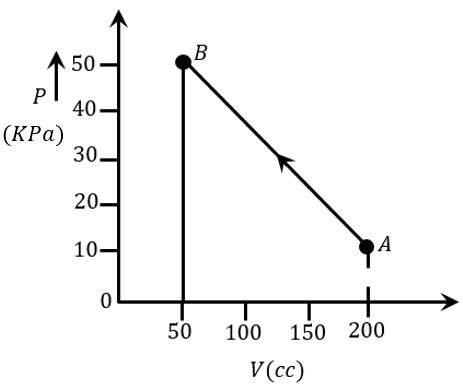
The pressure of a gas changes linearly with volume from $$A$$ to $$B$$ as shown in figure. If no heat is supplied to or extracted from the gas then change in the internal energy of the gas will be
Solution :
From first law of thermodynamics :
$$\Delta Q = \Delta U + W$$
Given, no heat is supplied or extracted :
$$\Delta Q = 0$$
Therefore,
$$\Delta U = -W$$
From graph, process occurs from A to B.
Coordinates :
At \(A\),
$$P_A = 10\text{ kPa}$$
$$V_A = 200\text{ cc}$$
At \(B\),
$$P_B = 50\text{ kPa}$$
$$V_B = 50\text{ cc}$$
Work done by gas is area under \(PV\) graph :
$$W = \frac{(P_A+P_B)}{2}(V_B-V_A)$$
$$= \frac{(10+50)}{2}(50-200)$$
$$= 30 \times (-150)$$
$$= -4500\text{ kPa-cc}$$
Now,
$$1\text{ kPa-cc} = 10^{-3}\text{ J}$$
Therefore,
$$W = -4500 \times 10^{-3}$$
$$= -4.5\text{ J}$$
Hence,
$$\Delta U = -(-4.5)$$
$$= 4.5\text{ J}$$
Final Answer :
$$4.5\text{ J}$$
Was this solution helpful?
Create a FREE account and get:
_1.webp)

Educational materials for JEE preparation

Ask our AI anything

AI can make mistakes. Please verify important information.
AI can make mistakes. Please verify important information.
