
Join Our JEE Preparation Group
Prep with like-minded aspirants; Get access to free daily tests and study material.
Sign in
Please select an account to continue using cracku.in
↓ →
Join Our JEE Preparation Group
Prep with like-minded aspirants; Get access to free daily tests and study material.
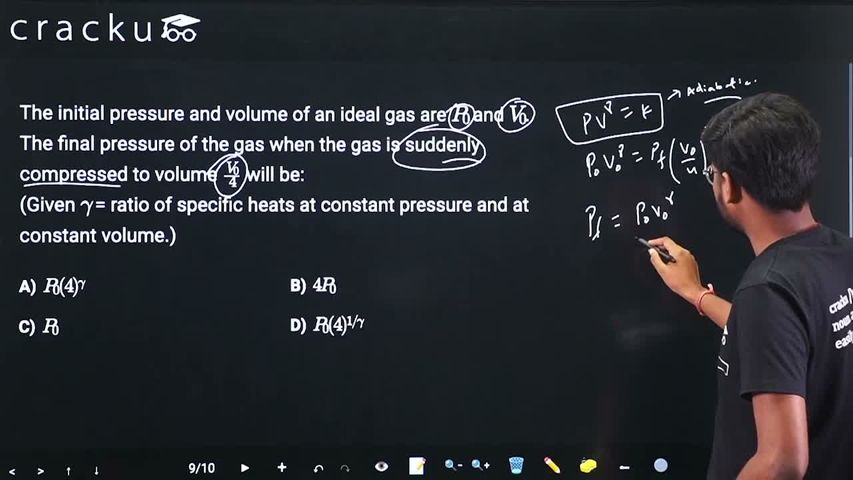
The initial pressure and volume of an ideal gas are $$P_0$$ and $$V_0$$. The final pressure of the gas when the gas is suddenly compressed to volume $$\frac{V_0}{4}$$ will be:
(Given $$\gamma$$ = ratio of specific heats at constant pressure and at constant volume.)
We need to find the final pressure when an ideal gas is suddenly compressed from volume $$V_0$$ to $$V_0/4$$.
First, identify the type of process.
The key word is "suddenly" compressed. A sudden compression means the process happens so quickly that there is no time for heat exchange between the gas and its surroundings. This is an adiabatic process ($$Q = 0$$).
Now state the adiabatic relation for an ideal gas.
For a reversible adiabatic process involving an ideal gas, pressure and volume are related by:
$$ PV^\gamma = \text{constant} $$
where $$\gamma = C_p/C_v$$ is the ratio of specific heats. This relation is derived from the first law of thermodynamics ($$dU = -PdV$$ for adiabatic process) combined with the ideal gas law and the relation $$dU = nC_v dT$$.
Now apply the adiabatic relation to initial and final states.
Initial state: pressure $$P_0$$, volume $$V_0$$
Final state: pressure $$P_f$$, volume $$V_0/4$$
Using $$P_i V_i^\gamma = P_f V_f^\gamma$$:
$$ P_0 V_0^\gamma = P_f \left(\frac{V_0}{4}\right)^\gamma $$
Next, solve for $$P_f$$.
$$ P_f = P_0 \cdot \frac{V_0^\gamma}{\left(\frac{V_0}{4}\right)^\gamma} = P_0 \cdot \frac{V_0^\gamma}{\frac{V_0^\gamma}{4^\gamma}} = P_0 \cdot 4^\gamma $$
Therefore, the final pressure is:
$$ P_f = P_0 (4)^\gamma $$
Note that since $$\gamma > 1$$ for all gases (for a monoatomic gas $$\gamma = 5/3$$, for diatomic $$\gamma = 7/5$$), the factor $$4^\gamma > 4$$. This means the pressure increase in an adiabatic compression is greater than what would occur in an isothermal compression (where $$P_f$$ would be simply $$4P_0$$). This is because during adiabatic compression, the temperature also rises (no heat is removed), which further increases the pressure.
The correct answer is Option 1: $$P_0(4)^\gamma$$.
Was this solution helpful?
Click on the Email ☝️ to Watch the Video Solution
Create a FREE account and get:
_1.webp)

Educational materials for JEE preparation

Ask our AI anything

AI can make mistakes. Please verify important information.
AI can make mistakes. Please verify important information.
