
Join Our JEE Preparation Group
Prep with like-minded aspirants; Get access to free daily tests and study material.
Sign in
Please select an account to continue using cracku.in
↓ →
Join Our JEE Preparation Group
Prep with like-minded aspirants; Get access to free daily tests and study material.
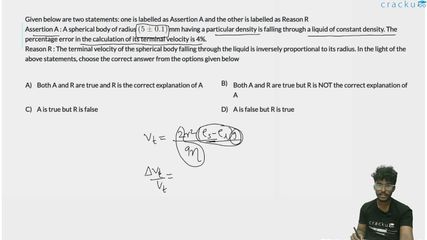
Given below are two statements: one is labelled as Assertion A and the other is labelled as Reason R
Assertion A : A spherical body of radius $$(5 \pm 0.1)$$ mm having a particular density is falling through a liquid of constant density. The percentage error in the calculation of its terminal velocity is 4%.
Reason R : The terminal velocity of the spherical body falling through the liquid is inversely proportional to its radius. In the light of the above statements, choose the correct answer from the options given below
Assertion A: The terminal velocity of a sphere falling through a liquid is given by Stokes' law:
$$v_t = \frac{2r^2(\rho_s - \rho_l)g}{9\eta}$$
Since $$v_t \propto r^2$$, the percentage error in $$v_t$$ is:
$$\frac{\Delta v_t}{v_t} = 2 \times \frac{\Delta r}{r} = 2 \times \frac{0.1}{5} = 2 \times 0.02 = 0.04 = 4\%$$
So Assertion A is true.
Reason R: The terminal velocity is inversely proportional to its radius.
From Stokes' law, $$v_t \propto r^2$$ (directly proportional to the square of radius, not inversely proportional).
So Reason R is false.
The answer is option 3: A is true but R is false.
Was this solution helpful?
Click on the Email ☝️ to Watch the Video Solution
Create a FREE account and get:
_1.webp)

Educational materials for JEE preparation

Ask our AI anything

AI can make mistakes. Please verify important information.
AI can make mistakes. Please verify important information.
