
Join Our JEE Preparation Group
Prep with like-minded aspirants; Get access to free daily tests and study material.
Sign in
Please select an account to continue using cracku.in
↓ →
Join Our JEE Preparation Group
Prep with like-minded aspirants; Get access to free daily tests and study material.
Let $$S = \{w_1, w_2, \ldots\}$$ be the sample space associated to a random experiment. Let $$P(w_n) = \frac{P(w_{n-1})}{2}$$, $$n \geq 2$$. Let $$A = \{2k + 3l; k, l \in \mathbb{N}\}$$ and $$B = \{w_n; n \in A\}$$. Then $$P(B)$$ is equal to
Step 1: Determine the probabilities of the individual sample points
We are given that $$S = \{w_1, w_2, w_3, \ldots\}$$ is the sample space of a random experiment. The relation between successive probabilities is:
$$P(w_n) = \frac{P(w_{n-1})}{2} \quad \text{for} \quad n \geq 2$$
This forms a geometric sequence with a common ratio of $$\frac{1}{2}$$:
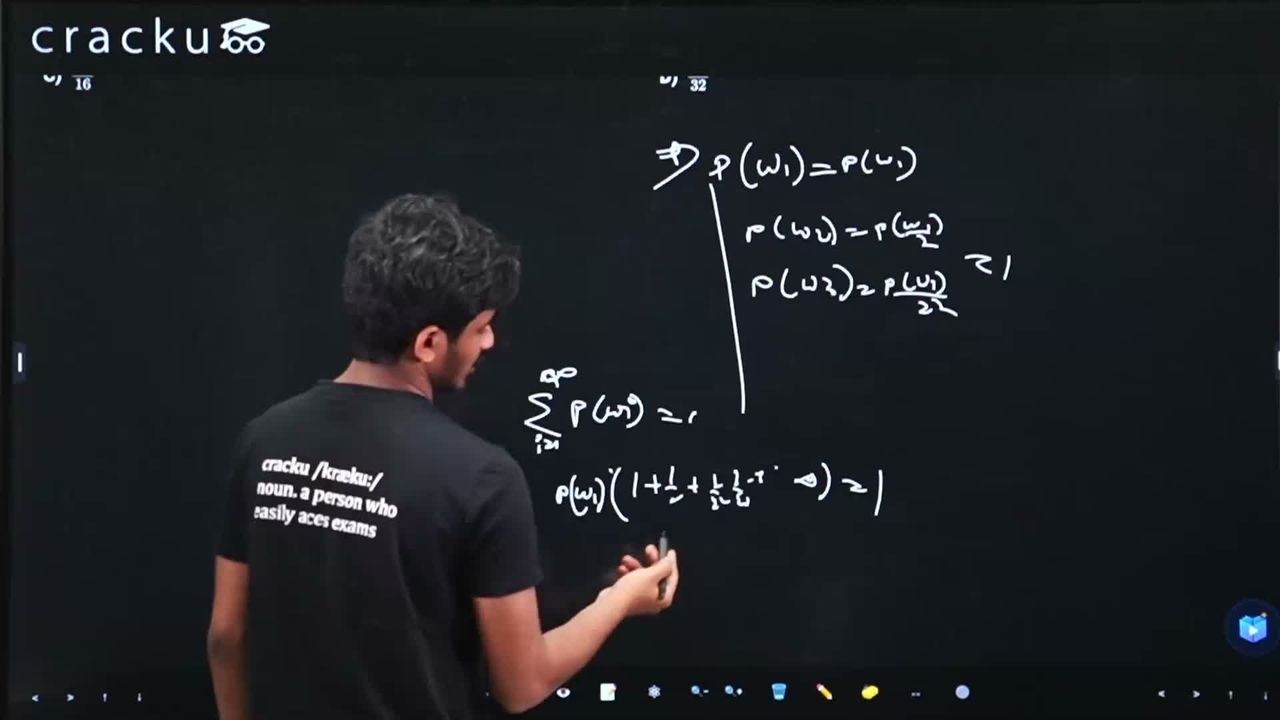
$$P(w_1) = P(w_1)$$
$$P(w_2) = \frac{P(w_1)}{2}$$
$$P(w_3) = \frac{P(w_1)}{2^2}$$
$$P(w_n) = \frac{P(w_1)}{2^{n-1}}$$
Since the sum of all probabilities in a sample space must equal 1:
$$\sum_{n=1}^{\infty} P(w_n) = 1$$
$$P(w_1) \left(1 + \frac{1}{2} + \frac{1}{2^2} + \dots\right) = 1$$
Using the sum of an infinite geometric progression formula $$S_{\infty} = \frac{a}{1-r}$$:
$$P(w_1) \cdot \left(\frac{1}{1 - \frac{1}{2}}\right) = 1$$
$$2 P(w_1) = 1 \implies P(w_1) = \frac{1}{2}$$
Substituting $$P(w_1)$$ back into the general term gives:
$$P(w_n) = \frac{1}{2^n}$$
Step 2: Identify the elements of set A
The set $$A$$ is defined for natural numbers $$k, l \in \mathbb{N}$$ ($$k, l \geq 1$$) as:
$$A = \{2k + 3l; \, k, l \in \mathbb{N}\}$$
Let us find the possible values generated by this linear combination starting from the minimum values:
- For $$k = 1, l = 1 \implies 2(1) + 3(1) = 5$$
- For $$k = 2, l = 1 \implies 2(2) + 3(1) = 7$$
- For $$k = 1, l = 2 \implies 2(1) + 3(2) = 8$$
- For $$k = 3, l = 1 \implies 2(3) + 3(1) = 9$$
- For $$k = 2, l = 2 \implies 2(2) + 3(2) = 10$$
By analyzing the values, we observe that:
- The numbers $$1, 2, 3, 4$$ cannot be formed because the minimum value is 5.
- The number $$6$$ cannot be formed because if $$2k + 3l = 6$$, since $$l \geq 1$$, the only options are $$l=1 \implies 2k=3$$ (no integer solution) or $$l \geq 2 \implies 2k \leq 0$$ (not a natural number).
- All other natural numbers greater than or equal to 5 can be formed.
Thus, the set $$A$$ contains all natural numbers except $$\{1, 2, 3, 4, 6\}$$:
$$A = \{5, 7, 8, 9, 10, 11, \ldots\}$$
Step 3: Calculate the probability of event B
The event $$B$$ is defined as $$B = \{w_n; \, n \in A\}$$. The total probability $$P(B)$$ is the sum of probabilities of $$w_n$$ for all $$n \in A$$:
$$P(B) = \sum_{n \in A} P(w_n) = \sum_{n \in A} \frac{1}{2^n}$$
We can compute this by taking the sum of the entire infinite series from $$n = 1$$ to $$\infty$$ and subtracting the probabilities of the missing indices $$\{1, 2, 3, 4, 6\}$$:
$$P(B) = \sum_{n=1}^{\infty} \frac{1}{2^n} - \left(\frac{1}{2^1} + \frac{1}{2^2} + \frac{1}{2^3} + \frac{1}{2^4} + \frac{1}{2^6}\right)$$
We know that the full sum evaluates to:
$$\sum_{n=1}^{\infty} \frac{1}{2^n} = \frac{\frac{1}{2}}{1 - \frac{1}{2}} = 1$$
Now, calculate the sum of the excluded terms:
$$\frac{1}{2} + \frac{1}{4} + \frac{1}{8} + \frac{1}{16} + \frac{1}{64} = \frac{32 + 16 + 8 + 4 + 1}{64} = \frac{61}{64}$$
Subtracting this from 1:
$$P(B) = 1 - \frac{61}{64} = \frac{3}{64}$$
Conclusion:
The value of $$P(B)$$ is equal to $$\frac{3}{64}$$.
Was this solution helpful?
Click on the Email ☝️ to Watch the Video Solution
Create a FREE account and get:
_1.webp)

Educational materials for JEE preparation

Ask our AI anything

AI can make mistakes. Please verify important information.
AI can make mistakes. Please verify important information.
