
Join Our JEE Preparation Group
Prep with like-minded aspirants; Get access to free daily tests and study material.
Sign in
Please select an account to continue using cracku.in
↓ →
Join Our JEE Preparation Group
Prep with like-minded aspirants; Get access to free daily tests and study material.
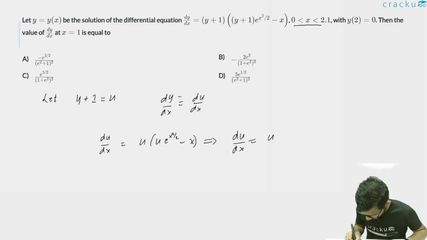
Let $$y = y(x)$$ be the solution of the differential equation $$\frac{dy}{dx} = (y+1)\left((y+1)e^{x^2/2} - x\right)$$, $$0 < x < 2.1$$, with $$y(2) = 0$$. Then the value of $$\frac{dy}{dx}$$ at $$x = 1$$ is equal to
Given differential equation,
$$\frac{dy}{dx}=(y+1)\left((y+1)e^{x^2/2}-x\right)$$
Put
$$u=y+1$$
Then,
$$\frac{du}{dx}=u(ue^{x^2/2}-x)$$
$$\frac{du}{dx}+xu=u^2e^{x^2/2}$$
Now put
$$v=\frac1u$$
Then,
$$\frac{dv}{dx}=-\frac1{u^2}\frac{du}{dx}$$
Substituting,
$$-\frac{dv}{dx}+xv=e^{x^2/2}$$
$$\frac{dv}{dx}-xv=-e^{x^2/2}$$
This is a linear differential equation.
Integrating factor:
$$IF=e^{\int -x\,dx}$$
$$=e^{-x^2/2}$$
Multiplying throughout,
$$e^{-x^2/2}\frac{dv}{dx}-xe^{-x^2/2}v=-1$$
Hence,
$$\frac{d}{dx}\left(ve^{-x^2/2}\right)=-1$$
Integrating,
$$ve^{-x^2/2}=-x+C$$
$$v=e^{x^2/2}(C-x)$$
Since
$$v=\frac1{y+1},$$
$$\frac1{y+1}=e^{x^2/2}(C-x)$$
Using condition
$$y(2)=0,$$
$$1=e^2(C-2)$$
$$C=2+e^{-2}$$
Therefore,
$$\frac1{y+1}=e^{x^2/2}(2+e^{-2}-x)$$
At
$$x=1,$$
$$y+1=\frac1{e^{1/2}(1+e^{-2})}$$
Now,
$$\frac{dy}{dx}=(y+1)\left((y+1)e^{x^2/2}-x\right)$$
At
$$x=1,$$
$$(y+1)e^{1/2}=\frac1{1+e^{-2}}$$
Hence,
$$\left.\frac{dy}{dx}\right|_{x=1} =\frac1{e^{1/2}(1+e^{-2})} \left(\frac1{1+e^{-2}}-1\right)$$
$$=\frac1{e^{1/2}(1+e^{-2})} \left(\frac{1-(1+e^{-2})}{1+e^{-2}}\right)$$
$$=\frac{-e^{-2}}{e^{1/2}(1+e^{-2})^2}$$
Multiply numerator and denominator by $$e^4$$:
$$=-\frac{e^{3/2}}{(e^2+1)^2}$$
Therefore,
$$\boxed{-\frac{e^{3/2}}{(e^2+1)^2}}$$
Was this solution helpful?
Click on the Email ☝️ to Watch the Video Solution
Create a FREE account and get:
_1.webp)

Educational materials for JEE preparation

Ask our AI anything

AI can make mistakes. Please verify important information.
AI can make mistakes. Please verify important information.
