
Join Our JEE Preparation Group
Prep with like-minded aspirants; Get access to free daily tests and study material.
Sign in
Please select an account to continue using cracku.in
↓ →
Join Our JEE Preparation Group
Prep with like-minded aspirants; Get access to free daily tests and study material.
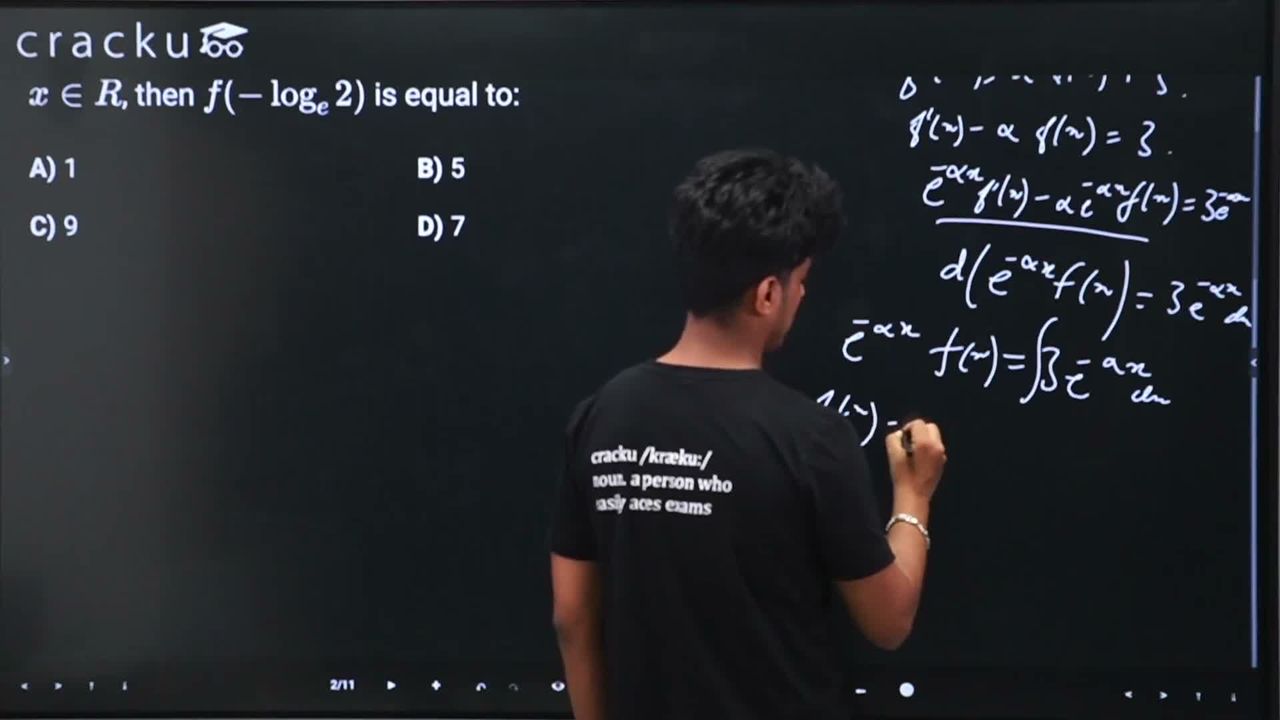
Let $$\alpha$$ be a non-zero real number. Suppose $$f: R \to R$$ is a differentiable function such that $$f(0) = 1$$ and $$\lim_{x \to -\infty} f(x) = 1$$. If $$f'(x) = \alpha f(x) + 3$$, for all $$x \in R$$, then $$f(-\log_e 2)$$ is equal to:
The linear differential equation is $$\frac{df}{dx} - \alpha f = 3$$, giving the general solution:
$$f(x) = -\frac{3}{\alpha} + C e^{\alpha x}$$
Using $$f(0)=1 \implies C = 1 + \frac{3}{\alpha}$$.
Using $$\lim_{x\to-\infty} f(x) = 1$$, the exponential term $$e^{\alpha x}$$ must vanish as $$x \to -\infty$$, meaning $$\alpha < 0$$ and its coefficient must be zero: $$1 + \frac{3}{\alpha} = 0 \implies \alpha = -3$$.
This simplifies $$f(x)$$ to the constant function $$f(x) = 1$$. Thus, $$f(-\log_e 2) = 1$$.
Was this solution helpful?
Click on the Email ☝️ to Watch the Video Solution
Create a FREE account and get:
_1.webp)

Educational materials for JEE preparation

Ask our AI anything

AI can make mistakes. Please verify important information.
AI can make mistakes. Please verify important information.
