
Join Our JEE Preparation Group
Prep with like-minded aspirants; Get access to free daily tests and study material.
Sign in
Please select an account to continue using cracku.in
↓ →
Join Our JEE Preparation Group
Prep with like-minded aspirants; Get access to free daily tests and study material.
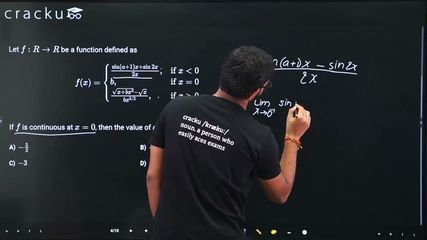
Let $$f : R \to R$$ be a function defined as
$$$f(x) = \begin{cases} \frac{\sin(a+1)x + \sin 2x}{2x}, & \text{if } x < 0 \\ b, & \text{if } x = 0 \\ \frac{\sqrt{x+bx^3} - \sqrt{x}}{bx^{5/2}}, & \text{if } x > 0 \end{cases}$$$
If $$f$$ is continuous at $$x = 0$$, then the value of $$a + b$$ is equal to :
Given,
$$f(x)=\begin{cases}\dfrac{\sin(a+1)x+\sin2x}{2x},&x<0\\[4pt]b,&x=0\\[4pt]\dfrac{\sqrt{x+bx^3}-\sqrt{x}}{bx^{5/2}},&x>0\end{cases}$$
For continuity at
$$x=0,$$
we require
$$\text{LHL}=\text{RHL}=f(0)=b$$
First find the left-hand limit.
$$\text{LHL}=\lim_{x\to0^-}\frac{\sin(a+1)x+\sin2x}{2x}$$
$$=\frac12\left[\lim_{x\to0}\frac{\sin(a+1)x}{x}+\lim_{x\to0}\frac{\sin2x}{x}\right]$$
Using
$$\lim_{x\to0}\frac{\sin kx}{x}=k,$$
we get
$$\text{LHL}=\frac12\left((a+1)+2\right)$$
$$=\frac{a+3}{2}$$
Now find the right-hand limit.
$$\text{RHL}=\lim_{x\to0^+}\frac{\sqrt{x+bx^3}-\sqrt{x}}{bx^{5/2}}$$
Factor out
$$\sqrt{x}:$$
$$=\lim_{x\to0^+}\frac{\sqrt{x}\left(\sqrt{1+bx^2}-1\right)}{bx^{5/2}}$$
$$=\lim_{x\to0^+}\frac{\sqrt{1+bx^2}-1}{bx^2}$$
Rationalizing,
$$=\lim_{x\to0^+}\frac{(1+bx^2)-1}{bx^2\left(\sqrt{1+bx^2}+1\right)}$$
$$=\lim_{x\to0^+}\frac{1}{\sqrt{1+bx^2}+1}$$
$$=\frac12$$
Therefore,
$$b=\frac12$$
Now continuity gives
$$\frac{a+3}{2}=b=\frac12$$
Hence,
$$a+3=1$$
$$a=-2$$
Therefore,
$$a+b=-2+\frac12$$
$$=-\frac32$$
Hence, the required value is
$$\boxed{-\frac32}$$
Was this solution helpful?
Click on the Email ☝️ to Watch the Video Solution
Create a FREE account and get:
_1.webp)

Educational materials for JEE preparation

Ask our AI anything

AI can make mistakes. Please verify important information.
AI can make mistakes. Please verify important information.
