
Join Our JEE Preparation Group
Prep with like-minded aspirants; Get access to free daily tests and study material.
Sign in
Please select an account to continue using cracku.in
↓ →
Join Our JEE Preparation Group
Prep with like-minded aspirants; Get access to free daily tests and study material.
If the maximum value of $$a$$, for which the function $$f_a(x) = \tan^{-1}(2x) - 3ax + 7$$ is non-decreasing in $$\left(-\dfrac{\pi}{6}, \dfrac{\pi}{6}\right)$$, is $$\bar{a}$$, then $$f_{\bar{a}}\left(\dfrac{\pi}{8}\right)$$ is equal to
For
$$f_a(x)$$
to be non-decreasing on
$$\left(-\frac{\pi}{6},\frac{\pi}{6}\right)$$,
we must have
$$f_a'(x)\ge 0$$
throughout the interval.
Differentiating,
$$f_a'(x)=\frac{2}{1+4x^2}-3a$$
Therefore,
$$\frac{2}{1+4x^2}-3a\ge 0$$
$$3a\le \frac{2}{1+4x^2}$$
for every
$$x\in\left(-\frac{\pi}{6},\frac{\pi}{6}\right)$$.
To obtain the maximum possible value of
$$a$$,
we need the minimum value of
$$\frac{2}{1+4x^2}$$
on the interval.
Since
$$x^2$$
is largest at
$$x=\pm\frac{\pi}{6}$$,
we get
$$3\bar a=\frac{2}{1+\frac{\pi^2}{9}}$$
$$=\frac{18}{9+\pi^2}$$
Hence
$$\bar a=\frac{6}{9+\pi^2}$$
Now,
$$f_{\bar a}\left(\frac{\pi}{8}\right)=\tan^{-1}\left(\frac{\pi}{4}\right)-3\bar a\left(\frac{\pi}{8}\right)+7$$
Substituting
$$\bar a=\frac{6}{9+\pi^2}$$,
$$f_{\bar a}\left(\frac{\pi}{8}\right)=7+\tan^{-1}\left(\frac{\pi}{4}\right)-\frac{18}{9+\pi^2}\cdot\frac{\pi}{8}$$
$$=7+\tan^{-1}\left(\frac{\pi}{4}\right)-\frac{9\pi}{4(9+\pi^2)}$$
Therefore,
$$f_{\bar a}\left(\frac{\pi}{8}\right)=8-\frac{9\pi}{4(9+\pi^2)}$$
Was this solution helpful?
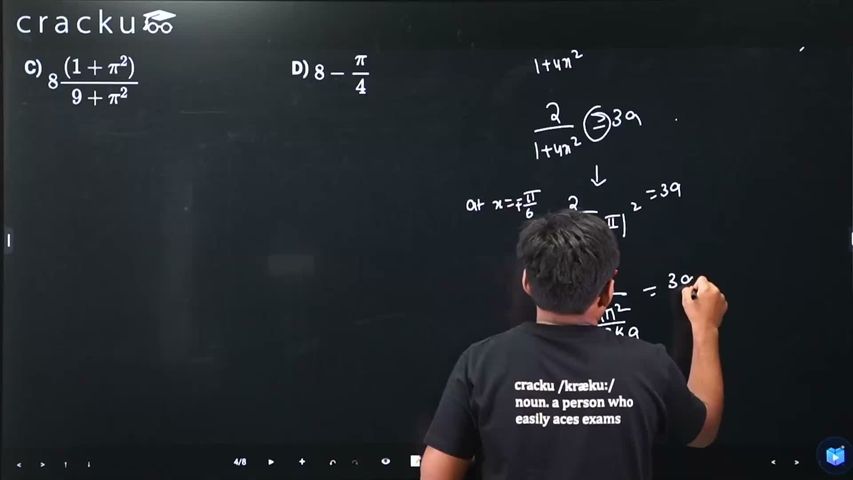
Click on the Email ☝️ to Watch the Video Solution
Create a FREE account and get:
_1.webp)

Educational materials for JEE preparation

Ask our AI anything

AI can make mistakes. Please verify important information.
AI can make mistakes. Please verify important information.
