
Join Our JEE Preparation Group
Prep with like-minded aspirants; Get access to free daily tests and study material.
Sign in
Please select an account to continue using cracku.in
↓ →
Join Our JEE Preparation Group
Prep with like-minded aspirants; Get access to free daily tests and study material.
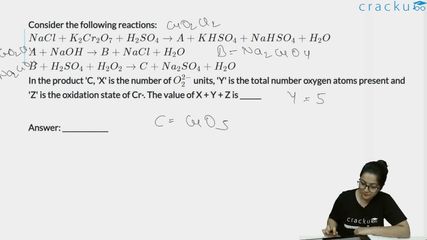
Consider the following reactions:
$$NaCl+K_{2}Cr_{2}O_{7}+H_{2}SO_{4}\rightarrow A+KHSO_{4}+NaHSO_{4}+H_{2}O$$
$$A+NaOH\rightarrow B+NaCl+H_{2}O$$
$$B+H_{2}SO_{4}+H_{2}O_{2}\rightarrow C+Na_{2}SO_{4}+H_{2}O$$
In the product 'C, 'X' is the number of $$O_{2}^{2-}$$ units, 'Y' is the total number oxygen atoms present and 'Z' is the oxidation state of Cr·. The value of X + Y + Z is ______
Correct Answer: 13
We need to identify products A, B, and C through a sequence of reactions, then find X + Y + Z.
Reaction 1: Identifying product A
$$NaCl + K_2Cr_2O_7 + H_2SO_4 \rightarrow A + KHSO_4 + NaHSO_4 + H_2O$$
This is the classic chromyl chloride test. When a chloride salt is heated with potassium dichromate and concentrated sulphuric acid, chromyl chloride is formed:
$$4NaCl + K_2Cr_2O_7 + 6H_2SO_4 \rightarrow 2CrO_2Cl_2 + 4NaHSO_4 + 2KHSO_4 + 3H_2O$$
Therefore, A = $$CrO_2Cl_2$$ (chromyl chloride, a deep red oily liquid).
Reaction 2: Identifying product B
$$A + NaOH \rightarrow B + NaCl + H_2O$$
When chromyl chloride reacts with sodium hydroxide:
$$CrO_2Cl_2 + 4NaOH \rightarrow Na_2CrO_4 + 2NaCl + 2H_2O$$
Therefore, B = $$Na_2CrO_4$$ (sodium chromate, a yellow compound).
Reaction 3: Identifying product C
$$B + H_2SO_4 + H_2O_2 \rightarrow C + Na_2SO_4 + H_2O$$
When sodium chromate reacts with sulphuric acid and hydrogen peroxide, it forms chromium pentoxide ($$CrO_5$$), which is a blue-coloured compound:
$$Na_2CrO_4 + H_2SO_4 + 2H_2O_2 \rightarrow CrO_5 + Na_2SO_4 + 3H_2O$$
Therefore, C = $$CrO_5$$ (also known as perchromic acid).
Structure of $$CrO_5$$:
$$CrO_5$$ has the structure $$CrO(O_2)_2$$, meaning it contains:
- 1 oxide ion ($$O^{2-}$$)
- 2 peroxide units ($$O_2^{2-}$$)
Finding X, Y, and Z:
X = number of $$O_2^{2-}$$ units = 2
Y = total number of oxygen atoms in $$CrO_5$$ = 5 (1 from oxide + 2 + 2 from two peroxide units)
Z = oxidation state of Cr in $$CrO_5$$:
Let the oxidation state of Cr be $$x$$. Each oxide contributes $$-2$$, each peroxide unit contributes $$-2$$:
$$x + (-2) + 2(-2) = 0$$
$$x - 2 - 4 = 0 \implies x = +6$$
So Z = +6.
Final calculation:
$$X + Y + Z = 2 + 5 + 6 = 13$$
The answer is 13.
Was this solution helpful?
Click on the Email ☝️ to Watch the Video Solution
Create a FREE account and get:
_1.webp)

Educational materials for JEE preparation

Ask our AI anything

AI can make mistakes. Please verify important information.
AI can make mistakes. Please verify important information.
