
Join Our JEE Preparation Group
Prep with like-minded aspirants; Get access to free daily tests and study material.
Sign in
Please select an account to continue using cracku.in
↓ →
Join Our JEE Preparation Group
Prep with like-minded aspirants; Get access to free daily tests and study material.
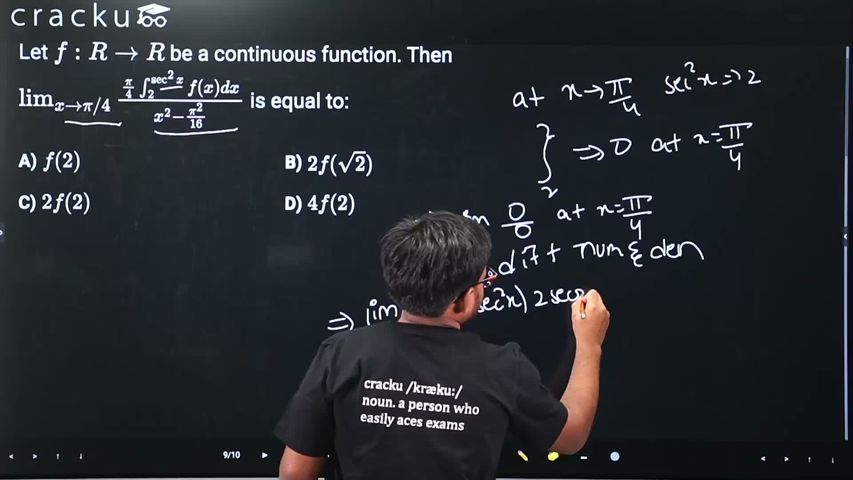
Let $$f : R \rightarrow R$$ be a continuous function. Then $$\lim_{x \to \pi/4} \frac{\frac{\pi}{4}\int_2^{\sec^2 x} f(x) dx}{x^2 - \frac{\pi^2}{16}}$$ is equal to:
We have to evaluate the limit
$$\displaystyle L=\lim_{x\to\frac{\pi}{4}} \frac{\dfrac{\pi}{4}\displaystyle\int_{2}^{\sec^{2}x}f(t)\,dt} {x^{2}-\dfrac{\pi^{2}}{16}}\;.$$
First notice what happens to the numerator and the denominator as $$x$$ approaches $$\dfrac{\pi}{4}$$:
$$\sec^{2}\!\left(\frac{\pi}{4}\right)=\left(\frac{1}{\cos\frac{\pi}{4}}\right)^{2}= \left(\frac{1}{\frac{\sqrt2}{2}}\right)^{2}=2,$$ so the upper limit of the integral tends to the lower limit $$2$$ and therefore
$$\frac{\pi}{4}\int_{2}^{\sec^{2}x}f(t)\,dt \longrightarrow 0.$$
Similarly,
$$x^{2}-\frac{\pi^{2}}{16}\;\longrightarrow\;\Bigl(\frac{\pi}{4}\Bigr)^{2}-\frac{\pi^{2}}{16}=0.$$
Thus the limit is of indeterminate form $$\dfrac{0}{0}$$. Whenever both numerator and denominator approach zero and the functions involved are differentiable in a neighbourhood of the point, we may apply L’Hospital’s Rule, which states:
$$\text{If }\lim_{x\to a}\!N(x)=\lim_{x\to a}\!D(x)=0\text{ and }N,D\text{ are differentiable near }a, \text{ then }L=\lim_{x\to a}\frac{N'(x)}{D'(x)},$$ provided this latter limit exists.
Define
$$N(x)=\frac{\pi}{4}\int_{2}^{\sec^{2}x}f(t)\,dt \quad\text{and}\quad D(x)=x^{2}-\frac{\pi^{2}}{16}.$$
We next differentiate each of these expressions with respect to $$x$$.
Differentiating the numerator.
Before differentiating, recall the Fundamental Theorem of Calculus-Leibniz form:
$$\frac{d}{dx}\Bigl[\int_{a}^{g(x)}f(t)\,dt\Bigr]=f\!\bigl(g(x)\bigr)\,g'(x).$$
Applying this to our situation with $$g(x)=\sec^{2}x$$, we get
$$\frac{d}{dx}\!\left[\int_{2}^{\sec^{2}x}f(t)\,dt\right] =f\!\bigl(\sec^{2}x\bigr)\,\frac{d}{dx}\!\bigl(\sec^{2}x\bigr).$$
Also, the derivative of $$\sec^{2}x$$ is computed as follows:
$$\frac{d}{dx}(\sec^{2}x)=2\sec x\cdot\frac{d}{dx}(\sec x) =2\sec x\cdot(\sec x\tan x)=2\sec^{2}x\tan x.$$
Therefore,
$$\frac{d}{dx}\!\left[\int_{2}^{\sec^{2}x}f(t)\,dt\right] =f\!\bigl(\sec^{2}x\bigr)\;2\sec^{2}x\tan x.$$
Multiplying by the constant factor $$\dfrac{\pi}{4}$$ in front, the derivative of $$N(x)$$ becomes
$$N'(x)=\frac{\pi}{4}\cdot 2\sec^{2}x\tan x\;f\!\bigl(\sec^{2}x\bigr) =\frac{\pi}{2}\sec^{2}x\tan x\,f\!\bigl(\sec^{2}x\bigr).$$
Differentiating the denominator.
$$D(x)=x^{2}-\frac{\pi^{2}}{16}\quad\Longrightarrow\quad D'(x)=2x.$$
Now we can apply L’Hospital’s Rule:
$$L=\lim_{x\to\frac{\pi}{4}}\frac{N'(x)}{D'(x)} =\lim_{x\to\frac{\pi}{4}} \frac{\dfrac{\pi}{2}\sec^{2}x\tan x\,f\!\bigl(\sec^{2}x\bigr)} {2x}.$$
We may simplify the constant factor first:
$$\frac{\dfrac{\pi}{2}}{2x}=\frac{\pi}{4x},$$
so
$$L=\lim_{x\to\frac{\pi}{4}} \left[\frac{\pi}{4x}\;\sec^{2}x\tan x\,f\!\bigl(\sec^{2}x\bigr)\right].$$
At $$x=\dfrac{\pi}{4}$$ we know
$$\sec^{2}\!\left(\frac{\pi}{4}\right)=2,\qquad \tan\!\left(\frac{\pi}{4}\right)=1.$$ Substituting these values and $$x=\frac{\pi}{4}$$ into the expression gives
$$L=\frac{\pi}{4\cdot\frac{\pi}{4}}\;\cdot 2 \cdot 1 \cdot f(2) =\frac{\pi}{\pi}\,f(2)\cdot 2 =2f(2).$$
Hence, the correct answer is Option C.
Was this solution helpful?
Click on the Email ☝️ to Watch the Video Solution
Create a FREE account and get:
_1.webp)

Educational materials for JEE preparation

Ask our AI anything

AI can make mistakes. Please verify important information.
AI can make mistakes. Please verify important information.
